DIGITAL LINES-continuousdata
LIGNES NUMÉRIQUES CONTINUES
by ILUMINADA GARCIA-TORRES (b.1949 Elche-Elx Alicante, Spain)
https://iluminadagarciatorres/lines-continuousdata
iluminadagarciatorres.blogspot.com
https://www.instagram.com/iluminadagarciatorres/
https://avam.es/artistas/iluminada-garcia-torres/

"SLEEPING ARIADNE" (2nd century AD) classical Roman marble sculpture from the PRADO MUSEUM, Madrid. Where to decipher its HARMONY I painted two oils/canvas (1986-87) of 'Sleeping Ariadne in Naxos' in her deep MYTHOLOGICAL SLEEP - THE DEPARTURE FROM THE LABYRINTH.- Understood its MATHEMATICAL principle and GEOMETRY which generated in 1991 - COMBINABLES, CONTINUOUS SPATIAL TRACING, ARIADNE'S THREAD of Geometric-DIGITAL Art, painting, sculpture. Expo Catalogue COMBINABLES, Alicante 1993. Text by ILUMINADA GARCIA-TORRES (b.Elche1949).
diagram-musicality.blogspot.com
continuous-spatial-paths.blogspot.com
"ARIADNA DORMIDA" (siglo II d.C.) escultura clásica romana de mármol del MUSEO del PRADO, Madrid. Donde para descifrar su ARMONÍA pinté dos óleos/lienzo (1986-87) de 'Ariadna Dormida en Naxos' en su profundo SUEÑO MITOLÓGICO - LA SALIDA DEL LABERINTO.- Comprendí su principio MATEMÁTICO y GEOMETRÍA que generó en 1991- COMBINABLES, TRAZADO ESPACIAL CONTINUO, El HILO DE ARIADNA de Arte Geométrico-DIGITAL, pintura, escultura. Catálogo Expo COMBINABLES, Alicante 1993. Texto by ILUMINADA GARCIA-TORRES (b.Elche1949)
continuous-spatial-design.blogspot.com PARIS
« ARIANE ENDORMIE » (IIe siècle apr. J.-C.), sculpture classique romaine en marbre du MUSÉE du PRADO, Madrid. Où, pour déchiffrer son HARMONIE, j'ai peint deux huiles sur toile (1986-87) d'« Ariane endormie à Naxos » dans son profond SOMMEIL MYTHOLOGIQUE - LA SORTIE DU LABYRINTHE. — J'ai compris son principe MATHÉMATIQUE et sa GÉOMÉTRIE qui ont généré en 1991 : COMBINABLES, TRACÉ SPATIAL CONTINU, Le FIL D'ARIANE d'Art Géométrique-DIGITAL, peinture, sculpture. Catalogue Expo COMBINABLES, Alicante 1993. Texte par ILUMINADA GARCIA-TORRES (née à Elche en 1949).
https://geometria-color-musicalidad-by-ILUMINADA-GARCIA-TORRES-exposicion-Elche-2015
"CONCEPT of the geometric-digital artwork by visual artist ILUMINADA GARCIA-TORRES (b. 1949, Elche, SPAIN) featured in her catalogs and exhibitions (1993–2015) in Madrid, London, Valencia, Alicante, and Elche-Elx: Compositions based on <Lines drawn within each 'mathematical unit-matrix square'>— with sides consisting of <'four communicating horizons'>—aligned with adjacent squares, deploy a 'continuum' of visual rhythms expanded into cartographies of musicality. These rhythms reflect a perception of various cities and countries through computer-variables derived from her original 1991 concept. The geometric potential is maintained until reaching the harmony of the digital diagrams of Musicality (from Madrid to the Universe): Sweden-Beijing-Africa-Madrid-Greece-New York-Brooklyn-Mumbai Bombay-Europe-Tokyo-Paris-Nepal-Berlin-Latin America-Universe."
ILUMINADA GARCÍA-TORRES (b.1949, Spain) is a visual artist who studied at the Royal Academy of Fine Arts of San Fernando and the UCM (1965-1970) in Madrid, where she was a student of the geometric painter Eusebio Sempere.
https://geometria-color-musicalidad-by-ILUMINADA-GARCIA-TORRES-exposicion-Elche-2015
"CONCEPTO de la obra de arte geométrico-digital de la artista visual ILUMINADA GARCIA-TORRES (n.1949 Elche, España ) presente en los catálogos y sus exposiciones (1993–2015) en Madrid, London, Valencia, Alicante y Elche-Elx: Composiciones basadas en, <líneas trazadas en cada 'cuadrado matriz-unidad matemática'> —con lados que consisten en <cuatro horizontes comunicantes>— alineados con los cuadrados adyacentes despliegan un 'continuum' de ritmos visuales expandidos en cartografías de musicalidad. Estos ritmos reflejan una percepción de diversas ciudades y países mediante variables informáticas derivadas de su concepto original de 1991. El potencial geométrico se mantiene hasta alcanzar la armonía de los diagramas digitales de Musicalidad (desde Madrid hasta el Universo): Sweden-Beijing-Africa-Madrid-Greece-New York-Brooklyn-Mumbai Bombay-Europa-Tokyo-Paris-Nepal-Berlin-Latinoamérica-Universo-"
ILUMINADA GARCÍA-TORRES (n.1949 Elche, España) artista visual, estudió en la Real Academia de Bellas Artes de San Fernando y en la UCM (1965–1970) en Madrid, donde fue alumna del pintor geométrico Eusebio Sempere
iluminadagarciatorres.blogspot.com
https://geometria-color-musicalidad-by-ILUMINADA-GARCIA-TORRES-exposicion-Elche-2015
https://geometria-color-musicalidad-by-ILUMINADA-GARCIA-TORRES-exposicion-Elche-2015
continuous-spatial-design.blogspot.com PARIS
CONCEPT de l'œuvre d'art géométrique-digital de l'artiste visuelle ILUMINADA GARCIA-TORRES (née en 1949 à Elche, Espagne) présente dans les catalogues et ses expositions (1993–2015) à Madrid, Londres, Valence, Alicante et Elche-Elx: Des compositions basées sur des <lignes tracées dans chaque 'carré matrice-unité mathématique'> — avec des côtés constitués de <quatre horizons communicants>— alignés avec los carrés adjacents, déploient un 'continuum' de rythmes visuels expansés dans des cartographies de musicalité. Ces rythmes reflètent une perception de diverses villes et pays à travers des variables informatiques dérivées de son concept original de 1991. Le potentiel géométrique se maintient jusqu'à atteindre l'harmonie des diagrammes digitaux de Musicalité (de Madrid jusqu'à l'Univers): Sweden-Beijing-Africa-Madrid-Greece-New York-Brooklyn-Mumbai Bombay-Europa-Tokyo-Paris-Nepal-Berlin-LatinAmérica-Universo.
ILUMINADA GARCÍA-TORRES (née en 1949 à Elche, Espagne), artiste visuelle, a étudié à la Académie Royale des Beaux-Arts de San Fernando et à l'UCM (1965–1970) à Madrid, où elle fut l'élève du peintre géométrique Eusebio Sempere.
https://geometria-color-musicalidad-by-ILUMINADA-GARCIA-TORRES-exposicion--Elche-2015
https://geometria/trazado-espacial-continuo-Hilo-de-Ariadna-by-ILUMINADA-GARCIA-TORRES-MACE-municipal-exposiciones-de-ELCHE-2000
The conceptual relationships between: VICENTE VERDÚ and the artwork of ILUMINADA GARCIA-TORRES (b. Elche1949 Spain) focuses on the synthesis of art, mathematics, and science. Verdú, a prominent Spanish writer and journalist, authored the text "The Essence of Ariadne" (7/4/2000) specifically for Iluminada García-Torres's artistic project, catalogue and exhibition titled "Continuous Spatial Tracing - Ariadne's Thread." (6-31/5/2000)
-
"The Thread of Ariadne" as a Methodology: For Iluminada García-Torres, the geometric and mathematical pattern derived from the classical sculpture Sleeping Ariadne (Prado Museum) serves as the foundation for her compositions, Verdú suggests thats this is the pattern represents the MUSIC and DNA of the marble sculpture, forming the basis of Iluminada García-Torres's geometric art.
-
DNA and Musicality: The work explores the "musicality" of geometry, where lines and structures follow a rhythmic and almost biological logic (DNA).
-
Verdú's Perspective: Verdú's text providing a literary and philosophical narrative for the visual form. Verdú often wrote about the intersection of culture, design, and the zeitgeist (spirit of the times), finding in the work of Iluminada García-Torres (born 1949, Elche) a reflection of modern complexity resolved through geometric harmony.
"The Thread of Ariadne" stems from the visual artist's deep obsession with the marble sculpture Sleeping Ariadne in Naxos at the Prado Museum, which she began two painting on canvas at the museum,1986-87
Concepts of the Work
-
Origin at the Prado Museum: Iluminada García-Torres discovered a geometric and mathematical pattern in the classical marble sculpture of Ariadne that defines the figure's harmony.
-
Geometric Translation: From the classical figure, the artist develops a system of "combinables" and lines in continuous spatial layouts based on the matrix square.
-
Music and DNA: Vicente Verdú's text explores how Iluminada García-Torres decodes the sculpture as if it were a musical score the genetic code (DNA), transforming the marble's lines into musical vibrations and digital diagrams.
-
"The Thread of Ariadne": This series connects mythology with technological modernity, using geometry as the "thread" that guides creation through time and space.
It is fascinating how ILUMINADA GARCIA-TORRES (1949) manages to break a 2nd-century piece of marble to find its digital rhythm. Vicente Verdú, with his usual sharp wit, perfectly captured that transition: the artist does not merely copy the Sleeping Ariadne; she "hacks" her. By extracting the master square from the Prado Museum sculpture, she converts the classical myth into a language of vibrations and algorithms. It is, in essence, transforming stone into a visual score where the "thread" is no longer wool, but an infinite geometric connection. ILUMINADA GARCIA-TORRES doesn’t stop at contemplating the marble; she treats it as source code.
net-squares-lines.blogspot.com
spatial-layout.blogspot.com LONDON-1998-2000
diagram-musicality.blogspot.com
net-drawings.blogspot.com 1976-90
gravitationalwaves-music.blogspot.com
iluminadagarciatorres.blogspot.com
https://GeometryDigital/IluminadaGarciaTorres2015
(+34) 696302487 arte geométrico

gravitationalwaves-music.blogspot.com
1990·Paintings oil/canvas the ARIADNE DORMIDA IN NAXOS of the marble sculpture in the Museo Nacional del Prado, Madrid by ILUMINADA GARCIA TORRES, exhibition Galería Albatros, Madrid 1990
net-squares-lines.blogspot.com 2000
diagram-musicality.blogspot.com iluminadagarciatorres.blogspot.com
Textos desde 2000: SIGLO XXI (21st Century)
net-squares-lines.blogspot.com 2000
LA ESENCIA DE ARIADNA por Vicente Verdú 7/04/2000
catálogo exposición "Trazado espacial continuo-Hilo de Ariadna"
arte geométrico by ILUMINADA GARCIA-TORRES
ILUMINADA GARCIA-TORRES (Elche 1949) repite con asiduidad al referirse a sus actuales pinturas que el origen de su evolución descansa en el profundo descubrimiento (pintó dos lienzos al óleo 1986-87) de la escultura de "Ariadna dormida" en el Museo del Prado hace más de diez años. A primera vista, cualquiera se sorprendería de la radical evolución que se despliega desde sus primeros cuadros donde se recreaban las rotundas formas clásicas hasta estos actuales ejercicios geométricos y cromáticos desprendidos de figuración. En apariencia lo presente podría interpretarse como una ruptura con el pasado y la neta experiencia actual una manera de evasión de la objetiva aventura de antaño. La magia, sin embargo, de la pintura de Iluminada García-Torres es que constituye, de principio a fin, una misma tarea de indagación, tan rigurosa y veraz como la que han emprendido en la historia los pintores más comprometidos con la verdad de su oficio. El arte es una forma de comunicación y una forma de conocimiento, y su historia bascula sobre las diferentes proporciones de esta doble composición.
La obra de Iluminada García-Torres alejada por convicción y temple de las modas internacionales y los trucos sensacionalistas o de los amaneramientos que se adaptan a las convenciones de la actualidad. Durante muchos años casi en solitario tanto dentro como fuera de España.
ILUMINADA GARCIA-TORRES ha ido avanzando en una depuración de. sus pesquisas, De la contemplación de la escultura clásica de mármol, Ariadna dormida no obtubo, como definitivo, el visible botín de su ostentosa rotundidad, sino se adentró incluso más allá de su marmórea efigie, en su estructura y más allá de su estructura, en el "dibujo de su música". ILUMINADA denominó esta exploración como un camino en persecución de la armonía y con esa tenacidad obsesiva ha ido obteniendo las partículas más puras de la composición, ahora en los cuadros se perciben figuras geométricas, plasmaciones de una serie de motivos elementales que son como si, en el proceso de la investigación, ILUMINADA GARCIA-TORRES hubiera llegado a vislumbrar y aislar la secuencia genética de la escultura original, su fascinación por aquel mármol que pintó desde dos perspectivas, que recreó en distintos paisajes, que soñó en interminables versiones, se le ha revelado definitivamente en los términos de su enigma, lo que ahora aparece proyectado en los cuadrados es la arquitectura lineal de aquella corporeidad, poque el tiempo destinado a la esencialidad y abstracción del objeto ha llegado hasta este secreto fundamental, hasta su mismo ADN primario. Sobre el lienzo no aparece el cuerpo de "El hilo de Ariadna" sino su genoma deconstruido en líneas y color, su alma retratada en la impalpable calidad de la armonía que el lienzo entrega como síntesis de lo primordial. Pocos pintores son capaces de haber mantenido una fidelidad tan severa y honda a la vocación de conocimiento y pocos han sumado a ello una honrradez tan afianzada en los principios. Gracias a un pequeño grupo de artistas como ILUMINADA GARCIA-TORRES, el arte sigue viviendo y reclamando su necesidad ajeno a los efectismos utilitaristas.
LA ESENCIA DE ARIADNA por Vicente Verdú 7/04/2000
catálogo exposición Trazado espacial continuo-Hilo de Ariadna
arte geométrico by ILUMINADA GARCIA-TORRES (Elche1949 España).
MACE exposiciones temporales de Elche 2000
net-squares-lines.blogspot.com 2000
TRAZADO ESPACIAL CONTINUO - HILO DE ARIADNA, geometría por ILUMINADA GARCÍA-TORRES en Centro Municipal de Exposiciones de ELCHE-ELX, 05-31 de mayo de 2000
https://geometria-color-musicalidad-by-ILUMINADA-GARCIA-TORRES-exposicion--Elche-2015
https://geometria/trazado-espacial-continuo-Hilo-de-Ariadna-by-ILUMINADA-GARCIA-TORRES-MACE-municipal-exposiciones-de-ELCHE-2000
iluminadagarciatorres.blogspot.com
net-squares-lines.blogspot.com
Texts since 2000: The 21st Century
THE ESSENCE OF ARIADNA "La esencia de Ariadna" by Vicente Verdú 7/04/2000 Exhibition Catalogue: Continuous Spatial Tracing- Ariadne's Thread "Trazado espacial continuo-Hilo de Ariadna" Geometry by ILUMINADA GARCÍA-TORRES (b.Elche 1949, Spain)
ILUMINADA GARCÍA-TORRES (Elche 1949) repeatedly mentions, when referring to her current paintings, that the origin of her evolution rests upon the profound discovery (she painted two oil canvases 1986-87) of the sculpture "Sleeping Ariadne" in the Museo del Prado more than ten years ago. At first glance, anyone would be surprised by the radical evolution that unfolds from her first paintings—where rounded classical forms were recreated—to these current geometric and chromatic exercises detached from figuration. In appearance, the present could be interpreted as a break with the past, and the distinct current experience as a way of escaping the objective adventure of yesteryear.
The magic, however, of Iluminada García-Torres’s painting is that it constitutes, from beginning to end, a single task of inquiry, as rigorous and truthful as that which the painters most committed to the truth of their craft have undertaken throughout history. Art is a form of communication and a form of knowledge, and its history oscillates upon the different proportions of this double composition.
For many years [she has worked] almost in solitude, both inside and outside of Spain ILUMINADA GARCIA-TORRES (Elche 1949) has been advancing in a purification of her inquiries. From the contemplation of the classical marble sculpture, "Sleeping Ariadne", she did not obtain, as definitive, the visible booty of its ostentatious rotundity, but rather delved even beyond its marble effigy, into its structure, and beyond its structure, into the "drawing of its music." She called this exploration a path in pursuit of harmony, and with that obsessive tenacity, she has been obtaining the purest particles of the composition.
Now, in the paintings, geometric figures are perceived—expressions of a series of elementary motifs as if, in the research process, Iluminada García-Torres had managed to glimpse and isolate the genetic sequence of the original sculpture. Her fascination for that marble—which she painted from two perspectives, recreated in different landscapes, and dreamed of in endless versions—has been definitively revealed to her in the terms of its enigma.
What now appears projected on the squares is the linear architecture of that corporeality, because the time destined for the essentiality and abstraction of the object has reached this fundamental secret, its very primary DNA. Upon the canvas, the body of "Ariadne's Thread" does not appear, but rather its genome deconstructed into lines and color; its soul portrayed in the impalpable quality of the harmony that the canvas delivers as a synthesis of the primordial. Few painters are capable of having maintained such a severe and deep fidelity to the vocation of knowledge, and few have added to it an honesty so firmly established in principles. Thanks to a small group of artists like Iluminada García-Torres, art continues living and reclaiming its necessity, oblivious to utilitarian artifice. The painting fo ILUMINADA GARCIA-TORRES thus offers a fundamental challenge and the opportunity to enjoy the emotion of the essential. THE ESSENCE OF ARIADNA by Vicente Verdú (04/07/2000) https://geometria/trazado-espacial-continuo-Hilo-de-Ariadna-by-ILUMINADA-GARCIA-TORRES-centro-municipal-exposiciones-de-ELCHE-2000
net-squares-lines.blogspot.com spatial-layout.blogspot.com LONDON 1998-2000
E X H I B I T I O N I N T R O D U C T I O N
CONTINUOUS SPATIAL TRAJECTORY—ARIADNE'S THREAD 1991–2000
ILUMINADA GARCÍA-TORRES (Elche-Elx, 1949) embodies pure dedication; the sheer strength and consistency of her vocation represent something truly singular in the art world.
Conceiving art as the essential and central meaning of existence requires, at the very least, a level of courage that commands profound respect. For her, life ceases to be a mere succession of chronological events. Instead, much like Ariadne’s Thread, it becomes a constant search for self through myth and the labyrinth of her chromatic weaves.
In her painting, concept and number beckon us through the lines of geometric compositions, where color manifests as pure beauty and balance.
ILUMINADA GARCÍA-TORRES pays homage to the eternally changing, harmonious organization that underlies the very nature of the Universe, where wise and mysterious laws create the magic surrounding us.
Isabel Chinchilla Mata
Curator of the Museu d'Art Contemporani d'Elx (Museum of Contemporary Art of Elche).
Exhibition catalogue text, May 2000.
CONTINUOUS SPATIAL TRAJECTORY—ARIADNE'S THREAD, geometry by ILUMINADA GARCÍA-TORRES at the Elche-Elx Municipal Exhibition Center, May 5–31, 2000.
Las relaciones conceptuales entre VICENTE VERDÚ y la obra de ILUMINADA GARCIA-TORRES (Elche 1949, España) se centran en la síntesis del arte, las matemáticas y la ciencia. V.Verdú, destacado escritor y periodista español, fue el autor del texto "La esencia de Ariadna" (7/4/2000) escrito específicamente para el proyecto artístico, catálogo y exposición titulada "Trazado espacial Continuo - Hilo de Ariadna" de Iluminada García-Torres.
"El Hilo de Ariadna" como metodología: Para Iluminada García-Torres, el patrón geométrico y matemático derivado de la escultura clásica, "Ariadna Dormida" del Museo del Prado que V.Verdú sugiere que es, Música y ADN de la escultura de mármol, es el patrón de las composiciones de arte geométrico de Iluminada García-Torres.
ADN y musicalidad: La obra explora la "musicalidad" de la geometría, donde las líneas y estructuras siguen una lógica rítmica y casi biológica (ADN).
La perspectiva de Verdú: El texto de Vicente Verdú proporciona una narrativa literaria y filosófica para esta forma visual. Verdú solía escribir sobre la intersección entre la cultura, el diseño y el "espíritu de los tiempos", encontrando en la obra de Iluminada García-Torres un reflejo de la complejidad moderna resuelta a través de la armonía geométrica.
"El Hilo de Ariadna" surge de una profunda obsesión de la artista visual con la escultura de mármol "Ariadna dormida en Naxos" del Museo del Prado, la cual comenzó a pintar dos lienzos en 1986-87, en el Museo.
Conceptos de la obra Origen en el Museo del Prado: ILUMINADA GARCIA-TORRES descubrió en la escultura clásica de mármol de Ariadna un patrón geométrico y matemático que define la armonía de la escultura.
Traducción Geométrica: A partir de la estatua clásica, la artista desarrolla un sistema de "combinables" y líneas en trazados espaciales continuos basados en el cuadrado matriz.
Música y ADN: El texto de Vicente Verdú destaca cómo la artista visual Iluminada García-Torres decodifica la escultura como si fuera una partitura el código genético (ADN), transformando las líneas del mármol en vibraciones musicales y diagramas digitales.
El Hilo de Ariadna: Esta serie conecta la mitología con la modernidad tecnológica, utilizando la geometría como el "hilo" que guía la creación a través del tiempo y el espacio.
Es fascinante cómo ILUMINADA GARCIA-TORRES logra romper una pieza de mármol del siglo II para encontrarle el ritmo digital. Vicente Verdú, con su agudeza habitual, captó perfectamente esa transición: la artista no solo copia a la "Ariadna dormida", sino que la hackea. Al extraer el cuadrado matriz de la escultura del Museo del Prado, convierte el mito clásico en un lenguaje de vibraciones y algoritmos. Es, en esencia, transformar la piedra en una partitura visual donde el "hilo" ya no es de lana, sino una conexión geométrica infinita.
ILUMINADA GARCIA-TORRES no se queda en la contemplación del mármol; lo trata como código fuente.
catálogo Colección Arte Contemporáneo Generalitat Valenciana IV 2021
painting Ariadne's Thread-Continual Spatial Line 2002 / ILUMINADA García Torres
Geometric purity
María Marco
Velázquez's fascination when contemplating the sculpture of Ariadna in the Villa Medicis gardens is probably the same that Iluminada García felt when she discovered this Roman copy in the Prado Museum. The "sleeping Ariadne" lies on the beach, abandoned by Theseus, reminding us of the thread that helped the Athenian prince escape from the labyrinth. The defeat of the minotaur and the Ariadna's deeds did away with Minos' reign of terror; it signalled a break with tradition and heralded a new era. Also the painting copy of this sculpture, in terms of its analysis, led to a major shift in the pictorial production of Iluminada García. Its essence and history have led her to reflect on the labyrinth, more specifically on its layout. Thus begins a path that continues to the present day based on a plastic language based on geometry, on geometric abstraction.
After attending the Alicante School of Arts and Crafts, in 1965 she entered the art school known as Escuela Superior de Bellas Artes de San Fernando where she was taught by Antonio López in her first year. In her early works, the influence of this realist painter is noteworthy, as can be seen in the painting Paisaje urbano de Madrid (Urban Landscape of Madrid; 1982). On a wide and solitary landscape rises the communications tower, which leaves the city in the background. A bench in the foreground creates a right angle to the tower. The composition highlights two shapes, the rectangle in the lower area and the cylinder that represents the tower. Along with other landscapes of this first period, she created intimate still lives in which the objects acquire a metaphysical character approaching the aesthetics of Morandi. These objects are gradually shedding their functionality, being reduced to their own geometric shapes. In this way her first labyrinths appear, landscapes in which cylinders and rectangles face each other, generating corridors between the stillness of space. They are images that recall the empty squares depicted by De Chirico, with the soft light filtering through the objects and eerily intensifying their mystery.
In 1993 she held an exhibition in the room of the Caja de Ahorros del Mediterráneo (CAM) with the title Combinables. In that exhibition works created since 1991 and revealing inroads to geometric abstraction were shown for the first time. The reference to reality disappears, leaving only the essence, the harmony based on repetition, the square as the base element.
"The motivations of the fact and reflection of the act of painting lead me to express that: The square is the container of space, and its development carries time in itself."
2º I call the matrix square (universe), the container square of the 25 structures. The structures deployed imaginatively or represented, with points or lines are supports and referential anchors of the composition.
The elements, the point, the line and the figures that are generated can be interpreted as independent worlds that, in turn, participate in the same meaning that we give to the totality. Therefore, each element participates in the whole and the totality is contained in the essence of a single element."²
Each of the works are mathematically studied. The matrix square acts as a module that is repeated throughout the pictorial space. A mathematical system that establishes a continuous, infinite path, an order that is governed by the principle of harmony. Thus, lines, shapes and colours are established as a whole and each part also has a distinctive character.
The painting El hilo de Ariadna. Trazado espacial continuo is an enormous 180 x 180 cm square, containing, at the same time, multiple squares. In different shades of blues, the vertical lines are marked by three strips of horizontal lines. Within this structure there is a subdivision into small squares that are barely perceptible. The work possesses the spirituality of neoplasticism as well as the repetition of minimalism, and creates an internal musicality, a rhythm of its own.
She was fortunate to be taught by Eusebio Sempere in 1969 at the Faculty of Fine Arts at Madrid's Universidad Complutense; under Sempere's supervision, she did various artworks and delved into geometric abstraction. Sempere, at that time, was part of the Automatic Generation Seminar at the Complutense Calculation Centre. Iluminada García tells of the impression made on her by using a computer as an artistic tool. This was a radically new art based on mathematical and geometric principles.³ Although her interest at that time tended towards figuration, she affirms that meeting Sempere and his utter enthusiasm for a new form of production influenced the artistic discourse in her later works. She happily remembers how Sempere took his class to visit the Open Air Sculpture Museum on the Castellana boulevard, with those magnificent abstract works and the bridge railing designed by the academic himself.
These experiences, together with her exhaustive study of geometric abstraction and mathematical developments, resulted in a deep exploration of digital art at the beginning of the new millennium. The use of the plotter gave her the opportunity to execute larger pieces and achieve lines as fine as those drawn by Zóbel or Sempere.
In 2002 she inaugurated in the halls of the Alicante Fish Market the exhibition El hilo de Ariadna (The thread of Ariadna); the work can now be seen as part of the Col·lecció d'Art Contemporani de la Generalitat Valenciana. Again, in the catalogue, she summarizes the process of abstraction of her artistic production, which starts from the image of a dormant Ariadna until her last works, in which the lines multiply and the process becomes more complex. "As a result of the vision of the sculpture of Ariadna in the Prado Museum and through the oil paintings that I painted of her image there, I obtained the awareness that her harmony, alchemy of power and subtlety that so impressed
3ºme, provoking my fascination, was not the result of mere chance. I discovered that this harmony invokes a geometric and mathematical cosmos that now guides the poetics of my painting.»⁴ As Vicente Verdú pointed out in the catalogue published by the Elche City Council in 2002, the harmony of the lines in combination with the colour purifies the object in such a way that it "delves into the drawing akin to music emanating from it" Iluminada García uses a musical kind of discourse or pattern that repeats notes harmoniously, as in Bach, possibly one of the musicians who best represents the relationship between music and mathematics. Many of the master's compositions possess a symmetric property, a stream of geometric relationships, an established fractal system.
The work in this exhibition creates a matrix plot where a play of light and shadow is established on the same blue tone. Although the pattern is not exactly the same in this piece, the multiple repetitions are enough to create an internal harmony, an order that we find in each of her works. All this tracing takes us back to the myth of Ariadne, and the thread that helped Theseus to escape from the monster.
A thread that serves to get out of the labyrinth, understood as a line that configures geometric shapes that allows, in its journey, to escape from any complex situation.
1 Both her still life Works and the labyrinths that were exhibited in 1990 at the Galería Albatros in Madrid, are the preamble to her new stage based on geometric abstraction. Landscapes, portraits and objects give way to orthogonal shapes, thus beginning a whole research process that has the square as its starting point.
2 Iluminada's own words in: Combinables. [Exhibition catalogue] Fundación Cultural CAM, 1993. Pág. 11.
3 In 1966, through an agreement between the University and the IBM company, the Computing Centre of the Complutense University of Madrid was created. As a result of years of work, two exhibitions were held at the said centre: the first in 1969 with the title Formas computables (Computable forms) and the second Generación automática de formas plásticas (Automatic generation of plastic forms) in 1970 to mark the closure of the academic year. The collaboration between computer scientists and artists aimed to show that the machine could also help in the tasks of creativity. Two other exhibitions were held in 1971: Computer Assisted Art Exhibition at the National Congress Palace in Madrid, coinciding with a European symposium on computer design and the second Formas computadas (Computed Forms) with works from the seminar.
4 GARCÍA-TORRES, ILUMINADA, 2002: El hilo de Ariadna 1991-2002. [Exhibition catalogue]. Excmo. Ayuntamiento de Alicante. Patronato Municipal de Cultura. Pág. 14.
—GARCÍA-TORRES, ILUMINADA, 2014: Ariadne's Thread-Music, digital music diagram 1991-2014. [Exhibition catalogue]. Diputación de Alicante. Área de Cultura.
—GARCÍA-TORRES, ILUMINADA, 2003: El hilo de Ariadna - Combinatoria (2003). Colección Amérigo. [Exhibition catalogue]. Excmo. Ayuntamiento de Alicante.
—GARCÍA-TORRES, ILUMINADA, 2009: Retrospectiva 1982-2009. [Exhibition catalogue]. Ayuntamiento de Alicante. Alicante Cultura.
—HUERTA, RICARD (cord) 2001:Eusebi Sempere. Del'art al microxip. Universitat de València.
catálogo Colección Arte Contemporáneo Generalitat Valenciana IV 2021
painting Ariadne's Thread-Continual Spatial Line 2002 by ILUMINADA García Torres
iluminadagarciatorres@gmail.com 34 696302487 digital geometry
https://elhilodeariadna/texto-mariamarco-iluminadagarciatorres
Art Contemporani de la Generalitat Valenciana IV Año: 2021
Páginas: 559 páginas, 246-259 pintura "El HILO de ARIADNA-Trazado Espacial Continuo 2002" by Iluminada García-Torres, texto de María Marco
Edita: Generalitat Valenciana
ISBN: 978-84-482-6622-6
elhilodeariadna-combinatoria.blogspot.com 2021
iluminadagarciatorres.blogspot.com
gravitationalwaves-music.blogspot.com1990
catálogo Colección Arte Contemporáneo Generalitat Valenciana IV 2021
El HILO DE ARIADNA Trazado Espacial Continuo 2002
by ILUMINADA GARCIA-TORRES
Pureza geométrica
María Marco
La fascinación de Velázquez al contemplar la escultura de Ariadna en los jardines de Villa Medicis es, probablemente, la misma que sintió Iluminada García al descubrir esta copia romana en el Museo del Prado. La "Ariadna dormida" yace en la playa, abandonada por Teseo, como que el hilo que ayudó al príncipe ateniense a escapar del laberinto. La derrota del minotauro y la acción de Ariadna terminan con el terror ejercido por Minos, rompen con la tradición y presagian una nueva era. También la copia en pintura de esta escultura, su análisis y estudio, genera un cambio en la producción pictórica de Iluminada García. Su esencia e historia la conducen a una reflexión sobre el laberinto, más concretamente sobre su trazado. Así comienza un camino que continúa hasta la actualidad fundamentado en un lenguaje plástico centrado en la geometría, en la abstracción geométrica.
Tras pasar por la Escuela de Artes y Oficios de Alicante, en 1965 ingresa en la Escuela Superior de Bellas Artes de San Fernando, donde el primer año tiene como profesor a Antonio López. Es destacable, en sus primeras obras, la influencia de este pintor realista como puede observarse en la pintura «Paisaje urbano de Madrid» (1982). Sobre un amplio y solitario paisaje se alza la torre de comunicaciones, que deja al fondo la ciudad. Un banco en primer plano genera un ángulo recto con la torre. La composición destaca dos formas, el rectángulo de la zona inferior y el cilindro que representa la torre. Junto a los paisajes de esta primera etapa realiza bodegones intimistas en los cuales los objetos adquieren un carácter metafísico cercano a la estética de Morandi. Estos objetos poco a poco van desprendiéndose de su funcionalidad quedando reducidos a sus propias formas geométricas. De esta manera aparecen sus primeros laberintos, paisajes en los que se enfrentan cilindros y rectángulos generando pasillos entre la quietud del espacio. Son imágenes que recuerdan a las plazas vacías de De Chirico, con la suave luz filtrándose por los objetos e intensificando su misterio.
En 1993 realiza una exposición en la sala de la Caja de Ahorros del Mediterráneo (CAM) con el título «Combinables». Se muestran por primera vez los trabajos que desde 1991 abren una nueva etapa a la abstracción geométrica. La referencia a la realidad desaparece, quedando solo la esencia, la armonía basada en la repetición, el cuadrado como elemento base.
«Las motivaciones del hecho y reflexión del acto de pintar me conducen a expresar que: El cuadrado es el continente del espacio y el desarrollo de este conlleva en sí mismo al tiempo.
2º Llamo cuadrado matriz (universo), al cuadrado contenedor de las 25 estructuras. Las estructuras trazadas imaginariamente o representadas, con puntos o líneas son apoyo y referencia para la composición.
Los elementos, el punto, la línea y las figuras que engendran podemos interpretarlos como mundos independientes que, a su vez, participan del mismo significado que damos a la totalidad. Por lo cual cada elemento participa del todo y la totalidad está contenida en la esencia de un solo elemento».²
Cada una de las obras están estudiadas matemáticamente. El cuadrado matriz actúa como módulo que se repite a lo largo del espacio pictórico. Un sistema matemático que establece un trazado continúo, infinito, un orden que se rige por el principio de armonía. Así, líneas, formas y colores se establecen como un todo y cada parte posee también un carácter especial.
La pintura «El hilo de Ariadna. Trazado espacial continuo» es un enorme cuadrado de 180x180 cm., que contiene, a la vez, múltiples cuadrados. En distintas gamas de azules, las líneas verticales quedan cortadas por tres tiras de líneas horizontales. Dentro de esta estructura hay una subdivisión en pequeños cuadrados a penas imperceptibles. La obra posee la espiritualidad del neoplasticismo y la repetición del minimalismo, y crea una musicalidad interna, un ritmo propio.
En la Facultad de Bellas Artes de la Complutense de Madrid tiene como profesor a Eusebio Sempere durante el año 69. Con él realiza algunos trabajos y profundiza en la abstracción geométrica. Sempere, en aquel momento, formaba parte del Seminario de Generación Automática del Centro de Cálculo de la Complutense. Iluminada García cuenta la impresión que le produjo el hecho utilizar una computadora como herramienta artística. Ello suponía un arte radicalmente nuevo basado en principios matemáticos y geométricos.³ Aunque su interés en aquel momento tendía hacia la figuración, afirma que el hecho de conocer a Sempere y su entusiasmo por una nueva forma de producción influyó en su posterior lenguaje plástico. Recuerda como Sempere llevó a su clase a visitar el Museo de Escultura al aire libre de la Castellana, con aquellas magníficas obras abstractas y la barandilla del puente diseñada por él mismo.
Estas experiencias, junto a su exhaustivo estudio en la abstracción geométrica y los desarrollos matemáticos, desembocarán en el arte digital a principios del nuevo milenio. El uso del plóter le brindaba la oportunidad de ejecutar piezas de mayores dimensiones y conseguir líneas tan finas como las dibujadas por Zóbel o Sempere.
En el 2002 inaugura en la Lonja del Pescado de Alicante la muestra «El hilo de Ariadna» en la que se expuso la obra que ya forma parte de la Col·lecció d’Art Contemporani de la Generalitat Valenciana. De nuevo, en el catálogo, resume el proceso de abstracción de su producción artística que parte de la imagen de Ariadna dormida hasta sus últimas obras, en que las líneas se multiplican y el proceso se vuelve más complejo. «A raíz de la visión de la escultura de Ariadna en el Museo del Prado y a través de los cuadros al óleo que allí pinté de su imagen, obtuve la conciencia de que su armonía, alquimia
iluminada garcía torres
3º de la potencia y sutileza que tanto me impresionó provocando mi fascinación, no fue por azar. Descubrí que esta armonía invoca un cosmos geométrico y matemático que ahora guía la poética de mi pintura».⁴ Como apunto Vicente Verdú en el catálogo publicado por el Ayuntamiento de Elche en el 2002, la armonía de las líneas en combinación con el color depura de tal manera al objeto que «se adentra en el dibujo de su música». Iluminada García utiliza un patrón similar a la música que repite las notas para ser armónico, como en Bach, posiblemente uno de los músicos que mejor representan la relación entre la música y las matemáticas. Muchas de las composiciones del maestro poseen una propiedad simétrica, una corriente de relaciones geométricas, un sistema fractal.
La obra de esta exposición crea una trama matriz donde se establece un juego de luces sobre un mismo tono azul. Aunque el patrón no es exactamente igual en esta pieza, las múltiples repeticiones son suficientes para crear una armonía interna, un orden que encontramos en cada una de sus obras. Todo este trazado nos lleva de nuevo al mito de Ariadna, al hilo que ayudó a Teseo a escapar del monstruo.
Un hilo que sirve para salir del laberinto, entendido como una línea que va configurando formas geométricas que permite, en su recorrido, escapar de cualquier situación compleja.
1 Tanto los bodegones como los laberintos que se expusieron en el 1990 en la Galería Albatros de Madrid, son el preámbulo de su nueva etapa basada en la abstracción geométrica. Paisajes, retratos y objetos dejan paso a formas ortogonales, comenzando así todo un proceso de investigación que tiene como punto de partida el cuadrado.
2 Palabras de iluminada García en: Combinables. [Catálogo de exposición]. Fundación Cultural CAM, 1993. Pág. 11.
3 En el año 1966, mediante un acuerdo entre la Universidad y la empresa IBM, se crea el Centro de Cálculo de la Universidad Complutense de Madrid. Como resultado de los años de trabajo se realizaron, en el mismo Centro, dos exposiciones: la primera de ellas en 1969 con el título «Formas computables» y la segunda «Generación automática de formas plásticas» en 1970 como clausura del curso. La colaboración entre informáticos y artistas tenía como objetivo mostrar que la máquina podría también ayudar en las tareas de la creatividad. En 1971 se realizaron otras dos muestras: «Computer Assisted Art Exhibition» en el Palacio Nacional de Congresos de Madrid coincidiendo con un simposio europeo sobre diseño con ordenador y «Formas computadas» con trabajos del seminario.
4 GARCÍA-TORRES, ILUMINADA, 2002: El hilo de Ariadna 1991-2002. [Catálogo de exposición]. Excmo. Ayuntamiento de Alicante. Patronato Municipal de Cultura. Pág. 14.
—GARCÍA-TORRES, ILUMINADA, 2014: Ariadne's Thread-Music, digital music diagram 1991-2014. [Catàleg d'exposició]. Diputación de Alicante. Área de Cultura.
—GARCÍA-TORRES, ILUMINADA, 2003: El fil d'Ariadna- Combinatòria (2003). Col·lecció Amérigo. [Catálogo de exposición]. Excmo. Ayuntamiento de Alicante.
—GARCÍA-TORRES, ILUMINADA, 2009: Retrospectiva 1982-2009. [Catálogo de exposición]. Ayuntamiento de Alicante. Alicante Cultura.
—HUERTA, RICARD (cord) 2001: Eusebi Sempere. Del l'art al microxip. Universitat de València.
catálogo Colección Arte Contemporáneo Generalitat Valenciana IV 2021
EI HILO DE ARIADNA-Trazado Espacial Continuo 2002 by ILUMINADA GARCIA-TORRES
ILUMINADA García-Torres (1949 Elx) geometria 34 696302487 iluminadagarciatorres@gmail.com
Relación entre la música de Bach, los fractales y la pintura de Iluminada García-Torres
La autora (María Marco) y la propia artista establecen un puente conceptual y formal donde las matemáticas actúan como el lenguaje común entre la música, la geometría de la naturaleza y el arte plástico.
-
El patrón de repetición armónica: El texto compara la estructura de la pintura de García-Torres con la música de Johann Sebastian Bach. Así como Bach repite, invierte y varía notas o temas musicales para construir una estructura armónica perfecta, la artista utiliza "múltiples repeticiones" de líneas y cuadrados para generar una "musicalidad interna" y un ritmo propio en el lienzo.
-
La estructura fractal: Se menciona que las composiciones de Bach poseen un "sistema fractal". Un fractal es una estructura geométrica que se repite a diferentes escalas. En la pintura El hilo de Ariadna, esto se traduce visualmente: es un enorme cuadrado mayor (180x180 cm) que contiene en su interior "múltiples cuadrados", los cuales a su vez se subdividen en "pequeños cuadrados apenas imperceptibles".
-
La depuración del objeto: Citando a Vicente Verdú, se explica que la combinación de líneas matemáticas y color limpia el objeto de su función realista. Al eliminar la referencia física, la pintura se "adentra en el dibujo de su música", convirtiéndose en una red puramente geométrica y matemática (una "trama matriz").
Contexto histórico del Centro de Cálculo de la UCM y el arte por ordenador en España
El texto ofrece un valioso testimonio de un momento pionero y crucial para las vanguardias artísticas españolas de finales de los años 60 y principios de los 70.
-
Origen e infraestructura: El Centro de Cálculo de la Universidad Complutense de Madrid se fundó en 1966 gracias a un acuerdo entre la universidad e IBM, que aportó una de las primeras grandes computadoras del país.
-
El Seminario de Generación Automática de Formas Plásticas: En este espacio, liderado en su momento por figuras como Eusebio Sempere (quien fue profesor de la artista en 1969), se dio un encuentro inédito en España entre informáticos y artistas plásticos. El objetivo principal era experimentar y demostrar que la máquina ("la computadora") podía ser una herramienta válida y un aliado en los procesos creativos y de investigación artística.
-
Hitos y exposiciones: El texto documenta la rápida evolución de este movimiento a través de exposiciones clave celebradas en el propio centro y en espacios nacionales:
-
1969: Exposición «Formas computables».
-
1970: Exposición «Generación automática de formas plásticas» (clausura del curso).
-
1971: «Computer Assisted Art Exhibition» en el Palacio Nacional de Congresos de Madrid, en paralelo a un simposio europeo de diseño por ordenador, y la muestra «Formas computadas».
-
-
Impacto en los artistas (El salto al arte digital): Para creadores de tradición geométrica o cinetista como Sempere, y posteriormente para alumnas como Iluminada García, el uso del ordenador supuso una revolución radical. Aunque inicialmente existía un apego a la figuración, el entusiasmo por este sistema basado en leyes matemáticas transformó su lenguaje plástico. A largo plazo (hacia el nuevo milenio), esto permitió a la artista dar el salto definitivo al arte digital, utilizando herramientas como el plóter para trazar líneas infinitamente finas y ejecutar obras de gran formato imposibles de realizar con la precisión manual tradicional.
-
análisis de cómo el texto de María Marco reinterpreta el mito clásico a través del lenguaje de la abstracción geométrica de Iluminada García-Torres:
-
El mito clásico como punto de partida
-
En la mitología griega, Ariadna entrega un hilo de oro al príncipe Teseo para que este pueda adentrarse en el laberinto de Creta, derrotar al Minotauro y, fundamentalmente, encontrar el camino de regreso. El hilo representa la salvación, la guía y el orden dentro de un caos diseñado para perderse.
-
-
La reinterpretación geométrica en la obra de la artista
-
La obra de Iluminada García-Torres despoja al mito de su narrativa literaria y de su horror original (el terror de Minos) para transformarlo en un concepto puramente plástico y estructural a través de tres claves:
-
El hilo como línea matemática: En la pintura El hilo de Ariadna. Trazado espacial continuo, el hilo ya no es un objeto físico o textil, sino que se convierte en una línea abstracta. Esta línea se multiplica y se cruza con precisión matemática (líneas verticales cortadas por tres tiras de horizontales), sirviendo como el elemento estructural que guía la composición sobre el lienzo.
-
El laberinto como estructura ortogonal: En lugar de muros de piedra caóticos, el "laberinto" de la artista se racionaliza. Se construye mediante un "cuadrado matriz" que contiene "múltiples cuadrados" y subdivisiones casi imperceptibles. El laberinto es ahora un sistema fractal y un juego de pasillos geométricos que se generan entre la confrontación de cilindros y rectángulos.
-
La salida del laberinto a través del orden: En el mito, el hilo es la herramienta para escapar de un peligro físico. En la poética de la artista, el recorrido de la línea a través del cuadro configura formas geométricas que permiten "escapar de cualquier situación compleja". La salida del laberinto se reinterpreta así como un proceso mental y estético: el caos de la realidad desaparece y se resuelve mediante la armonía, la repetición y el orden matemático. El hilo/línea es el instrumento que depura el espacio y encuentra la luz en medio del misterio.
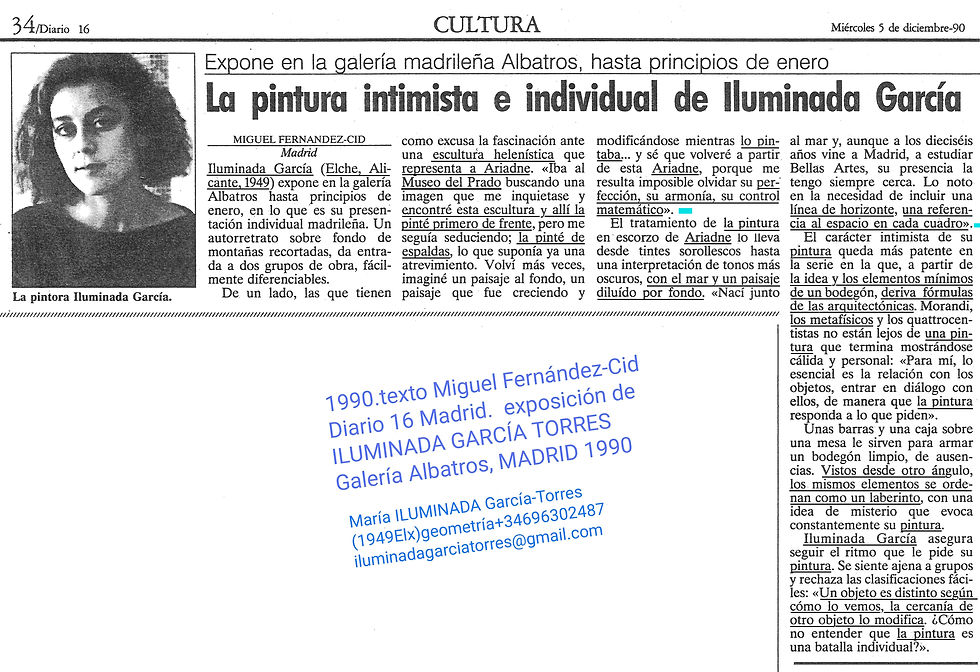
Entrevista de Miguel Fernández-Cid. Diario 16, 5 de dic. 1990
a ILUMINADA GARCIA-TORRES (Elche 1949, España)
Título: "La pintura intimista e individual de Iluminada García"
"Iluminada García (Elche, Alicante, 1949) expone en la galería Albatros hasta principios de enero, en lo que es su presentación individual madrileña. Un autorretrato sobre fondo de montañas recortadas, da entrada a dos grupos de obra, fácilmente diferenciables.
De un lado, las que tienen como excusa la fascinación ante una escultura helenística que representa a Ariadne. «Iba al Museo del Prado buscando una imagen que me inquietase y encontré esta escultura y allí la pinté primero de frente, pero me seguía seduciendo; en otro lienzo la pinté de espaldas, lo que suponía ya una atrevimiento. Volví más veces, imaginé un paisaje al fondo, un paisaje que fue creciendo y modificándose mientras lo pintaba... y sé que volveré a partir de esta Ariadne, porque me resulta imposible olvidar su perfección, su armonía, su control matemático».
El tratamiento de la pintura en escorzo de Ariadne lo lleva desde tintes sorollescos hasta una interpretación de tonos más oscuros, con el mar y un paisaje diluido por fondo. «Nací junto al mar y, aunque a los dieciséis años vine a Madrid a estudiar Bellas Artes, su presencia la tengo siempre cerca. Lo noto en la necesidad de incluir una línea de horizonte, una referencia al espacio en cada cuadro».
El carácter intimista de su pintura queda más patente en la serie en la que, a partir de la idea y los elementos mínimos de un bodegón, deriva fórmulas de las arquitectónicas. Morandi, los metafísicos y los quattrocentistas no están lejos de una pintura que termina mostrándose cálida y personal: «Para mí, lo esencial es la relación con los objetos, entrar en diálogo con ellos, de manera que la pintura responda a lo que piden».
Unas barras y una caja sobre una mesa le sirven para armar un bodegón limpio, de ausencias. Vistos desde otro ángulo, los mismos elementos se ordenan como un laberinto, con una idea de misterio que evoca constantemente su pintura.
Iluminada García asegura seguir el ritmo que le pide su pintura. Se siente ajena a grupos y rechaza las clasificaciones fáciles: «Un objeto es distinto según cómo lo vemos, la cercanía de otro objeto lo modifica. ¿Cómo no entender que la pintura es una batalla individual?»."
Interview by Miguel Fernández-Cid. Diario 16, Dec 5, 1990
To ILUMINADA GARCÍA-TORRES (Elche 1949, Spain)
Title: "The Intimate and Individual Painting of Iluminada García"
Iluminada García (Elche, Alicante, 1949) is exhibiting at the Albatros Gallery until early January, marking her solo debut in Madrid. A self-portrait on a backdrop of silhouetted mountains introduces two easily distinguishable groups of work.
On one side are the pieces inspired by her fascination with a Hellenistic sculpture of Ariadne.
"I went to the Prado Museum looking for an image that would unsettle me, and I found this sculpture. I first painted her from the front, but she continued to seduce me; in another canvas, I painted her from behind, which was already an act of daring. I returned several times, imagined a landscape in the background—a landscape that grew and changed as I painted it... and I know I will return to this Ariadne again, because it is impossible for me to forget her perfection, her harmony, her mathematical control."
Her treatment of Ariadne in foreshortening ranges from Sorolla-esque hues to interpretations in darker tones, with the sea and a diluted landscape as a backdrop.
"I was born by the sea and, although I came to Madrid at sixteen to study Fine Arts, its presence is always close to me. I notice it in the need to include a horizon line—a reference to space—in every painting."
The intimate nature of her painting is most evident in the series where, starting from the idea and minimal elements of a still life, she derives architectural formulas. Morandi, the Metaphysical painters, and the Quattrocento masters are never far from a style that ultimately reveals itself as warm and personal:
"For me, the essential thing is the relationship with objects—entering into a dialogue with them so that the painting responds to what they demand."
A few bars and a box on a table serve to construct a clean still life of "absences." Seen from another angle, these same elements are arranged like a labyrinth, carrying a sense of mystery that her painting constantly evokes.
An Individual Journey
Iluminada García insists on following the rhythm dictated by her work. She feels detached from artistic groups and rejects easy classifications:
"An object is different depending on how we see it; the proximity of another object modifies it. How can one not understand that painting is an individual battle?"
ILUMINADA GARCÍA-TORRES (Elche, 1949) describe en sus obras "COMBINABLES" y "Trazado Espacial Continuo" un enfoque sinestésico donde el lienzo funciona como una partitura musical.
En esta partitura, "las líneas trazadas dentro de cada 'cuadrado matriz—unidad matemática' como módulo base, las variaciones en las dimensiones de las líneas en proporción a los módulos y los cambios de color expresados en 'pinceladas de un solo gesto' actúan como 'ritmos visuales' y 'ecos' sobre el lienzo.
Al repetir o contrastar estas unidades cuadrangulares, se crea una 'cadencia visual' que transforma una cuadrícula geométrica estática en una 'composición dinámica' de ritmos geométricos sucesivos. Dado que en el sistema consisten 'cuatro horizontes comunicantes los lados' alineados con los lados de los cuadrados adyacentes, se establece un 'continuo' de musicalidad etérea de las composiciones geométricas".
ILUMINADA GARCÍA-TORRES es una artista visual que estudió en la Real Academia de Bellas Artes de San Fernando y en la UCM (1965–1970) en Madrid, donde fue alumna del pintor geométrico Eusebio Sempere.
"CONCEPTO de la obra de arte geométrico-digital de la artista visual ILUMINADA GARCIA-TORRES (n.1949 Elche, España ) presente en los catálogos y sus exposiciones (1993–2015) en Madrid, London, Valencia, Alicante y Elche-Elx: Composiciones basadas en, <líneas trazadas en cada 'cuadrado matriz-unidad matemática'> —con lados que consisten en <cuatro horizontes comunicantes>— alineados con los cuadrados adyacentes despliegan un 'continuum' de ritmos visuales expandidos en cartografías de musicalidad. Estos ritmos reflejan una percepción de diversas ciudades y países mediante variables informáticas derivadas de su concepto original de 1991. El potencial geométrico se mantiene hasta alcanzar la armonía de los diagramas digitales de Musicalidad (desde Madrid hasta el Universo): Sweden-Beijing-Africa-Madrid-Greece-New York-Brooklyn-Mumbai Bombay-Europa-Tokyo-Paris-Nepal-Berlin-Latinoamérica-Universo-"
ILUMINADA GARCÍA-TORRES (n.1949 Elche, España) artista visual, estudió en la Real Academia de Bellas Artes de San Fernando y en la UCM (1965–1970) en Madrid, donde fue alumna del pintor geométrico Eusebio Sempere
iluminadagarciatorres.blogspot.com
https://geometria-color-musicalidad-by-ILUMINADA-GARCIA-TORRES-exposicion-Elche-2015
La artista visual Iluminada García-Torres (Elche 1949 España) en su proyecto de arte geométrico-digital, investiga la intersección entre la matemática, la musicalidad, y la cartografía urbana.
Iluminada García-Torres ha desarrollado un lenguaje visual que denomina "diagramas digitales de Musicalidad"que forma parte de su proyecto más amplio "El Hilo de Ariadna". Sus obras, como la que presenta, utilizan algoritmos y conceptos matemáticos para transformar la estructura de ciudades y paises (como Latinoamérica, Suecia, Beijing o Madrid) en patrones concéntricos vibrantes que sugieren ritmos musicales y conexiones espaciales desarrollado un lenguaje propio denominado.
Detalles del Proyecto
-
Concepto Generativo: A partir de cada "cuadrado matriz", Iluminada García-Torres utiliza variables computacionales definidas desde 1991, manteniendo una armonía proporcional para expandir líneas en lo que ella llama "horizontes comunicantes" en cartografías que expresan una percepción sensorial y pensamiento, de diversos lugares del mundo.
-
El diagrama creado por Iluminada García- Torres específicamente "musicality - Latinoamérica 9 - digital", no es una representación geográfica literal, sino una traducción rítmica y geométrica de la esencia de un lugar.
-
Estructura: Los círculos concéntricos y los patrones fragmentados funcionan como una partitura visual, donde el color y la disposición de los píxeles buscan alcanzar una armonía similar a la musical en una síntesis visual del Universo.
Trayectoria y Estilo
Su trabajo se caracteriza por ser arte geométrico normativo y generativo. Integra la pintura y la escultura tradicionales con las posibilidades del arte digital temprano, buscando siempre un orden matemático que ella considera consustancial a la belleza y a la identidad humana.
Esta pieza en particular fue parte de una exposición en el Museo Municipal MACE Exposiciones Temporales de Elche en 2015, mostrando la vigencia de su sistema creativo desarrollado a lo largo de décadas.
The musicality diagrams from the NEW YORK series by ILUMINADA GARCÍA-TORRES (Elche,1949)
represent the culmination of her research into the mathematical relationship between line, space, time, and geometry, ILUMINADA GARCÍA-TORRES describing a synesthetic approach where the canvas functions like a score. .
Concept of the Diagrams
These pieces are not simply compositions, but digital geometric scores
-
Base Module: Each "matrix square" as a mathematical unit in the proportional relation with lines and color, rhythms capture that sense of visual cadence are generated that suggest a musicality within the language geometric.
-
Ariadne's Thread (El Hilo de Ariadna): This concept runs through her work as a poetric guide. The line functions as a "continuous geometric flow" connecting different planes and moments, similar to how a melody develops over time.
-
Inspiration in New York: In this specific series, the artist captures the vibration and structure of the metropolis, interpreting its urban energy through "chromatic rhythms" and complex digital patterns.
Evolution: Iluminada García-Torres moved from academic figuration (studying at the Real Academia de Bellas Artes de San Fernando and UCM, 1965–70) to a normative abstraction. This shift was influenced by the research of her professor Eusebio Sempere at the UCM Computing Center (1969) and her residency in London (1998).
-
Medium: Although the origin is digital (generative), these works are typically presented as digital prints on canvas or paper, allowing mathematical precision to coexist with the texture of traditional art.
-
Context: Her work was a central part of the exhibition "Geometry, Color, and Musicality" at MACE Elche (2015), summarizing over two decades of geometric art process.
The NEW YORK-MUSIC catalog belongs to the visual artist by ILUMINADA GARCÍA TORRES (1949 Elche), whose work is defined by the intersection of digital geometry, mathematics, and musicality. Key exhibitions include:
-
Ateneo de Alicante (2014): Presented "Ariadne's Thread Music," focusing on digital musical diagrams printed on canvas.
-
MACE museo, Elche (2015): The exhibition "Geometría Color y Musicalidad" covered her evolution from 1991 to 2015, integrating both geometric painting and her innovative digital diagrams.
Style and Concept
Iluminada García-Torres' work has evolved from realistic figuration toward a rigorous geometric abstraction.
-
Mathematical Foundation: Lines in mathematical proportions used to establish harmony.
-
Digital Musicality: Her pieces are "diagrams" that visualize chromatic rhythms and the passage of time through space, reflecting the influence of master like Eusebio Sempere (1969).
cartography-musicality.blogspot.com NY
spatial-layout.blogspot.com LONDON 2000
net-squares-lines.blogspot.com 2000
Los diagramas musicales de la serie New York de Iluminada García-Torres (Elche1949) representan la culminación de su investigación sobre la relación matemática entre el espacio, el tiempo y geometría.
Concepto de los Diagramas
Estas piezas no son solo composiciones visuales, sino partituras geométricas digitales.
Módulo Base: Cada "cuadrado matriz" como unidad matemática en la relación proporcional con las líneas y el color generan ritmos que sugieren musicalidad en el lenguaje geométrico.
Ariadne's Thread (El Hilo de Ariadna): Este concepto atraviesa su obra como una guía poética. La línea funciona como un "flujo geométrico continuo" que conecta diferentes planos y momentos, similar a como una melodía se desarrolla en el tiempo.
Inspiración en New York: En esta serie específica, la artista captura la vibración y estructura de la metrópolis, interpretando su energía urbana a través de "ritmos cromáticos" y tramas digitales complejas.
Trayectoria y Técnica
Evolución: Iluminada García-Torres pasó de la pintura realista tradicional (estudió en la Real Academia de Bellas Artes de San Fernando y UCM (1965-70) a una abstracción normativa en 1991, influenciada por la investigación de su profesor en 1969, Eusebio Sempere, en el Centro de Cálculo de la UCM y su residencia en Londres, 1998.
Soporte: Aunque el origen es digital (generativo), estas obras suelen presentarse como impresiones digitales sobre lienzo o papel, permitiendo que la precisión matemática conviva con la textura del arte tradicional.
La obra en el catálogo fue parte central de su exposición retrospectiva "Geometría, Color y Musicalidad" en el Museo MACE de Elche (2015), donde ILUMINADA GARCIA TORRES (Elche1949) resumió más de dos décadas del proceso en arte geométrico.
2014 exposicion de en el Ateneo Científico Literario Artístico de Alicante, ARIADNE'S THREAD-MUSIC
En el catálogo que muestra NEW YORK-MUSIC pertenece a la artista visual ILUMINADA GARCIA TORRES (nacida en Elche, 1949), cuya obra se caracteriza por la intersección entre la geometría digital, la matemática y la musicalidad.
Contexto de las Exposiciones
La imagen corresponde a un periodo clave en su producción reciente, donde consolidó su serie -New York de "diagramas musicales".
Ateneo de Alicante (2014): Presentó la exposición "Ariadne's Thread Music", centrada en diagramas musicales digitales impresos sobre lienzo. La obra utiliza el concepto del "hilo de Ariadna" como una metáfora de la línea geométrica que guía al espectador a través de estructuras complejas.
MACE Elche (2015): En el Museo de Arte Contemporáneo de Elche, exposiciones temporales (MACE) realizó la retrospectiva "Geometría Color y Musicalidad" , que abarcó su evolución desde 1991 hasta 2015, integrando tanto Arte Geométrico: pintura como sus innovadores diagramas digitales.
Estilo y Concepto
La obra de ILUMINADA GARCIA TORRES ha evolucionado desde una figuración realista hacia una abstracción geométrica rigurosa.
Fundamento Matemático: líneas en proporciones matemáticas para establecer armonía.
Musicalidad Digital: Sus piezas son "diagramas" que buscan visualizar ritmos cromáticos y el paso del tiempo a través del espacio, integrando influencias de su formación con rl maestros en la Universidad Complutense de Madrid, Eusebio Sempere, 1969.
En 1990, con motivo de su exposición individual en la galería madrileña Albatros, Iluminada García no oculta la seducción bajo la que pinta: una escultura helenística, mostrada en el Museo del Prado. A los cuadros asoman entonces la excusa, Ariadne, y un paisaje que oscila entre la evocación mediterránea y un orden interno y mental. Pasados los años, y ante su empeño cada vez más firme en depurar a las imágenes de lo accesorio, en mantenerse en vibraciones de formas y color, resulta difícil no recordar que de Ariadne le interesaba "su perfección, su armonía, su control matemático". No es otro el espíritu, la búsqueda, de "Trazado espacial continuo". M.F.C.
Texto de Miguel Fernández-Cid Catálogo XI edición Premio Pintura L' ORÉAL.
1995.catálogo exposición
XI edición Premio Pintura L' ORÉAL.
TRAZADO ESPACIAL CONTINUO
by ILUMINADA GARCIA-TORRES
Texto de Miguel Fernández-Cid
Centro Cultural Conde Duque
MADRID 1995
TRAZADO ESPACIAL CONTINUO acrílico sobre lienzo. 180 x 180 cm. 1995
"A raíz de la experiencia de pintar la escultura de Ariadna en el Museo del Prado, fui consciente de que la armonía de Ariadna, unión de la potencia y sutileza que tanto me impresionó y provocó mi fascinación por pintarla, pues era esa la forma de intentar desvelar el misterio de su armonía, no era un azar. Descubrí que esta armonía correspondía a un principio geométrico y matemático. La consecuencia de la profunda consciencia surgida a causa de esta vivencia, de que las manifestaciones en apariencia más naturales, casuales, etc. pueden estar regidas por leyes complejas, que aún no siendo del todo comprendidas, podemos llegar a percibir, es el origen, punto de partida del hilo conductor de mi motivación hacia la búsqueda de la comprensión del significado clave de la ARMONIA, que me conduce progresivamente por el camino que voy haciendo.
El sentido de este camino TRAZADO ESPACIAL CONTINUO, es el 'HILO DE ARIADNA'."
Iluminada García-Torres, Madrid 5, VII, 1995.
1995 Text by ILUMINADA GARCIA-TORRES (Elche 1949), Madrid July 5th, 1995. Published in the catalogue of the exhibition for the XI L'ORÉAL Painting Prize at the Centro Cultural Conde Duque, Madrid. PAINTING: Continuous Spatial Trace, acrylic on canvas, 180 x 180 cm, 1995. Publisher: Madrid City Council, Department of Culture, Madrid, 1995.
Diario INFORMACIÓN 7 Junio 2001 ARTE
LO OCULTO Y LO EVIDENTE
texto de MARIO JIMÉNEZ MIGALLÓN
La ilicitana ILUMINADA GARCIA-TORRES (n.Elche 1949) personifica al artista verdadero que, no satisfecho con los logros alcanzados en un campo de la creación y cuando todo parece consolidado y claro, da un giro y hace de su obra algo radicalmente diferente a los planteamientos de origen. De esta manera y siguiendo los pasos de los auténticos constructores de belleza, que dedican su vida a la investigación y a la experimentación, ILUMINADA pasa de la figuración de sus inicios a una abstracción delicada y hermosa aunque en ningún momento renuncie a mirarse en los clásicos. Y así llega a la Casa de la Cultura del Campello, pretendiendo capturar en la obra expuesta la esencia de la mitología y ya de paso, puesto que éstos no son más que transfiguraciones de nosotros mismos, secuestrar la forma y la esencia del alma de todos.
Será la escultura de Ariadna Dormida la excusa para ir más allá y entretejer una enorme trama de color y línea de sorprendente y magnífica complejidad compositiva que hará viajar al espectador por el interior de extraños mecanismos casi musicales. Lo esencial de las propuestas de la artista crea inquietud en el visitante que, viéndose despojado de lo accesorio, se hace preguntas para las cuales sin duda hallará respuesta en la obra de ILUMINADA GARCIA-TORRES. Obra por lo tanto que plantea incógnitas que ella misma se encargará de contestar en un acto generoso que nos sumerge en un campo de espacios simultáneos de velocidad y desaceleración. Ariadna se geometriza y queda la esencia, la verdad implacable de un interior mecánico, pero no por ello carente de espiritualidad en la sorprendente repetición de trazo, siempre diferente, generando una escala que rompe la geometría por la que solo aparentemente transitan sus formas.
ILUMINADA demuestra que ama la creación por encima del orden que en su obra será, como ya se señaló, sólo apariencia. Matemática febril y apasionada para lograr la unidad transparente de espacio-tiempo. Compleja meta a la cual ILUMINADA GARCIA-TORRES se aproxima hasta llegar, seguro que prontamente, a desprenderse de los últimos espinos que no nos permiten ascender por la cuesta, siempre dura y difícil, que nos conducirá al espacio del entendimiento. El cosmos se pliega y Ariadna lo acoge en su interior para expulsarlo en forma de hermoso artefacto mecánico, que no es otra cosa que su verdadero yo, el verdadero yo de todos nosotros. ILUMINADA GARCIA-TORRES nos plantea lo más complejo a través de una pintura en que lo oculto cobra más valor que lo evidente y queda todo en suspenso hasta que la energía depositada por la autora revelará la verdad de que el tiempo es la residencia del espíritu.
2001 Escultura Cerámica y Pintura by ILUMINADA GARCÍA-TORRES
exposición CASA de la CULTURA EL CAMPELLO, ALICANTE
Diario INFORMACIÓN 7 Junio 2001
THE HIDDEN AND THE EVIDENT
Text by MARIO JIMÉNEZ MIGALLÓN 2001
The Elche native ILUMINADA GARCIA-TORRES (b. Elche 1949) personifies the true artist who, not satisfied with the achievements reached in one field of creation and when everything seems consolidated and clear, takes a turn and makes of her work something radically different from the original approaches. In this way, and following in the footsteps of the authentic builders of beauty, who dedicate their lives to research and experimentation, ILUMINADA passes from the figuration of her beginnings to a delicate and beautiful abstraction, although at no point does she renounce looking at herself in the classics. And thus she arrives at the Casa de la Cultura del Campello, intending to capture in the exhibited work the essence of mythology and, while she is at it, since these are nothing more than transfigurations of ourselves, to kidnap the form and the essence of the soul of everyone.
It will be the sculpture of Sleeping Ariadne that serves as the excuse to go further and interweave an enormous web of color and line of surprising and magnificent compositional complexity, which will make the spectator travel through the interior of strange, almost musical mechanisms. The essence of the artist's proposals creates restlessness in the visitor who, finding themselves stripped of the incidental, asks questions for which they will undoubtedly find an answer in the work of ILUMINADA GARCIA-TORRES. A work, therefore, that poses unknowns that she herself will take charge of answering in a generous act that plunges us into a field of simultaneous spaces of speed and deceleration. Ariadne becomes geometrized and the essence remains—the relentless truth of a mechanical interior, yet not for that reason lacking in spirituality in the surprising repetition of the stroke, always different, generating a scale that breaks the geometry through which her forms only apparently pass.
ILUMINADA demonstrates that she loves creation above the order that, in her work, will be—as already noted—only appearance. A feverish and passionate mathematics to achieve the transparent unity of space-time. A complex goal toward which ILUMINADA GARCIA-TORRES approaches until she manages, surely soon, to shed the last thorns that do not allow us to ascend the slope, always hard and difficult, that will lead us to the space of understanding. The cosmos folds and Ariadne welcomes it into her interior to expel it in the form of a beautiful mechanical artifact, which is nothing other than her true self, the true self of us all. ILUMINADA GARCIA-TORRES presents us with the most complex through a painting in which the hidden takes on more value than the evident, and everything remains in suspense until the energy deposited by the author reveals the truth that time is the residence of the spirit.
2001 Ceramic Sculpture and Painting by ILUMINADA GARCÍA-TORRES
Exhibition CASA de la CULTURA EL CAMPELLO, ALICANTE 2001
Diario INFORMACIÓN June 7, 2001

This image is a digital geometry work on canvas titled EUROPA-Musicality (2014) by the Spanish visual artist ILUMINADA GARCIA-TORRES.
The piece belongs to her long-running series "Ariadne's Thread" (El Hilo de Ariadna), which she began in the early 1990s. Her work is characterized by the use of digital diagrams and "continuous geometric lines" to explore themes of rhythm, DNA, and the "musicality" of visual lines and colors.
This specific work was part of a major retrospective titled "Geometría, Color y Musicalidad: diagramas digitales y pintura 1991-2015" at the C. Exposiciones Municipal MACE in Elche: The artist's hometown, where it was exhibited from May 15 to september 9, 2015 and at Ateneo Científico, Literario y Artístico de Alicante: Held from October 7 to 30, 2014.
"Her transition from figurative realism to mathematical digital geometry was significantly influenced by her 1986 discovery and painted two canvas of the classical marble sculpture of Sleeping Ariadne at the Museo del Prado, which she to reinterpret through the “mathematical unit-square matrix” as a base module to create continuous digital geometric rhythms".
ILUMINADA GARCÍA-TORRES (Elche, 1949) describe en sus obras "COMBINABLES" y "Trazado Espacial Continuo" un enfoque sinestésico donde el lienzo funciona como una partitura musical.
En esta partitura, "las líneas trazadas dentro de cada 'cuadrado matriz—unidad matemática' como módulo base, las variaciones en las dimensiones de las líneas en proporción a los módulos y los cambios de color expresados en 'pinceladas de un solo gesto' actúan como 'ritmos visuales' y 'ecos' sobre el lienzo.
Al repetir o contrastar estas unidades cuadrangulares, se crea una 'cadencia visual' que transforma una cuadrícula geométrica estática en una 'composición dinámica' de ritmos geométricos sucesivos.
Dado que en el sistema consisten 'cuatro horizontes comunicantes los lados' alineados con los lados de los cuadrados adyacentes, estos forman un 'continuo' de musicalidad etérea de las composiciones geométricas".
ILUMINADA GARCÍA-TORRES es una artista visual que estudió en la Real Academia de Bellas Artes de San Fernando y en la UCM (1965–1970) en Madrid, donde fue alumna del pintor geométrico Eusebio Sempere.
ILUMINADA GARCÍA-TORRES (Elche, Spain, 1949) describes in her works "COMBINABLES" and "Continuous Spatial Tracing" a synesthetic approach where the canvas functions as a musical score.
In this score, "the lines drawn within each 'matrix square—mathematical unit' as a base module, the variations in line dimensions in proportion to the modules, and the chromatic shifts expressed in 'single-gesture brushstrokes' act as visual 'rhythms' and 'echoes' upon the canvas.
By repeating or contrasting these quadrangular units, a 'visual cadence' is created, transforming a static geometric strctures into a 'dynamic composition' of successive geometric rhythms.
Since the system consists of 'four communicating horizon sides' aligned with the sides of adjacent squares, they form a 'continuum' of ethereal musicality of the geometric compositions".
ILUMINADA GARCÍA-TORRES (Elche, 1949) is a visual artist who studied at the Royal Academy of Fine Arts of San Fernando and the UCM (1965–1970) in Madrid, where she was a student of the geometric painter Eusebio Sempere.
Soy un párrafo. Haz clic aquí para agregar tu propio texto y edítame. Es muy sencillo.


exposición 1993, Caja Ahorros del Mediterráneo, Oscar Esplá 37 Alicante.

¡Qué buena pieza de historia visual de Madrid! Esta pintura capta el Pirulí (Torrespaña RTVE) poco después de su inauguración en 1982. Fue realizada la pintura por ILUMINADA GARCIA-TORRES (1949 Elche).
Detalles clave sobre la pintura y su contexto:
-
Artista visual: ILUMINADA GARCIA-TORRES (1949 Elche), una pintora conocida entonces por su estilo realista.
-
Obra: Un óleo sobre lienzo de 116 x 89 cm. Presenta una vista clara y algo minimalista de Torrespaña, destacando su altura sobre el horizonte madrileño de la época.
-
Contexto de la imagen: Esta pintura formó parte de una exposición en el TORREÓN de LOZOYA (Segovia) en febrero de 1985, y más tarde en la exposición "ILUMINADA GARCIA-TORRES Retrospectiva 1982-2009" en el Castillo de Santa Bárbara en Alicante.
Es curioso ver cómo la artista plasmó la TORRE cuando era el símbolo de modernidad absoluta en España. El contexto urbano (1982) le da un aire casi nostálgico, en ese momento era una construcción nueva pero todavía casi sin antenas.
iluminadagarciatorres.blogspot.com
elhilodeariadna-musicalidad.blogspot.com 2015
thethreadofariadne-musicality.blogspot.com 2014
music-numerical.blogspot.com Berlin
numerical-musicality.blogspot.com Europa
musica-numerico.blogspot.com Madrid
musicality-numerical.blogspot.com mumbai
lines-numerical.blogspot.com Sweden
music-numerical-drawings.blogspot.com AFRICA
cartography-musicality.blogspot.com NY
musicality-numerical-drawings.blogspot.com tokyo


Esta obra forma parte de la serie
Musicalidad, un proyecto de ILUMINADA GARCIA-TORRES (Elche 1949, España) que fusiona las matemáticas, la tecnología digital y la sensibilidad artística para cartografiar visualmente diferentes rincones del mundo.
Análisis de la obra: "El Hilo de Ariadna - Musicalidad-MADRID 7 Cg"
La pieza presentada es un diagrama digital (impresión digital sobre lienzo) de 150x50 cm, creado entre 1991 y 2015. Se basa en una estructura matemática rigurosa que la artista denomina "cuadrado matriz".
-
Geometría Conectiva: Cada cuadrado matriz tiene cuatro lados que actúan como "horizontes comunicantes". Esto permite que la geometría se expanda de forma infinita y fluida, creando una cartografía digital que no es estática, sino que parece estar en constante movimiento.
-
Concepto de Musicalidad: Para Iluminada García-Torres, la música y las matemáticas son lenguajes paralelos. Las variables generadas por su sistema matemático traducen la esencia vibrante de Madrid en ritmos visuales de color y forma, logrando una "armonía de diagramas".
-
Percepción Global: Aunque esta pieza específica se centra en Madrid, forma parte de un conjunto que abarca desde Tokio hasta Latinoamérica o Universo. Es una búsqueda de orden y belleza universal a través de algoritmos propios.
ILUMINADA GARCIA-TORRES (Elche 1949, Spain) es una figura clave en la transición de la pintura tradicional al arte digital en España. Su trabajo destaca por:
-
Sistemática: El uso de un concepto matemático desarrollado en 1991 como base de toda su producción posterior.
-
Abstracción Lírica: A pesar de su base técnica, el resultado es profundamente estético y busca evocar emociones similares a las de una composición musical.

ILUMINADA POR EL ARTE
texto de Joaquín Santo Matas (2009)
ILUMINADA GARCIA TORRES (ELCHE 1949.Spain), En 1967, Madrid, es alumna del profesor de Dibujo Cristóbal Toral, siendo también discípula, en dos etapas, 1965 y 1984, del pintor hiperrealista Antonio López García. Y aunque supiera asimilar la docencia de sus maestros, ha marcado un estilo perfectamente definido con unas etapas evolutivas que pudieran parecer drásticas pero están plenas de una coherencia absoluta.
Residente desde tiempo en Alicante, podemos contemplar ahora en el Castillo de Santa Bárbara, la excelente exposición "Retrospectiva de ILUMINADA GARCIA-TORRES, 1982-2009", y que permiten asimilar la madura fortaleza expresiva que emana de su obra. Los paisajes y la fruta del membrillo nos muestran sus comienzos como pintora realista, para posteriormente descubrir el año 1984, tiempo de seducción, en el Museo del Prado la escultura helenista de Ariadna dormida en Naxos que plasmará al óleo desde distintas perspectivas, y cuya armonía, según sus palabras, “ codifica un cosmos, geométrico y matemático ”.
La gran aportación innovadora de ILUMINADA GARCIA-TORRES arribará en 1991. La abstracción geométrica había tenido su maestro en Eusebio Sempere pero ella con su investigación matemática y geométrica COMBINABLES, en el terreno del arte analítico y su nexo con el gesto, enlaza la geometría y la medida con el impacto directo de la pincelada, -afirmación de la energía en cada trazo- que rompe con la línea estricta y precisa.
Y comienza a trabajar en serigrafía, poseyendo dieciocho de las suyas, realizadas en 1996, la Biblioteca Nacional. Será esta técnica, tan utilizada en el pop-art y por los cinéticos, un paso de su interés por el arte digital. Tiene muy claro ILUMINADA GARCIA-TORRES que la investigación de las formas geométricas y del color, con las aplicaciones informáticas, no disminuye la capacidad creadora sino que aporta nuevas posibilidades y también lo que ella denomina -la democratización del arte- el acceso de las mayorías a una obra, con la copia por el autor mediante los nuevos medios tecnológicos, sin perder un ápice de calidad ni los colores originales. Aunque este concepto pudiera llamar a la controversia, ILUMINADA GARCIA-TORRES piensa que es necesario un cambio de mentalidad, una nueva mirada al Arte Electrónico actual, pensar que los avances técnicos que permitieron reproducir una pieza musical en un disco o un texto literario en un libro, no menoscaba la calidad de los autores sino que han hecho posible, sin acudir a un concierto ni leer un manuscrito, que se conozca o adquiera.
El Hotel H. Amérigo de Alicante posee una colección cercana al centenar de obras de Arte Geométrico Digital realizadas por ILUMINADA GARCIA-TORRES, una posibilidad de contemplar sugerentes geometrías impresas en lienzo, con innovadoras combinatorias. En 2003 tuve el inmenso honor de escribir con el título "PÍXELES LA HUELLA DEL TRAZO" en el catálogo de la exposición que sobre esta colección se hizo y ahora me ratifico en los conceptos de admiración “ un mundo de armonías fusionadas con la luz mediterránea ”.
texto de Joaquín Santo Matas
Diario LA VERDAD Alicante 18-10-09
ILUMINADA GARCIA TORRES Retrospectiva 1982- 2009
exposición en el Castillo de Santa Bárbara. ALICANTE
https://arte-geometrico/2009-texto-de-joaquin-santo-retrospectiva-de-iluminada-garciatorres
https://Retrospectiva/by-IluminadaGarciaTorres2009
https://EL-HILO-de-ARIADNA-ARMONIA-by-ILUMINADA-GARCIA-TORRES-geometriaDigital/exposicion-Alicante-2008
https://-Convocatoria-Artes-plasticas-fotografia-09-DIP-Alicante-pintura-by-Iluminada-Garcia-Torres-2009
https://n17-El Salt-IAC-Juan-Gil-Albert-january 2009/iluminada -garcia-torres
¡Qué fascinante retrospectiva! El texto de Joaquín Santo Matas ofrece una visión profunda de cómo Iluminada García-Torres (Elche.1949)evolucionó desde el realismo (influenciada por Antonio López) hasta convertirse en una pionera del arte geométrico digital.
Puntos clave para entender la obra que ves en la imagen:
-
volución Estilística: Su trabajo partió de algún paisaje urbano pero lo dedicó especialmente a pintar bodegones y otras composiciones realistas, pero un encuentro con la escultura "Ariadna dormida" en el Museo del Prado en 1984 la llevó a ver el arte como un "cosmos geométrico y matemático".
-
Innovación Digital: A partir de 1991, rompió con la línea estricta de la abstracción geométrica tradicional (como la de Eusebio Sempere) para fusionarla con la energía de la pincelada directa y las herramientas informáticas para crear arte.
-
Democratización del Arte: Iluminada García-Torres defiende el uso de la tecnología para que el arte sea más accesible. Considera que una obra generada por medio del ordenador, digital, impresa en lienzo mantiene la calidad original, permitiendo que más personas puedan disfrutarla, de forma similar a como un disco permite escuchar música sin estar en un concierto.
-
Presencia en Alicante: Esta exposición Retrospectiva de 2009 en el Castillo de Santa Bárbara resumió casi 30 años de carrera. Además, el Hotel Amérigo en Alicante desde 2004 alberga una colección permanente de casi cien de sus obras de arte geométrico digital.
-
Iluminada García Torres (b. 1949) is a Spanish painter who evolved from realism to geometric abstraction, creating "COMBINABLES" that blend structured geometry with gestural brushstrokes. Based in Alicante, her career includes a transition from traditional painting to digital art, focusing on the "democratization of art" through technological reproduction.
Iluminada García Torres (b. 1949) is a Spanish artist whose career evolved from realism to innovative digital geometric abstraction, as highlighted in a 2009 retrospective at the Castle of Santa Bárbara. Joaquín Santo Matas notes her, "COMBINABLES" series, which blend geometric, mathematical research with energetic, gestural brushstrokes. Additionally, she champions the democratization of art through digital and silk-screen techniques, with notable collections housed in Alicante.
This 2009 text by Joaquín Santo Matas highlights the artistic evolution of Iluminada Garcia Torres (Elche, 1949), highlighting her transition from realism under Antonio López García to an innovative style merging geometric abstraction with digital art. Following a 1982–2009 retrospective at Alicante's Santa Bárbara Castle, the article emphasizes her "COMBINABLES" series, which combines mathematical structure with gestural brushwork and champions the democratization of art through technology.
ILLUMINATED BY ART
Text by Joaquín Santo Matas (2009)
ILUMINADA GARCIA TORRES (Elche, Spain, 1949). In 1967, in Madrid, she was a student of drawing professor Cristóbal Toral, while also becoming a disciple—in two stages, 1965 and 1984—of the hyperrealist painter Antonio López García. Although she knew how to assimilate the teachings of her masters, she has established a perfectly defined style with evolutionary stages that might seem drastic, yet are full of absolute coherence.
A long-time resident of Alicante, we can now contemplate the excellent exhibition "Retrospective of ILUMINADA GARCIA-TORRES, 1982-2009" at the Santa Bárbara Castle. This collection allows us to absorb the mature expressive strength that emanates from her work. Her landscapes and quince fruit show her beginnings as a realist painter; later, in 1984—a time of seduction—she discovered the Hellenistic sculpture of "Ariadne Sleeping" in Naxos at the Prado Museum. She would capture this figure in oil from various perspectives, claiming its harmony "codifies a cosmos, both geometric and mathematical."
The great innovative contribution of ILUMINADA GARCIA-TORRES arrived in 1991. While geometric abstraction had found its master in Eusebio Sempere, she—through her mathematical and geometric research titled COMBINABLES—links geometry and measurement with the direct impact of the brushstroke within the field of analytical art. This "assertion of energy in every stroke" breaks away from strict, precise lines.
She then began working in silk-screen printing, and the National Library now holds eighteen of her prints produced in 1996. This technique, so widely used in Pop Art and by kinetic artists, served as a bridge toward her interest in digital art. ILUMINADA GARCIA-TORRES is very clear that the investigation of geometric forms and color through computer applications does not diminish creative capacity; rather, it provides new possibilities and what she calls the "democratization of art."
This refers to the public’s access to a work through the author’s own reproduction using new technological means, without losing a shred of quality or the original colors. Although this concept might invite controversy, she believes a change in mentality is necessary—a new way of looking at contemporary Electronic Art. She argues that just as technical advances allowed a musical piece to be reproduced on a record or a literary text in a book without devaluing the authors, these means have made it possible for art to be known or acquired without having to attend a concert or read a manuscript.
The Hotel H. Amérigo in Alicante holds a collection of nearly one hundred works of Digital Geometric Art created by ILUMINADA GARCIA-TORRES, offering a chance to contemplate suggestive geometries printed on canvas with innovative combinatorics. In 2003, I had the immense honor of writing the text "PIXELS: THE TRACE OF THE STROKE" for the exhibition catalogue of this collection. Today, I reaffirm my sentiments of admiration: "a world of harmonies fused with Mediterranean light."
Text by Joaquín Santo Matas
Diario LA VERDAD, Alicante, 10-18-09
ILUMINADA GARCIA TORRES: Retrospective 1982-2009
Exhibition at Santa Bárbara Castle, ALICANTE


Mujer actual e iconografía clásica
Quizás uno.
text M. Dolores Gallardo López, Madrid, March 22 and 23, 2013
Paper presented at the XIV National Congress of the Spanish Association of Art Critics, WOMEN IN ART, held at the Reina Sofía Museum of Contemporary Art.
2015 text of M. Dolores Gallardo López in the exhibition catalogue
Geometry, Color, and Musicality by ILUMINADA GARCÍA-TORRES Municipal Exhibition MACE of Elche-Elx 15/05 - 06/09 2015
Mujer actual e iconografía clásica
Quizás uno de los ejemplos más interesante de como un tema mítico puede evolucionar sea el de
ILUMINADA GARCIA-TORRES (Elche 1949, Alicante) que partiendo de un primer lienzo en el que en 1986 pintaba la escultura de Ariadna dormida traida por Velázquez para Felipe IV (se exhibe en el Museo del Prado), ha creado a través de Laberinto y trazado Espacial Continuo su propio "Hilo de Ariadna", que del realismo la llevó a la abstracción geométrica y posteriormente al arte digital, trayectoria mostrada en su exposición RETROSPECTIVA 1982-2009 ILUMINADA GARCIA-TORRES en el Castillo de Santa Bárbara de Alicante.
M. Dolores Gallardo López, Madrid, Marzo 22 y 23, 2013
Comunicación presentada en el XIV Congreso Nacional de la Asociación Española de Críticos de Arte, LA MUJER EN EL ARTE, celebrado en el Museo de Arte Contemporáneo Reina Sofía
2015 texto de M. Dolores Gallardo López en el catalogo "Geometría, Color, y Musicalidad" by ILUMINADA GARCÍA-TORRES Municipal Exposiciones MACE de Elche-Elx 15/mayo - 06/septiembre 2015
Modern Woman and Classical Iconography
Perhaps one of the most interesting examples of how a mythical theme can evolve is that of ILUMINADA GARCÍA-TORRES (b. Elche 1949, Spain). Starting from a first canvas in 1987, where she painted the sculpture of Ariadne brought by Velázquez for Philip IV (exhibited at the Museo del Prado), she has created her own "Ariadne's Thread" through Laberinto (Labyrinth) and Trazado espacial continuo (Continuous Spatial Layout). This journey led her from realism to geometric abstraction and subsequently to digital art, as demonstrated in her Retrospective Exhibition 1982-2009 at the Castle of Santa Bárbara in Alicante.
M. Dolores Gallardo López, Madrid, March 22 and 23, 2013
Paper presented at the XIV National Congress of the Spanish Association of Art Critics, WOMEN IN ART, held at the Reina Sofía Museum of Contemporary Art.
2015 text of M. Dolores Gallardo López in the exhibition catalogue
"Geometría, Color, y Musicalidad" by ILUMINADA GARCÍA-TORRES Municipal Exhibition MACE of Elche-Elx 15/may - 06/sept 2015
EUROMUNDO, 19.07.2013 Texto de Julia Sáez-Angulo
Geometría pictórica y digital en la serie Beijing y Tokyo
In geometric abstraction and with the generic title Ariadne's Thread, the painter ILUMINADA GARCIA-TORRES (Elche, Alicante. 1949) creates a series of digital "Combinables" of lines, pixels in the space of the square and incorporating the circle and the meditative and gestual brushstroke, of exuberant color, on supports of canvas, paper, metal, etc. The works of geometries that she began in 1991, she progressively develops in various stages. The latest of which are referred to Asia, especially to Beijing and Tokyo.
La mirada actual, January 4, 2014 Text by Julia Sáez-Angulo
"Iluminada García-Torres investigates in her digital and pictorial series Bombay"
ILUMINADA GARCIA-TORRES expands her research in digital geometry with the series she calls "Bombay", within her broader work of gaze and reflection on Asia.
In reality, all of her work in geometric abstraction starts from COMBINABLES, a work exhibited and included in a catalog in 1993, which bears the same title, where the origin and the bases of her Continuous Spatial Layout are found, which she has developed in her series such as those of Tokyo and Beijing and now Mumbai Bombay, within her Asian contemplation. She declares that after the New York series she became interested in Asia for what it has of musicality, color, and thought.
The visual artist ILUMINADA GARCIA-TORRES, with the idea of the point or circle, together with the "universe matrix square," which are the base of all her Combinables in proportionality with the lines and the color of the codes of her Bombay series, project—with their capacity for suggestion within the geometry itself—an unstoppable, almost infinite dynamic of the continuous spatial development that the artist has proposed within her inquiry.
2015—texts by Julia Sáez-Angulo in the exhibition catalogue
GEOMETRIA COLOR y MUSICALIDAD of ILUMINADA GARCÍA-TORRES
C. Municipal MACE Exhibitions of ELCHE-ELX 05/15 to 09/06 of 2015

ILUMINADA GARCÍA-TORRES (b.1949 Elche, Spain) is a visual artist who studied at the Royal Academy of Fine Arts of San Fernando and the UCM (1965-1970) in Madrid, where she was a student of the geometric painter Eusebio Sempere.
Born in Elche, Spain, in 1949, visual artist ILUMINADA GARCIA-TORRES investigates the intersection of mathematics, musicality, and urban cartography in her geometric-digital art project.
ILUMINADA GARCIA-TORRES has developed a unique visual language she calls "Digital Diagrams of Musicality,"
describing a synesthetic approach where the canvas or paper functions like a score, which is part of her broader project, "Ariadne's Thread." Her works utilize algorithms and mathematical concepts to transform the structures of cities and countries (such as Latin America, Sweden, Beijing, or Madrid) into vibrant concentric patterns that suggest musical rhythms and spatial connections.
Project Details
-
Generative Concept: Starting from each “mathematical unit-square matrix” as a base module, Iluminada García-Torres uses computational variables defined since 1991, maintaining proportional harmony to expand lines into what she calls "communicating horizons." These cartographies express a sensory and intellectual perception of various locations worldwide.
-
Musicality – Latinoamérica 9 – Digital: This specific diagram is not a literal geographical representation, but a rhythmic and geometric translation of a place's essence.
-
Structure: The concentric circles and fragmented patterns function as a visual score, where the color and pixel arrangement strive for a musical harmony within a visual synthesis of the Universe.
Career and Style
Her work is characterized as normative and generative geometric art. She integrates traditional painting and sculpture with the possibilities of early digital art, always seeking a mathematical order she considers inherent to beauty and human identity.
This particular piece was part of an exhibition by ILUMINADA GARCIA-TORRES at the MACE (Municipal Museum of Contemporary Art) in Elche in 2015, showcasing the enduring relevance of her creative system developed since 1991.


Este es un documento fascinante que detalla la intersección entre la música, la geometría y el arte digital en la obra de ILUMINADA GARCIA-TORRES (1949 Elche.Spain).
Puntos clave sobre la participación de Iluminada García-Torres, exposición "MÚSICA y ARTE II 15 pintores valencianos del siglo XXI" Catálogo nº 46 en el Palau de la Música de Valencia (2004-2005):
La Obra: "El Hilo de Ariadna - utopía música: sinfonía, sonata y penta"
-
Formato: Un tríptico de "digital pentagramas"
-
Técnica: Geometría digital sobre lienzo (canvas), con unas dimensiones imponentes de 300 x 200 cm.
-
Concepto del Píxel: La artista sustituye la pincelada tradicional por el píxel, utilizando procesos informáticos para crear combinatorias de color infinitas.
-
Origen Clásico: Su serie "El Hilo de Ariadna" nace de la armonía geométrica que descubrió en la escultura Ariadna dormida del Museo del Prado.
-
Música y Geometría digital: la artista visual Iluminada García-Torres se inspira en la estructura del pentagrama como base lineal para crear nuevos pentagramas digitales de geometrías y de signos musicales, creando un lenguaje visual vinculado al Optical Art (Op Art), con sus secuencias rítmicas y seriaciones formales.
-
Contexto Académico
Catálogo nº 46: Comisariado y textos de Manuel Muñoz Ibañez y Pascual Patuel. Presentación de María Irene Beneyto y Román de la Calle.
texto de Laura Sanz García (Universidad Carlos III de Madrid), destacando cómo Iluminada García-Torres logra evocar la grafía musical a través de la investigación digital.
Exposición "Música y Arte II". Palau de la Música de Valencia 2004-2005
MARÍA ILUMINADA GARCIA TORRES
Alicante. ESPAÑA +34 696302487
iluminadagarciatorres@gmail.com
iluminadagarciatorres.blogspot.com
combinables.blogspot.com/Iluminada-Garcia-Torres-1993
lines-among-musicality.blogspot.com-Iluminada-Garcia-Torres-1994
spatial-layout.blogspot.com/Iluminada-Garcia-Torres-LONDON-1998-2000
pixels-drawing.blogspot.com-2003
cartography-musicality.blogspot.com-NY
music-numerical.blogspot.com-Berlin
presentcontinuous-music.blogspot.com
lines-numerical.blogspot.com-Sweden
musica-numerico.blogspot.com-Madrid
numerical-musicality.blogspot.com-Europa
musicality-numerical.blogspot.com
http://spatial-drawings.blogspot.com/
https://Retrospectiva/iluminadaGarciaTorres-2009
http://lamiradaactual.blogspot.com.es/2016/02/Iluminada-Garcia-Torres-sonidos-digital-geometry.html
musicalidad-numerica.blogspot.com-2004
https://geometria-color-musicalidad-by-ILUMINADA-GARCIA-TORRES-exposicion-Elche-2015
http://lamiradaactual.blogspot.com.es/2015/06/iluminada-garcia-torres-geometria-color.html
https://lamiradaactual.blogspot.com/2019/11/retrato-iluminada-garcia-torres.html

"LAS HUELLAS DE ARIADNA" texto de José luis Ferris (2009)
En el Castillo alicantino de Santa Bárbara, en cuatro salas, desde el 6 de octubre y hasta el 29 de noviembre, custodian un hallazgo más que recomendable: la exposición que con el título de « RETROSPECTIVA 1982-2009 de ILUMINADA GARCÍA-TORRES» recoge casi tres décadas de la producción artística de ILUMINADA GARCÍA-TORRES Discípula destacada de Antonio López García en la Escuela Superior de BBAA de San Fernando, en Madrid, alberga una impecable formación pictórica que pronto se traduce en una obra figurativa de asombrosa madurez, de luz y pincelada precisa.
La fascinación llegó después, tras descubrir y pintar en el MUSEO DEL PRADO la escultura de ARIADNA (1986-88). El encuentro hizo que ILUMINADA se enfrentara al misterio de la estatua y más allá del mármol o su estructura, hallara en ella su MÚSICA secreta.
El arte fue desde entonces la puerta misma de la vida, el vano que conduce al espacio callado, al territorio del silencio.Después el HILO de aquella ARIADNA comenzó a deslizarse por la abstracción de sus «COMBINABLES» y su «TRAZADO ESPACIAL CONTINUO» que es sustancia geométrica, orden matemático, pero también latido humano, trazo único y razón poética.
De aquí surgió asimismo la escultura, la integración de formas planas y curvas, la alianza de cubos y cilindros como soporte del vacío, de la ausencia, de la nada quizás. Y más allá, probablemente al otro lado ya del laberinto, los últimos años han dado lugar una nueva serie («EL HILO DE ARIADNA / MÚSICA») de armonía y audacia en Arte Digital, secuencia medida, ritmos, gestos, huellas de una naturaleza matemática, emocional, que se sirve del lenguaje tecnológico para propagar sus latidos.
Ahora, 27 años después, la artista nos regala la insólita RETROSPECTIVA de una obra coherente hasta el asombro o hasta el misterio. Con una antológica de esta naturaleza, con una muestra tan sólida, tan sugerente y cabal, no creo que nadie dude de un hecho definitivamente irrebatible: que ILUMINADA GARCÍA-TORRES es una de las artistas más significativas de nuestro tiempo y una creadora que se ha ganado a pulso y a trazo un espacio en la historia del arte contemporáneo.
"LAS HUELLAS DE ARIADNA" texto de José luis Ferris (2009) Catálogo exposición "RETROSPECTIVA 1982-2009 ILUMINADA GARCÍA-TORRES"CASTILLO de SANTA BÁRBARA. ALICANTE, 6 de octubre al 29 de noviembre 2009
¡Qué texto tan evocador! Es una excelente síntesis de la trayectoria de
Iluminada García-Torres, escrita por José Luis Ferris para su exposición retrospectiva en Alicante.
La imagen que compartes muestra precisamente esa etapa de Arte Digital que menciona el texto: obras de geometría vibrante, secuencias medidas y ritmos que parecen "latidos tecnológicos".
Basado en el texto y la imagen, aquí tienes los puntos clave para comprender la evolución de esta artista:
1. La Formación Clásica y la Figuración
Iluminada comenzó como una discípula de Antonio López García (maestro del realismo español) en la Academia Bellas Artes de San Fernando de Madrid (1965). De ahí proviene su dominio técnico de la luz y la pincelada precisa que caracterizó su primera etapa figurativa de "asombrosa madurez".
2. El Punto de Inflexión: "la escultura clásica de Ariadna"
El texto marca un momento místico en el Museo del Prado. Al pintar en dos lienzos (1986-1987) la escultura de Ariadna, la artista no solo vio mármol, sino que descubrió una "música secreta". Este encuentro fue el detonante para abandonar la figuración tradicional y adentrarse en el territorio del silencio y el vacío.
3. La Abstracción y el Lenguaje Matemático
A partir de ahí, su obra se desplaza hacia:
-
"Combinables" y "Trazado Espacial Continuo": Donde la geometría y el orden matemático se mezclan con el trazo humano.
-
Escultura: la integración de formas planas y curvas, la alianza de cubos y cilindros como soporte del vacío.
4. La Era Digital: "El Hilo de Ariadna / Música"
La imagen que enviaste corresponde a esta etapa final descrita en el catálogo (2009). Utiliza el lenguaje tecnológico no como algo frío, sino como una herramienta para propagar "latidos emocionales". Son obras de arte geométrico digital donde el color y la repetición crean una armonía casi musical.
Es fascinante ver cómo una artista formada en el realismo más estricto termina encontrando su voz en la abstracción digital y matemática.
This is a beautiful, lyrical text. To capture José Luis Ferris’s poetic style while maintaining the technical art vocabulary, here is a translation into English:
ARIADNE’S FOOTPRINTS
Text by José Luis Ferris (2009)
Within the four halls of the Castle of Santa Bárbara in Alicante, from October 6th to November 29th, lies a discovery that is more than worth a visit: the exhibition titled "RETROSPECTIVE 1982-2009: ILUMINADA GARCÍA-TORRES." It gathers nearly three decades of artistic production by Iluminada García-Torres. A distinguished disciple of Antonio López García at the San Fernando Royal Academy of Fine Arts in Madrid, she possesses an impeccable pictorial foundation that quickly translated into figurative work of astonishing maturity, defined by light and precise brushwork.
Fascination arrived later, after discovering and painting the sculpture of ARIADNE (1986-88) at the Prado Museum. This encounter forced ILUMINADA to confront the mystery of the statue; looking beyond the marble or its structure, she found within it a secret MUSIC.
From that moment on, art became the very gateway to life—the opening that leads to a hushed space, a territory of silence. Later, the THREAD of that Ariadne began to glide through the abstraction of her "Combinables" and her "Continuous Spatial Tracing," which consists of geometric substance and mathematical order, but also a human heartbeat, a unique stroke, and poetic reason.
From this, sculpture also emerged—the integration of flat and curved forms, the alliance of cubes and cylinders serving as a support for the void, for absence, perhaps for nothingness. And further still—likely already on the other side of the labyrinth—recent years have given rise to a new series ("ARIADNE’S THREAD / MUSIC") of harmony and audacity in Digital Art: measured sequences, rhythms, gestures, and footprints of a mathematical yet emotional nature, using technological language to propagate its pulse.
Now, 27 years later, the artist gifts us this unusual RETROSPECTIVE of a body of work so coherent it borders on wonder, or perhaps mystery. With an anthology of this nature—with a showcase so solid, suggestive, and complete—I do not believe anyone can doubt a definitive, irrefutable fact: that ILUMINADA GARCÍA-TORRES (b. Elche 1949) is one of the most significant artists of our time, a creator who has earned her place in the history of contemporary art through the sheer strength of her pulse and her line.
"ARIADNE’S FOOTPRINTS" Text by José Luis Ferris (2009)
Exhibition Catalog: "RETROSPECTIVA 1982-2009 ILUMINADA GARCÍA-TORRES"
Santa Bárbara Castle, Alicante. October 6 – November 29, 2009
What an evocative text! It is an excellent synthesis of Iluminada García-Torres’ career, written by José Luis Ferris for her retrospective in Alicante.
The image you shared perfectly illustrates the Digital Art phase mentioned in the text: works of vibrant geometry, measured sequences, and rhythms that feel like "technological heartbeats."
Based on the text and the image, here are the key points to understanding this artist's evolution:
1. Classical Training and Figuration
Iluminada began as a disciple of Antonio López García (the master of Spanish Realism) at the San Fernando Royal Academy of Fine Arts in Madrid (1965). This is the source of her technical mastery of light and the precise brushwork that characterized her initial figurative stage of "astonishing maturity."
2. The Turning Point: "The Classical Sculpture of Ariadne"
The text marks a mystical moment at the Prado Museum. While painting the sculpture of Ariadne across two canvases (1986-1987), the artist saw more than just marble; she discovered a "secret music." This encounter triggered her departure from traditional figuration to enter the realms of silence and emptiness.
3. Abstraction and Mathematical Language
From that point on, her work shifted toward:
-
"Combinables" and "Continuous Spatial Tracing": Where geometry and mathematical order blend with the human stroke.
-
Sculpture: The integration of flat and curved forms; the alliance of cubes and cylinders serving as a support for the void.
4. The Digital Era: "Ariadne’s Thread / Music"
The image you sent corresponds to this final stage described in the 2009 catalog. She uses technological language not as something cold, but as a tool to propagate "emotional heartbeats." These are works of digital geometric art where color and repetition create an almost musical harmony.
It is fascinating to see how an artist trained in the strictest realism eventually found her voice in digital abstraction.
among-lines.blogspot.com 2009

https://www.instagram.com/iluminadagarciatorres/
https://avam.es/artistas/iluminada-garcia-torres/
https://www.elche.me/biografia/garcia-torres-iluminada
linkedin.com/in/iluminada-garcia-torres-793189326
https://www.avvac.net/artistas/iluminada-garcia-torres/
iluminadagarciatorres@gmail.com
MADRID+34 696302487 digital geometría
2003 exposición "El Hilo de Ariadna- Combinatoria". geometría Digital by ILUMINADA GARCIA-TORRES (1949). Centro Municipal Artes de Alicante.
"PÍXELES, LA HUELLA DEL TRAZO" texto de Joaquín Santo Matas (2003), Director del Instituto Alicantino de Cultura Juan Gil-Albert.
ILUMINADA GARCIA-TORRES (1949), en esta exposición muestra su obra de Arte Geométrico Digital, El Hilo de Ariadna - Combinatoria, una investigación con los nuevos medios tecnológicos. El resultado es innovador, riguroso y coherente que podemos observar en la evolución de su obra.
En la observación al pintar en el Museo del Prado la sublime escultura de mármol "Ariadna dormida," que ella vería en 1984, ILUMINADA GARCIA-TORRES intenta armonizar su Hilo creativo del laberinto de su artística capacidad. Geometría en el plano y en el espacio que en algo asimilaría, de las enseñanzas que ella recibiera del también artista de Alicante, Eusebio Sempere. Las líneas trazadas, realizadas de forma dinámica, de un solo gesto y en relación de proporcionalidad con el espacio de los cuadrados, en secuencias rítmicas, matemáticas y geometría, tiempo y luz.
Geometrías susceptibles de ser multiplicadas infinitamente gracias a las combinatorias del color y los procesos digitales, que son posibles al vincular su investigación con los nuevos avances tecnológicos de la ciencia informática.
Y el origen de Trazado Espacial Continuo se encuentra desde hace más de una década en la geometría de su obra COMBINABLES. Esta exposición, perteneciente al centenar de geometrías (impresión digital sobre lienzo 90x180cm each) que constituyen la Colección Amerigo, podrá ser contemplada en Alicante en el Hotel del mismo nombre.
Exposición El Hilo de Ariadna–Combinatoria by ILUMINADA GARCIA-TORRES. Centro Municipal de las Artes de ALICANTE diciembre 2003
https://el-hilo-ariadna-combinatoria-by-ILUMINADA-GARCIA-TORRES/centro-municipal-artes-Alicante-2003
pixel-pixels-design.blogspot.com 2003
La exposición El Hilo de Ariadna - Combinatoria, muestra cómo la tecnología y el arte geométrico se entrelazan en la obra de ILUMINADA GARCIA-TORRES:
Concepto y Estilo
-
Arte Geométrico Digital: La artista visual utiliza herramientas informáticas para explorar la combinatoria, creando secuencias rítmicas y matemáticas.
-
El Hilo de Ariadna: El título hace referencia al mito griego, simbolizando un "hilo creativo" que guía al espectador a través de un laberinto de formas y colores.
-
Influencias: Su trabajo tiene raíces en las enseñanzas de Eusebio Sempere, el gran referente del arte cinético y geométrico en Alicante.
Detalles de la Colección
-
Técnica: Se trata de impresiones digitales sobre lienzo.
-
Dimensiones: Cada pieza tiene un formato vertical de 90 x 180 cm.
-
Colección Amérigo: Estas obras forman parte de una serie de cien geometrías pertenecientes al Hotel Hospes Amérigo de Alicante.
2003 Exhibition: "Ariadne’s Thread – Combinatorics." Digital Geometry by ILUMINADA GARCIA-TORRES (Elche 1949). ALICANTE Municipal Arts Center.
"PIXELS: THE TRACE OF THE STROKE"
Text by Joaquín Santo Matas (2003), Director of the Juan Gil-Albert Alicantine Institute of Culture.
In this exhibition, Iluminada García-Torres presents her Digital Geometric Art series, Ariadne’s Thread – Combinatorics, an exploration of new technological media. The result is an innovative, rigorous, and coherent body of work that reflects the evolution of her artistic journey.
Inspired by her 1984 study at the Prado Museum of the sublime marble sculpture "Sleeping Ariadne", Iluminada García-Torres seeks to harmonize her creative "thread" within the labyrinth of her artistic capacity.
Her mastery of planar and spatial geometry draws from the teachings of fellow Alicante artist Eusebio Sempere. Her dynamic lines—rendered in a single gesture—maintain a proportional relationship with the square compositions, creating rhythmic sequences of mathematics, geometry, time, and light.
These geometries are capable of infinite multiplication through color combinatorics and digital processes, made possible by linking her research with the latest advancements in computer science.
The origins of her Continuous Spatial Tracing date back over a decade to her COMBINABLES series. This exhibition features selections from the Amerigo Collection—a series of one hundred geometric works (digital prints on canvas, 90x180cm each)—which can be viewed in Alicante at the hotel of the same name.
Exhibition: Ariadne’s Thread – Combinatorics by Iluminada García-Torres. Alicante Municipal Arts Center, December 2003.
https://el-hilo-ariadna-combinatoria-by-ILUMINADA-GARCIA-TORRES/centro-municipal-artes-Alicante-2003
pixel-pixels-design.blogspot.com 2003
Key Highlights of the Work visual artist Iluminada García-Torres:
-
Concept & Style: Digital Geometric Art. The artist uses computational tools to explore combinatorics, creating mathematical and rhythmic sequences.
-
Ariadne’s Thread: A reference to the Greek myth, symbolizing a "creative thread" that guides the viewer through a labyrinth of shapes and colors.
-
Influences: Deeply rooted in the teachings of Eusebio Sempere, the master of kinetic and geometric art in Alicante.
-
Technical Details: Digital prints on canvas, 90 x 180 cm each, part of the permanent collection at the Hotel Hospes Amérigo.
pixel-pixels-design.blogspot.com 2003
el-Hilo-de-Ariadna-combinatoria-by-Iluminada-Garcia-Torres-geometrydigital-2003


pixel-pixels-design.blogspot.com 2003
el-Hilo-de-Ariadna-combinatoria-by-Iluminada-Garcia-Torres-geometrydigital-2003

2003 ARTE GEOMÉTRICO DIGITAL/ El HILO de Ariadna-Combinatoria
by ILUMINADA GARCÍA-TORRES
exposición Centro Municipal Artes de ALICANTE 17.12. 2003
Cien obras de ILUMINADA GARCIA-TORRES para dar color al primer hotel de 5 estrellas del Centro Histórico
La pintora I. García-Torres muestra algunas de las obras de su serie Combinatoria que decorarán el primer hotel de lujo del centro.
S. Córcoles.- La pintora Iluminada García-Torres ha sobrevivido 25 años en el mundo del color dentro de las fronteras del estilo realista. Fue alumna del maestro Antonio López en la Escuela de Bellas Artes de San Fernando de Madrid y la experiencia pesó en su obra. Pero hoy se muestra satisfecha de experimentar con las nuevas tecnologías, con su cosmos matemático y geométrico, con sus nuevos cuadros de proyección futurista.
La moderna trayectoria de colores impactantes de ILUMINADA GARCIA-TORRES le ha conducido a una exigencia muy concreta. Se ha comprometido a servir cien obras de este estilo combinatorio para decorar el primer hotel de cinco estrellas que se abrirá dentro de unas semanas en el Centro Histórico de la ciudad. Se trata del hotel cuya terminación avanza en el edificio Amérigo, de mediados del siglo XIX, que tiene fachadas a las calles Mayor y Altamira. Este establecimiento está impulsado por el holding empresarial Hestia Hoteles. El grupo hotelero se configura así como impulsor de una colección de vanguardia.
Estampación digital
La pintora ha expuesto estos días algunas de estas obras de estampación digital en el Centro Municipal de las Artes. Parte de sus pinturas también se colgaron en la Lonja, en 2002, y una de sus esculturas COMBINABLES está instalada en la Plaza San Juan de Elche. Para la autora, sus actuales combinatorias de color "son ventanas para la imaginación".
texto Santiago Córcoles 17.12.2003 NOTICIAS DE ALICANTE
digital geometry by Iluminada García-Torres studio +34 696302487
iluminadagarciatorres@gmail.com
2003 DIGITAL GEOMETRIC Art Text by Santiago Córcoles Dec 17, 2003 ALICANTE NEWS
ARIADNE'S THREAD-COMBINATORIA by ILUMINADA GARCÍA-TORRES (b. Elche 1949)
Exhibition at the Municipal Arts Center of ALICANTE Dec 17, 2003
One hundred works by ILUMINADA GARCIA-TORRES to bring color to the Old Town’s first 5-star hotel
Visual Artist ILUMINADA GARCIA-TORRES (Elche 1949) showcases several pieces from her "Combinatoria" series, which will decorate the first luxury hotel in the city center.
S. Córcoles.- ILUMINADA GARCIA-TORRES has spent 25 years in the world of color within the boundaries of the realist style. She was a student of the master Antonio López at the San Fernando Royal Academy of Fine Arts in Madrid, and that experience left a mark on her work. However, today she expresses satisfaction in experimenting with new technologies, her mathematical and geometric cosmos, and her new paintings with a futuristic vision.
Iluminada García-Torres’ modern trajectory of striking colors has led her to a very specific demand. She has committed to providing one hundred works in this combinatorial style to decorate the first five-star hotel set to open in a few weeks in the city's Historic Center. This refers to the hotel currently nearing completion in the Amérigo building—a mid-19th-century structure with facades on Mayor and Altamira streets. This establishment is backed by the Hestia Hoteles business group. In doing so, the hotel group establishes itself as a promoter of an avant-garde collection, Digital Printing
In recent days, the visual artist ILUMINADA GARCIA-TORRES has exhibited some of these digital printing works at the Municipal Arts Center. Some of her paintings were also displayed at "La Lonja" in 2002, and one of her sculptures adorns the Plaza San Juan in Elche. For the author, her current color combinations are "windows for the imagination."
digital geometry by Iluminada García-Torres
Text by Santiago Córcoles Dec 17, 2003 ALICANTE NEWS


La escultura "Combinabes Eje enerjético" de ILUMINADA GARCIA-TORRES (Elche 1949), analizada por el Arquitecto y Académico Tomás Martínez Blasco en el Diario INFORMACIÓN 10.noviembre.2002, con el título "La escultura de la plaza de San Juan" está construida con formas geométricas en bronce y acero para crear un "eje energético" que redefine el espacio urbano de la Plaza de San Juan en Elche. La obra actúa como un tótem moderno que conecta la tradición con la contemporaneidad a través de un diálogo visual dinámico.
"El análisis de la obra de ILUMINADA GARCIA-TORRES, a través de su 'Combinables Eje Energético2002', nos sitúa ante un ejercicio de geometría y volumen donde la materia (el acero y el bronce) adquiere una dimensión arquitectónica. La pieza no solo ocupa un espacio, sino que lo genera.
A través de sus formas verticales y los desplazamientos de sus bloques, la escultura establece un diálogo con el entorno urbano de la Plaza de San Juan, actuando como un tótem de modernidad que canaliza la fuerza estética del material. Es una obra de equilibrio y tensión, donde lo rígido del metal se vuelve dinámico mediante el juego de luces y sombras que proyectan sus planos combinables."
Resumen de la Obra
-
Estética Industrial: ILUMINADA GARCIA-TORRES utiliza en la escultura, acero en las formas cilíndricas y bronce en las cúbicas, materiales que aportan durabilidad y una textura cambiante bajo la luz solar.
-
Geometría y Modularidad: Pertenece a la serie "Combinables", caracterizada por el ensamblaje de volúmenes geométricos que parecen poder reconfigurarse, creando una estructura de gran verticalidad.
-
Integración Urbana: Fue concebida para revitalizar la Plaza de San Juan, actuando como un punto de referencia visual que conecta la tradición histórica del barrio con el lenguaje artístico contemporáneo.
-
Simbolismo: El "Eje Energético" representa una columna de fuerza y estabilidad, equilibrando la pesadez de los metales con los huecos y espacios vacíos que permiten que la mirada atraviese la escultura de ILUMINADA GARCIA-TORRES (Elche 1949) en la ciudad de Elche-Elx.
The sculpture "Combinables Eje Energético" by ILUMINADA GARCIA-TORRES (Elche, 1949)—analyzed by architect and academic Tomás Martínez Blasco in the Diario INFORMACIÓN on November 10, 2002, under the title "La escultura de la plaza de San Juan"—is constructed using geometric forms in bronze and steel. to create an "energy axis" that redefines the urban space of the Plaza de San Juan in Elche. The work acts as a modern totem that connects tradition with contemporaneity through a dynamic visual dialogue.
"The analysis of ILUMINADA GARCIA-TORRES's work, through her 'Combinables Eje Energético 2002', places us before an exercise in geometry and volume where matter (steel and bronze) acquires an architectural dimension. The piece does not merely occupy a space; it generates one.
Through its vertical forms and the displacement of its blocks, the sculpture establishes a dialogue with the urban environment of the Plaza de San Juan, acting as a totem of modernity that channels the aesthetic force of the material. It is a work of balance and tension, where the rigidity of the metal becomes dynamic through the play of light and shadows projected by its combinable planes."
Work Summary
-
Industrial Aesthetic: ILUMINADA GARCIA-TORRES uses steel for the cylindrical shapes and bronze for the cubic ones—materials that provide durability and a changing texture under sunlight.
-
Geometry and Modularity: It belongs to the "Combinables" series, characterized by the assembly of geometric volumes that appear reconfigurable, creating a highly vertical structure.
-
Urban Integration: It was conceived to revitalize the Plaza de San Juan, acting as a visual landmark that connects the neighborhood's historical tradition with contemporary artistic language.
-
Symbolism: The "Energy Axis" represents a column of strength and stability, balancing the heaviness of the metals with gaps and empty spaces that allow the viewer's gaze to pass through the sculpture.
-
Concept: It is designed as an "energy axis" (eje energético) that redefines the urban space of the Plaza de San Juan in Elche.
-
Style: As part of the "Combinables" series, the sculpture acts as a modern totem, bridging historical tradition with contemporary geometric art through a dynamic


%20-%20copia.jpg)

describe la trayectoria artística de Iluminada García-Torres, destacando sus 50 años de labor creativa hasta 2015.
Perfil de la Artista
-
Origen y Formación: ILUMINADA GARCIA-TORRES (1949 Elche.Spain). Realizó sus estudios en la Escuela Superior de Bellas Artes de San Fernando en Madrid entre 1965 y 1970 UCM, donde fue alumna de Antonio López y Eusebio Sempere.
-
Evolución Estilística: Su trabajo ha transitado desde una pintura realista hasta la abstracción geométrica: Digital, pintura. escultura.
-
Influencias Clave: En 1986-87, sus dos pinturas en lienzo de la escultura de mármol de "Ariadna dormida" en el Museo del Prado marcó un punto de inflexión, un cambio radical comenzando su investigación y obra de arte geométrico COMBINABLES y dándole un sentido poético por el mito del "HILO de ARIADNA".
Exposición "Geometría, Color y Musicalidad" (2015)
catálogo de esta exposición Retrospectiva celebrada en el Centro Municipal de Exposiciones de Elche (del 15 de mayo al 6 de septiembre de 2015)
-
Conceptos Centrales: La eexposición mostró la relación entre la geometría, el color y la música, integrando diagramas digitales impresos sobre lienzo.
-
Series Destacadas: Incluyó obras de las series Trazado Espacial Continuo y El Hilo de Ariadna-Musicalidad, las cuales representan percepciones de diversas ciudades y regiones del mundo, como Suecia, Beijing, Madrid, Nueva York, Mumbay-Bombay, Latinoamérica,Berlin.
Autora del Texto
El análisis crítico fue escrito por Viviana Rodríguez Gimeno en mayo de 2015, quien es profesional del periodismo y la comunicación vinculada a la UMH y la UCM.


-
Fecha:
-
Autor: José Luis Ferris
-
Título: Tras las huellas de Ariadna
-
TRAS LAS HUELLAS DE ARIADNA 2009·texto José Luis Ferris Diario INFORMACIÓN Alicante Diario INFORMACIÓN (Alicante)Domingo, 11 de octubre de 2009 Retrospectiva de ILUMINADA GARCIA TORRES (Elche 1949)
Dentro de unos días, sin remedio y si consuelo, se clausurará en el Museo Arqueológico de Alicante la prodigiosa exposición sobre «La belleza del cuerpo en la Grecia clásica». Desde su inauguración el pasado 3 de abril, la muestra ha emocionado y conmovido a miles de visitantes que han podido sentir el rumor de los siglos, las voces secretas de la piedra, el aroma del bronce o los perfiles sinuosos del mármol hecho forma y hecho diosa. Ahí estuvieron, expuestos a la contemplación, la embriagante curvatura del Discóbolo, decenas de cuerpos condenados a la perfección, ya fuera el viejo Crisipo, Hera o el vuelo detenido de la esfinge, la muerte del guerrero, Eros y Afrodita, la khítara de Apolo sonando en las estancias o la cabeza del atleta coronada de olivo.
Dentro de unos días nada quedará en el MARQ de tan perturbadora belleza; nada consolará nuestros ojos y nada recordará ese duelo callado entre dioses y semidioses que durante siete meses nos mantuvo cerca del cielo, del Olimpo o de la propia inmortalidad. Sin embargo, para que el vacío no nos gane la partida, alguien se ha encargado de poner a nuestro alcance el extremo de un hilo que conviene seguir para soportar la ausencia, para descubrir otra belleza posible y cercana.
A poco que el espectador o el visitante se esfuerce y siga el sinuoso hilo que le invita a salir del laberinto cotidiano, remontará el promontorio del castillo alicantino de Santa Bárbara, cruzará sus muros y alcanzará las cuatro salas que, desde el 6 de octubre y hasta el 29 de noviembre, custodian un hallazgo más que recomendable: la exposición que con el título de «Retrospectiva 1982-2009» recoge tres décadas de la producción realista y geométrica de Iluminada García-Torres.
Para quien no lo sepa, Iluminada pertenece, por edad y por visión, a la generación de aquel mayo del 68 que aún late bajo los adoquines, la de esos jóvenes que lograron combinar la rebeldía con la sugerencia de lo clásico, la contracultura y el culturalismo, el decadentismo y la vanguardia.
El encuentro hizo que se enfrentara al misterio de la escultura
Discípula destacada de Antonio López en la Escuela Superior de BBAA de San Fernando, en Madrid, alberga una impecable formación pictórica que pronto se traduce en una obra figurativa de asombrosa madurez, de luz personal y pincelada precisa. La fascinación llegó después, tras descubrir en el Museo del Prado la escultura de Ariadna. El encuentro hizo que Iluminada se enfrentara al misterio de la estatua y más allá de la piedra o su estructura, hallara en ella su música secreta. El arte fue desde entonces...la puerta misma de la vida, el vano que conduce al espacio callado, al territorio del silencio, a los objetos inorgánicos entre sombras que vibran y que pulsan la armonía. Después el hilo de aquella Ariadna comenzó a deslizarse por la abstracción de sus «Combinables» y su «Trazado espacial continuo» que es sustancia geométrica, orden matemático, pero también latido humano, trazo único y razón poética. De aquí surgió asimismo la escultura, la integración de formas planas y curvas, la alianza de cubos y cilindros como soporte del vacío, de la ausencia, de la nada quizás. Y más allá, probablemente al otro lado ya del labinento, los últimos años han dado lugar una nueva serie («El hilo de Ariadna / In Progress Utopia») de armonía y audacia digital, secuencia medida, ritmos, marcas, gestos, huellas de una naturaleza matemática y fruto de un impulso o una necesidad intelectual, emocional, que se sirve del lenguaje tecnológico para propagar sus latidos.
Ahora, 27 años después, la artista nos regala la insólita retrospectiva de una obra coherente hasta el dolor, hasta el asombro o hasta el misterio. Hemos tenido que seguir el hilo revelador de Ariadna, el mismo que sacó a Te-seo del laberinto, para llegar hasta aquí, para tocar y creer. Quiero decir que con una antológica de esta naturaleza, con una muestra tan sólida, tan sugerente y cabal, no creo que nadie dude de un hecho definitivamente irrebatible: que Iluminada García-Torres es una de las artistas más significativas de nuestro tiempo y una creadora que se ha ganado a pulso y a trazo un espacio en la historia de las artes contemporáneas.
Tras las huellas de Ariadna
El artículo destaca la trayectoria de Iluminada García-Torres, vinculándola con la generación del mayo del 68 y su capacidad para combinar rebeldía con clasicismo. Como discípula de Antonio López, evolucionó de una pintura figurativa precisa hacia una fascinación por la escultura, inspirada por la Ariadna del Museo del Prado.
Esta influencia la llevó a explorar el silencio, los objetos inorgánicos y la geometría en sus series "Combinables" y "Trazado espacial continuo". Posteriormente, su obra ha evolucionado hacia la escultura y la creación digital ("El hilo de Ariadna / In Progress Utopia"), integrando tecnología y naturaleza matemática.
Ferris califica la retrospectiva como una muestra sólida y coherente, posicionando a García-Torres como una de las artistas más significativas y consolidadas del panorama contemporáneo.
El texto describe la transición artística desde la representación de espacios silenciosos hacia la abstracción en los «Combinables» y el «Trazado espacial continuo», donde la geometría se une a la emoción humana [1]. Posteriormente, se menciona la creación escultórica que integra formas geométricas para sostener el vacío [1]. Finalmente, se destaca la serie «El hilo de Ariadna / In Progress Utopía», la cual utiliza el lenguaje digital y tecnológico para expresar ritmos y huellas de una naturaleza matemática, reflejando tanto un impulso intelectual como emocional
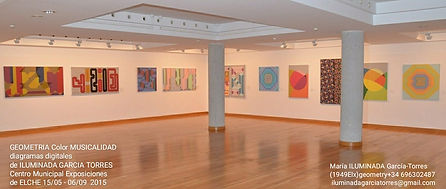
Colección Arte Contemporáneo Generalitat Valenciana IV pintura EXPOSICION Espai d ́Art Contemporani de CASTELLÓ, 06/07-03/10, 2021 Art Contemporani de la Generalitat Valenciana IV Año: 2021Páginas: 559páginas 246-259 pintura "El HILO de ARIADNA-Trazado Espacial Continuo 2002" by ILUMINADA GARCIA-TORRES (1949 Elche.España), texto de María Marco Edita: Generalitat ValencianaISBN: 978-84-482-6622-6
El texto que compartes es un ensayo de la crítica de arte
María Marco sobre la trayectoria de la artista alicantina Iluminada García-Torres, centrándose en su evolución hacia la abstracción geométrica y su obra "El hilo de Ariadna - Trazado espacial continuo 2002".
Aquí tienes los puntos clave del análisis:
-
Inspiración Clásica: El punto de partida es la escultura romana "Ariadna dormida". Esta figura conecta el mito del laberinto con la búsqueda formal de la artista, transformando el "hilo" narrativo en un trazado plástico y geométrico.
-
Evolución Estética:
-
Inicios: Influenciada por el realismo de Antonio López (fue su alumno en la Escuela de Bellas Artes de San Fernando). Sus primeras obras, como "Paisaje urbano de Madrid" (1982), ya mostraban un interés por la estructura geométrica oculta en la realidad.
-
Transición: Pasa por una etapa de bodegones intimistas con influencias de Morandi, donde los objetos pierden su función y se reducen a cilindros y rectángulos.
-
Abstracción Pura: A partir de 1991, con la exposición "Combinables", su obra se despoja de toda referencia figurativa. El cuadrado se convierte en el elemento base, representando la armonía, el espacio y el tiempo.
-
-
Conexiones Conceptuales: Su trabajo evoca la "pintura metafísica" de artistas como De Chirico, utilizando el silencio y el orden geométrico para crear espacios de reflexión.
La obra mencionada, "El hilo de Ariadna", es la culminación de este lenguaje donde el laberinto se convierte en un sistema de líneas y geometrías esenciales.
Colección Arte Contemporáneo Generalitat Valenciana IV texto de María Marco
El texto de la imagen profundiza en la técnica y las influencias de ILUMINADA GARCIA-TORRES (1949 Elche.España), destacando cómo su obra fusiona el rigor matemático con la sensibilidad artística.
Aquí tienes los aspectos más relevantes sobre su proceso creativo y formación:
Fundamentos Geométricos y Matemáticos
-
El "Cuadrado Matriz": La artista define así al contenedor de las 25 estructuras que conforman su universo visual. Cada elemento (punto, línea o figura) funciona como un mundo independiente que, a su vez, dota de sentido a la totalidad de la obra.
-
Estudio Matemático: Sus piezas no son azarosas; están regidas por un sistema matemático de repetición y armonía. Este enfoque busca un trazado continuo e infinito, similar a un orden musical o rítmico.
-
Conexión con el Neoplasticismo: El texto vincula su estilo con la espiritualidad de movimientos como el neoplasticismo de Mondrian y la repetición del minimalismo.
Influencias Determinantes
-
Eusebio Sempere: En 1969, García-Torres fue alumna de Sempere en la Complutense de Madrid. Él la introdujo en la abstracción geométrica y en el uso pionero de computadoras (a través del Centro de Cálculo) para generar arte, lo cual marcó su lenguaje plástico posterior.
-
Zóbel y la Tecnología: El uso del plóter le permitió alcanzar una precisión técnica extrema, logrando líneas tan finas y delicadas como las de Fernando Zóbel, pero aplicadas a obras de gran formato.
Obra Destacada: "El hilo de Ariadna"
-
Dimensiones y Color: Es un gran cuadrado de 180x180 cm que juega con gamas de azules.
-
Estructura: Se compone de líneas verticales cortadas por tres tiras horizontales, creando una subdivisión de pequeños cuadrados casi imperceptibles que generan una sensación de vibración y ritmo.
Colección Arte Contemporáneo Generalitat Valenciana IV texto de María Marco Edita: Generalitat Valenciana Esta última página del ensayo es fundamental porque cierra el círculo entre la teoría, la mística matemática y la genealogía técnica de ILUMINADA GARCIA-TORRES (1949 Elche.España).
Aquí tienes un análisis detallado de los puntos clave que presenta esta parte del texto:
1. La Conexión Musical: El "Bach" de la Pintura
El texto establece una analogía muy potente entre la obra de García-Torres y Johann Sebastian Bach.
-
Sincronía y Ritmo: Al igual que en una fuga de Bach, la artista utiliza la repetición de patrones para alcanzar la armonía. No es una repetición vacía, sino un "sistema fractal" donde cada pequeña parte refleja la estructura del todo.
-
La Música del Dibujo: Como cita Vicente Verdú, la línea se depura tanto que "se adentra en el dibujo de su música", sugiriendo que la pintura no es solo visual, sino que tiene una cadencia rítmica que el espectador puede "escuchar" visualmente.
2. El Simbolismo del Laberinto y el Hilo
El análisis del mito de Ariadna aquí no es solo poético, sino metodológico:
-
Orden contra el Caos: El "hilo" (la línea geométrica) es la herramienta que permite transitar y "escapar de cualquier situación compleja". La geometría actúa como un mapa ordenador frente a la confusión del mundo.
-
La Trama Matriz: Se describe la obra como un juego de luces y sombras sobre un fondo azul. Aunque parece uniforme, el texto aclara que el patrón no es idéntico en cada repetición; es esa sutil variación la que crea la "armonía interna".
3. El Vínculo Histórico con la Tecnología (Notas al Pie)
Las notas al pie de esta página son una mina de oro para entender su rigor técnico:
-
La Transición (1990): La nota 1 marca el momento crítico en la Galería Albatros donde abandona definitivamente el paisaje y el retrato para abrazar el cuadrado como unidad básica de investigación.
-
Pionera del Arte Digital (Centro de Cálculo): La nota 3 es vital. Sitúa a la artista en el contexto del Centro de Cálculo de la Universidad Complutense (1966). Su colaboración con IBM para crear "formas computables" explica por qué su obra tiene esa precisión matemática: ella fue parte de la generación que exploró por primera vez la computadora como herramienta creativa en España.
4. Síntesis Estética
La página concluye que su obra es un "trazado espacial continuo". Esto significa que la pintura no termina en el borde del lienzo, sino que la lógica geométrica sugiere una continuidad infinita. El color azul no es accidental; es el tono que mejor representa la profundidad, el vacío y lo metafísico.
Este análisis revela que ILUMINADA GARCIA-TORRES (1949 Elche.España) no solo pinta cuadros, sino que construye sistemas lógicos.
elhilodeariadna-combinatoria.blogspot.com 2021
https://drive.google.com/2021-catalogo/art-contemporani-de-la-generalitat-valenciana-iv-pag-246-iluminada-garcia-torres/
páginas 246-259 pintura "El HILO de ARIADNA-Trazado Espacial Continuo 2002" by Iluminada García-Torres, texto de María Marco

Exhibition Text: GEOMETRÍAS (1996) / Catalog: COMBINABLES (1993)By: ILUMINADA GARCIA-TORRES (1949 Elche, Spain)
GEOMETRIES Exhibition Text (1996)
By: ILUMINADA GARCIA-TORRES
Following the experience of painting the sculpture of Ariadne at the Museo del Prado, I became aware that the harmony of Ariadne—a union of power and subtlety that so impressed me and sparked my fascination with painting her, as that was my way of trying to unveil the mystery of her harmony—was not a matter of chance. I discovered that this harmony corresponded to a geometric and mathematical principle.
The consequence of the profound awareness arising from this experience—that manifestations which appear most natural, casual, etc., can be governed by complex laws which, though not fully understood, we can come to perceive—is the origin and starting point of the common thread of my motivation. This drives my search to understand the key meaning of harmony, leading me progressively along the path I am forging. The meaning of this path,
CONTINUOUS SPATIAL TRACING, is "ARIADNE'S THREAD".
I transcribe, once again, the text containing reflections on the general plastic foundation, and an excerpt from from the manuscript published on May 7, 1993, i those corresponding to the painting section,n the catalogue of the exhibition I held at the Caja de Ahorros del Mediterráneo, Cultural Foundation, Alicante.
In an attempt to explain to myself the causes of the geometrc approaches I was undertaking and to achieve a better understanding of them, I have been writing down several reflections.
By: ILUMINADA GARCIA-TORRES text 1991
I recognize, first of all, that if my evolution has led me to my current plastic language, it is because—step by step, starting from reality, painting from life, and delving deeper into it—I have encountered this path, motivated by the search for the essence of elements in plastic expression.I have intuited this path simultaneously through poetic texts, sculpture, and painting, starting from a unity of concept, with these languages being complementary to one another.
The motivations behind the act and reflection of painting lead me to express that: The square is the container of space, and its development encompasses itself at all times.
I call the square containing the structures the "universe matrix square-mathematics unit." The structures, whether imagined or represented with points or linearly, serve as a guide for the composition. These structures can join together or be subdivided, forming other structures of different dimensions, enhancing new compositions, as well as constituting the unique or partial artistic representation.
The elements—the point, the line, and the figures they generate—can be interpreted as independent worlds that, in turn, participate in the same meaning we give to the totality. Therefore, each element participates in the whole, and the totality is contained in the essence of a single element.
I find the full sense of space in the "universe matrix square" through the relationships it establishes with the elements represented in its structures. To the space contained within the square; its meaning is: free space.
-
If the elements—point, line, and the generated figures—are represented in the structures, these, in relation to the free space, contain the concept of the filled. I shall call this relationship: filled space.
-
When the space is determined by the non-representation of elements, partially or totally, it means that the void is consciously and deliberately expressed. Consequently, I value this space as: void space.
-
The concepts of the void and the filled in their own expression, and that originated in their relationship—whether by one, several, or all of the following causes: color, shape, number, direction, sense, etc., both of the elements represented in the structures of filled space and by the significance of the void space—produce, as an effect, a space of energy around them. This energy released between opposites, once harmony is reached between both, is: harmonic space.
-
The containing space will be: open space. Open space has an infinite essence, an unlimited nature, and lacks structures. Lacking structures, it lacks harmony, but it can be structured and harmonic through creation.
FREE SPACE • FILLED SPACE • VOID SPACE
HARMONIC SPACE • OPEN SPACE
By: ILUMINADA GARCIA-TORRES (1949 Elche, Spain)
Spontaneously, from the first painting I ever made, I established a proportional relationship between the width of the drawn lines, the intermediate spaces between them, and also with:
-
the resulting spaces between both ends of the lines
-
the space preceding the first line
-
the space following the last line
-
the sides of the structures.
I have attributed to each of these spaces half of the measurement given to the intermediate spaces between the lines. Therefore, the union of the four expressed spaces, with those corresponding to the immediate structures, will form a single space of the same measurement as the intermediate spaces. The length of the lines is determined by the measurement of the spaces between the ends of the lines and the sides of the structure.
In the structures, the space following the last line will join with the space preceding the first line, and the lower space with the upper space of the following structures / vice versa.
Therefore, depending on whether the stroke of the lines is vertical or horizontal, their location in each structure and their relationship with the other structures, these will be on the right or the left, above or below. Thus developing a "Continuum" of spaces and lines with the successive structures.
If we make consecutive subdivisions to the structures and the represented lines... the line being a continuous succession of points, the manifestation of the ultimate consequence of the "universe matrix square" will agree with the first: the point.
I consider the first and the last of the spaces to be equal, both the upper and the lower, or the one on the right and the one on the left.
Estimating the interaction of the spaces in the structure by: the relationship they establish with the elements • their magnitudes • the content of their meaning • the harmony between opposites • originating a single space from the fusion of the spaces, upper and lower, the one on the right with the one on the left and vice versa, for the generation of successive structures, from the "universe matrix square" which, being open and dynamic, evolves towards the expansion of itself, creating new spaces in continuum...
The beginning and end of the fused spaces as a totality form the unity, being all one.
THE COMPLETE ONE • THE SIMULTANEOUS ONE THE CONTINUOUS ONE • THE EXPANSIVE ONE • THE ONE THE POINT
Line Drawing, Pictorial Action. Text 1991 By: ILUMINADA GARCIA-TORRES
I encounter the space of the "universe matrix square." I resolve this free space by painting it with a single color, or with variations in tone, material intensity, etc., or by forming different planes of color within the modules... among other approaches depending on the material of the support used.
Both the chromatic execution and the technical finish of this space's surface will evoke a relationship of broad suggestions with the lines/strokes later painted on canvas or paper, focusing this study on the line as an essential element in my painting.
While painting, I perceive that the maximum sensitive power of the line is achieved through the action of a single brush gesture. This is because the following are simultaneous: the moment and time in which the stroke unfolds, the base space upon which the line is captured, and the breath of life infused by the person in their pictorial action.
Since each line is expressed in a single stroke, each one is unique and distinct from the others.
At the beginning of the action of drawing the line, as the brush is more heavily loaded with paint, the resulting trail is more compact. As it progresses, the impact of the stroke becomes lighter, allowing the background color to show through parts of it—enriching it chromatically and giving the line visual mobility.
When appropriate to provide greater liveliness and harmony to the composition, I study the sense of direction in the drawing, beginning the action from different ends of the lines.
In the trajectory of the line’s drawing, the "dynamic heartbeat" pressure exerted with the brush at certain moments of its path leaves a greater or lesser intensity of paint in its wake; similarly, by pressing the brush at the end, it gives a new intensity to the line.
The brush can be used in many ways—taking into account its own characteristics, as well as the paint being more fluid or thick, etc.—producing a specific imprint in the action of the brushstroke. This offers vast possibilities of expression, "heartbeat rhythms," and all of this joined with color is wonderfully boundless.
Exhibition Text: GEOMETRÍAS (1996) / Catalog: COMBINABLES (1993)
By: ILUMINADA GARCIA-TORRES (1949 Elche, Spain)
Texto Exposición: GEOMETRÍAS (1996) / Catálogo COMBINABLES (1993)
Por: ILUMINADA GARCIA-TORRES (1949 Elche, Spain)
A raíz de la experiencia de pintar la escultura de Ariadna en el Museo del Prado, fui consciente de que la armonía de Ariadna, unión de la potencia y sutileza que tanto me impresionó y provocó mi fascinación por pintarla, pues era esa la forma de intentar desvelar el misterio de su armonía, no era un azar. Descubrí que esta armonía correspondía a un principio geométrico y matemático. La consecuencia de la profunda consciencia surgida a causa de esta vivencia, de que las manifestaciones en apariencia más naturales, casuales, etc. pueden estar regidas por leyes complejas, que aún no siendo del todo comprendidas, podemos llegar a percibir, es el origen, punto de partida del hilo conductor de mi motivación hacia la búsqueda de la comprensión del significado clave de la armonía, que me conduce progresivamente por el camino que voy haciendo. El sentido de este camino
TRAZADO ESPACIAL CONTINUO, es el "HILO DE ARIADNA".
Transcribo, nuevamente, el texto con las reflexiones del fundamento plástico general, y un extracto de las que corresponden a la parte de la pintura, del manuscrito publicado, 7 mayo 1993, en el catálogo de la exposición COMBINABLES que celebré en la Caja de Ahorros del Mediterráneo, Fundación Cultural. Alicante.
GEOMETRIA Exhibition Texto (1991)
Intentando explicarme las causas de los planteamientos plásticos que estaba realizando y alcanzar mejor comprensión de estos, he ido escribiendo algunas reflexiones.
Reconozco en primer lugar, que si mi evolución me ha conducido hasta el actual lenguaje geométrico, ha sido porque, paso a paso, partiendo de la realidad, pintando del natural y ahondando en ello, he llegado al encuentro de este camino, motivada por hallar la esencia de los elementos en la expresión artística.
Este camino lo he intuido simultáneamente a través de textos poéticos, escultura y pintura, partiendo de una unidad de concepto y siendo estos lenguajes complementarios entre sí.
By: ILUMINADA GARCIA-TORRES (1949 Elche, Spain) texto 1991
Espontáneamente, ya desde el primer cuadro que pinté establecí una relación proporcional entre el ancho de las líneas trazadas con los espacios intermedios entre estas y también con:
-
Los espacios resultantes entre ambos extremos de las líneas.
-
El espacio anterior a la primera línea.
-
El espacio posterior a la última línea.
-
Con los lados de las estructuras.
He atribuido a cada uno de estos espacios, la mitad de la medida dada a los espacios intermedios entre las líneas, por lo que la unión de los cuatro espacios expresados, con los correspondientes de las inmediatas estructuras, formarán un sólo espacio, de igual medida que la de los espacios intermedios. La longitud de las líneas está determinada por la medida de los espacios entre los extremos de las líneas con los lados de la estructura.
En las estructuras, el espacio posterior a la última línea se unirá con el espacio anterior a la primera línea, y el espacio inferior con el espacio superior de las siguientes estructuras / viceversa.
Por tanto, según sea el trazo de las líneas vertical u horizontal, su ubicación en cada estructura y relación con las otras estructuras, éstas quedarán, a la derecha o a la izquierda, arriba o abajo. Desarrollando así un "Continuo" de espacios y líneas con las sucesivas estructuras.
Si a las estructuras y a las líneas representadas, hacemos consecutivas subdivisiones... siendo la línea una sucesión continua de puntos, la manifestación de la última consecuencia del "cuadrado matriz universo", concordará con la primera, el punto.
Al primero y al último de los espacios los considero en igualdad, tanto al superior como al inferior, o al de la derecha como al de la izquierda.
Estimando la interacción de los espacios en la estructura por:
-
La relación que establecen con los elementos.
-
Sus magnitudes.
-
El contenido de su significado.
-
La armonía entre los opuestos.
-
Originarse un solo espacio con la fusión de los espacios, superior e inferior, el de la derecha con el de la izquierda y viceversa, por la generación de las sucesivas estructuras, del "cuadrado matriz universo" que al ser abierto y dinámico, evoluciona hacia la expansión de sí mismo, creando nuevos espacios en continuo...
-
Por: ILUMINADA GARCIA-TORRES Texto 1991
Las motivaciones del hecho y reflexión del acto de pintar me conducen a expresar que:
El cuadrado es el continente del espacio y el desarrollo de éste abarca en sí mismo al tiempo.
Llamo "cuadrado matriz universo-unidad matemática" al módulo base. Las líneas de los bordes de los lados trazarlas imaginariamente o dibujadas, con puntos o linealmente, son guía para la composición. Estas estructuras pueden unirse, o bien subdividirse, formando otras estructuras de diferentes dimensiones, potenciando nuevas composiciones, como también constituir la única o parcial representación plástica.
Los elementos —el punto, la línea, y las geometrías que generan- podemos interpretarlos como mundos independientes que a su vez participan del mismo significado que damos a la totalidad. Por lo cual, cada elemento participa del todo, y la totalidad está contenida en la esencia de un solo elemento.
El pleno sentido del espacio en el "cuadrado matriz universo" lo encuentro en las relaciones proporcionales establecidas con las elementos, líneas o puntos inscritos en su espacio.
Al espacio contenido en el cuadrado; su significado es de: espacio libre.
-
Si los elementos punto, línea, y las geometrías generadas, están representados en las estructuras, éstos en relación con el espacio libre contienen el concepto de lo lleno. A esta relación la llamaré: espacio lleno.
-
Cuando el espacio queda determinado por la no representación de los elementos, parcial o totalmente, significa que de manera consciente y deliberada expreso el vacío. En consecuencia a este espacio lo valoro como: espacio vacío.
-
Los conceptos de lo vacío y lo lleno en su propia expresión y la originada en su relación, ya sea por una, varias, o todas las causas siguientes: color, forma, número, dirección, sentido, etc., tanto de los elementos representados en las estructuras del espacio lleno, como por la significación del espacio vacío, producen como efecto, un espacio de energía a su alrededor. A esta energía liberada entre opuestos y al alcanzar la armonía entre ambos, es el: espacio armónico.
-
El espacio continente será: espacio abierto. El espacio abierto tiene una esencia infinita, una naturaleza ilimitada, y carece de estructuras. Al carecer de estructuras carece de armonía, pero puede ser estructurado y armónico a través de la creación.
ESPACIO LIBRE • ESPACIO LLENO • ESPACIO VACÍO
ESPACIO ARMÓNICO • ESPACIO ABIERTO
Trazado de la línea, realización pictórica. Texto 1991 Por: ILUMINADA GARCIA-TORRES
Encuentro el espacio del "cuadrado matriz universo". Este espacio libre, lo resuelvo pintándolo con un solo color, o con variaciones de tono, intensidad matérica, etc., o formando con las estructuras distintos planos de color... Y otros planteamientos según sea el material del soporte utilizado.
Tanto la realización cromática o la terminación técnica de la superficie de este espacio, suscitara una relación de amplias sugerencias sobre los trazos que después se pinten sobre él, concretándolo en este estudio a la línea, como elemento esencial en mi pintura.
Al pintar, percibo, que la máxima potencia sensible de la línea, se alcanza, en la acción de un sólo gesto del pincel para su trazado, al ser simultáneo: el momento, el tiempo en el que se desarrolla el trazo, con el espacio, estructura en la cual se plasma la línea, más, el hálito de vida, que le infunde el artista en la realización.
Al ser expresada cada línea de un solo trazo, cada una de ellas es única y distinta a las demás.
Al principio de la acción, en el trazado de la línea, como el pincel está más cargado de pintura, la estela derivada es más compacta y en su transcurso va quedando más leve el impacto de su trazo, trasluciendo el color del fondo a través de algún fragmento de ésta, enriqueciéndose cromáticamente y dando al trazo de la línea movilidad visual.
Cuando es conveniente para dar mayor viveza y armonía a la composición, alterno el sentido de la dirección en el trazado, comenzando la acción por un extremo de la línea y en otras por el opuesto.
En la trayectoria del trazo, la presión "latido" ejercida con el pincel en determinados momentos de su recorrido, deja mayor o menor intensidad de pintura en la estela de su huella, tanto, como si al final al presionar el pincel, dar nueva intensidad "latido dinámico", a la línea.
El pincel se puede utilizar de muchos modos, contando con sus propias características, en combinación con la pintura, más fluida o espesa etc., produce una impronta específica en la acción del trazado como, en el resultado de ésta, dando amplísimas posibilidades de expresión, "ritmos del latido", y todo ello unido al color, es, maravillosamente inabarcable.
Texto Exposición: GEOMETRÍAS (1996) / Catálogo COMBINABLES (1993)
Por: ILUMINADA GARCIA-TORRES (1949 Elche, Spain
EL MUNDO, MIÉRCOLES 1 DE MAYO DE 2002
ILUMINADA GARCIA-TORRES presenta la Retrospectiva "El hilo de Ariadna. Pintura 1991-2002", Sala Municipal exposiciones LA LONJA de ALICANTE
MARTIN SANZ texto. LA LUZ NECESARIA PARA SALIR DEL LABERINTO
ALICANTE.– Quedaban dos deudas pendientes que se han saldado al mismo tiempo. Sabía que en Madrid reconocían su trazo geométrico a la primera. Estaba también por determinar el momento exacto en el que su Elche natal incorporaría una de sus obras al mobiliario urbano.
Hace apenas un mes presenció la instalación de su pieza COMBINABLES: Eje Energético –tres metros de bronce y acero inoxidable– en la plaza de San Juan de Elche y ayer mismo ILUMINADA GARCIA-TORRES (Elche, 1949) inauguró en la Sala Municipal Lonja del Pescado su exposición El hilo de Ariadna. Pintura 1991-2002. Además de veinte cuadros, el espacio acoge otra escultura que, habitualmente, puede contemplarse en la Colección Capa del Castillo de Santa Bárbara.
La historia es conocida por quienes desde hace años consideraban como una cuestión de algo más que justicia que en Alicante se organizara una muestra retrospectiva de Iluminada García-Torres. Fue a mediados de la década de los ochenta cuando la ilicitana visitaba el MUSEO del PRADO para disfrutar de cerca la pintura de las Meninas de Velázquez recién restauradas. Una vez allí, su atención se volvió a desviar hacia la escultura de Ariadna dormida. Comenzó en el Museo a pintarla día tras día hasta descifrar su esencia, la misma que ahora preside la estancia de la Lonja donde reposan el resto de las obras de la exposición.
Supuso un flash, «el conocimiento y la luz necesaria para salir del laberinto. Obtuve la consciencia de que su armonía, alquimia de potencia y sutileza que tanto me impresionó provocando mi fascinación, no fue por azar. Su armonía invocaba un cosmos geométrico y matemático», señala la pintora. En un ejercicio de concentración de fuerzas logró que aquellos jeroglíficos lineales se descifraran en su estudio, «en aquel primer cuadro, donde está todo», dice Iluminada García-Torres señalando uno de los lienzos de pintura geométrica.
Para la autora «el espacio es tan importante como las líneas, porque con la plasmación de su trazado a través de un solo gesto, con la expresión del instante constituido por línea-espacio-tiempo dentro de las relaciones de proporcionalidad, está expresado el lenguaje de las sensaciones y los conceptos que progresivamente voy desarrollando hacia la armonía», la misma que desprendía Ariadna.
Hoy por hoy, su trabajo prosigue en esa línea, «se desarrolla y evoluciona porque el hilo es continuo». Escucha las reflexiones al respecto procedentes de la voz de su antiguo maestro Antonio López, quien le impartió clases en los sesenta en la Academia de Bellas Artes de San Fernando y quince años después en el Círculo de Bellas Artes madrileño. « Esta investigación es posible por los veinticinco años previos de realismo. Expresar algo como he querido ha llegado tras muchos años y en ese sentido he sido muy exigente. El espacio y la línea proseguirán y, aunque elementales, son esenciales». ILUMINADA se acerca a las últimas tecnologías, y se manifiesta una única razón. «Son varias obras, pero al final podrían conformar una sola».
ALICANTE Calle García Morato 18. 03004. Tfno: 965982244. Fax: 965120641. E-mail: alicante.redaccion@el-mundo.es
Ángel de Pablos también escribía en El Adelantado de Segovia, Santos San Cristóbal (fallecido en 2021) fue el director del Torreón de Lozoya
EL MUNDO, on May 1, 2002
ILUMINADA GARCIA-TORRES presents her retrospective exhibition "El hilo de Ariadna. Pintura 1991-2002", at the La Lonja Municipal Exhibition Hall in ALICANTE
Text by Martin Sanz titled "LA LUZ NECESARIA PARA SALIR DEL LABERINTO" ("The Necessary Light to Exit the Labyrinth")
"El hilo de Ariadna. Pintura 1991-2002"LA LONJA de ALICANTE
MARTIN SANZ texto. LA LUZ NECESARIA PARA SALIR DEL LABERINTO
ALICANTE.– There remained two outstanding debts that have been settled at the same time. She knew that in Madrid they recognized her geometric stroke at first glance. It was also yet to be determined the exact moment in which her native Elche would incorporate one of her works into the urban furniture.
Barely a month ago she witnessed the installation of her piece COMBINABLES: Energy Axis –three meters of bronze and stainless steel– in the Plaza de San Juan of Elche, and just yesterday ILUMINADA GARCIA-TORRES (Elche, 1949) inaugurated in the Lonja del Pescado Municipal Gallery her exhibition Ariadne's Thread. Painting 1991-2002. In addition to twenty paintings, the space hosts another sculpture that, usually, can be contemplated in the Capa Collection of the Santa Bárbara Castle.
The story is known by those who for years considered it a matter of more than just justice that a retrospective exhibition of Iluminada García-Torres be organized in Alicante. It was in the mid-eighties when the woman from Elche visited the PRADO MUSEUM to enjoy up close the painting of Velázquez's recently restored Las Meninas. Once there, her attention was diverted again toward the sculpture of Sleeping Ariadne. She began to paint her in the Museum day after day until deciphering her essence, the same one that now presides over the room of the Lonja where the rest of the works of the exhibition rest.
It meant a flash, "the knowledge and the light necessary to exit the labyrinth. I obtained the consciousness that her harmony, an alchemy of power and subtlety that impressed me so much, provoking my fascination, was not by chance. Her harmony invoked a geometric and mathematical cosmos," points out the painter. In an exercise of concentration of forces, she managed to have those linear hieroglyphs deciphered in her studio, "in that first painting, where everything is," says Iluminada García-Torres, pointing to one of the canvases of geometric painting.
For the author, ILUMINADA GARCIA-TORRES “space is as important as lines, because with the representation of their layout through a single gesture, with the expression of the instant constituted by line-space-time within the relations of proportionality, the language of sensations and concepts that I am progressively developing towards harmony is expressed,” the same one that Ariadne.
Today, her work continues along that line, “it develops and evolves because the thread is continuous.” She listens to reflections on the matter coming from the voice of her former teacher Antonio López, who taught her classes in the sixties at the San Fernando Academy of Fine Arts and fifteen years later at the Madrid Circle of Fine Arts. “This research is possible because of the previous twenty-five years of realism. Expressing something as I have wanted has arrived after many years and in that sense I have been very demanding. Space and line will continue and, although elementary, are essential.” ILUMINADA approaches the latest technologies, and a single reason is manifested. “They are several works, but in the end they could form a single one.”

-
iluminadagarciatorres.blogspot.com
"LA CONSTRUCCIÓN DEL SUJETO ROBADO. El arte hecho por mujeres en Alicante (1950-2020)" / Texto de PASCUAL PATUEL / pintura, arte geométrico digital y escultura by ILUMINADA GARCIA-TORRES (1949 Elche.España). Juan A. Roche Cárcel (Ed.) PUBLICACIONS UNIVERSITAT D'ALACANT / INSTITUCIÓ ALFONS EL MAGNÀNIM-CVEI. COMUNIDAD VALENCIANA, España, (Spain)
pág 53 ILUMINADA GARCÍA-TORRES. EL CAMINO DE LA ABSTRACCIÓN
Pascual Patuel Catedrático de Historia del Arte, Universitat de València
INTRODUCCIÓN
In other words, there is an adaptation of veteran linguistic codes to the emerging expressive needs of society, in accordance with historical memory. As Román de la Calle points out:
pages 54-55 The interest in recovering the plastic past sometimes aims to complete or justifiably reissue our own history (to recover lost identity) and in other cases because this past—not always distant—can embody and/or generate a "rich wealth of values of all kinds, among which there is no shortage of opportunities for 'updating' and 'bonds' at the socio-economic and even political prestige level, given the current situation" (Calvo, July 26, 1992).
This is the context in which the work of ILUMINADA GARCÍA-TORRES develops, with an orientation within what we could call neo-constructivism (Patuel, 2012), occasionally with kinetic intent. It is one of the several options chosen by artists incorporated into Valencian art during the era of democracy. Her work fits within this horizon of postmodernity, which fosters a reunion with and revision of the artistic past with a creative desire to extract valid and innovative lessons for the present.
ILUMINADA GARCÍA-TORRES has made a firm commitment to geometric abstraction with a kinetic character, guided by the desire to overcome the figurative past inspired by nature, leading to the development of increasingly pure and orthogonally organized forms and colors. From a very young age, she felt an interest in painting and the desire to be an artist. She completed her initial studies at the School of Arts and Crafts in Alicante (1964), preparing for admission to the San Fernando Royal Academy of Fine Arts in Madrid (1965-1970).
During her first year at the San Fernando Academy of Fine Arts, she was a student of the painter Antonio López García, who would leave a lasting impression on her early artistic stage while attending his Color and Composition classes. Years later, she would again be his student in a Contemporary Art Workshop taught by López García at the Círculo de Bellas Artes in Madrid in 1984. The influence of this artist would foster the development of a realist phase that was to last about 20 years. In 1969, she took classes from Eusebio Sempere and, during this year, balanced her formal studies with firsthand experience in cybernetics at the Computer Center of the University of Madrid, where Sempere was immersed in the Seminar on Automatic Generation of Plastic Forms organized by this institution. The fruits of this learning experience in computer work remain evident to this day. In 1997, she settled in London for a period of time. Between 1998 and 1999, ILUMINADA GARCÍA-TORRES was invited as a resident artist by the Gasworks Studios and Gallery in London. In the year 2000, she exhibited her geometric artwork at the Hortensia Art Gallery of the Kensington & Chelsea College in London.
The realist phase lasted from 1965 to 1989, featuring themes native to her land of Alicante and still lifes. In December 1990, the art critic of Diario 16 gathered some statements of hers on the occasion of her exhibition at the Albatros Gallery in Madrid, in which our artist said: "I was born by the sea and, although I came to Madrid at sixteen to study Fine Arts, I always keep its presence near. I noticed it in the need to include a horizon line, a reference to space in each painting" (Miguel Fernández-Cid, 1990: 34). This would be the last realist exhibition she would hold featuring still lifes and geometric landscapes, where formal purification is highly noticeable.
An important part of her subsequent career is dedicated to the still life, which experienced a new revitalization thanks to the painting of Paul Cézanne and Pablo Picasso. This pictorial genre was the subject of her work between 1982 and 1989. In this context, she draws from the proposals of Giorgio Morandi, with certain influences from metaphysical painting, seeking above all the geometry of objects.
page 58
Photo 5 Continuous Spatial Tracing XIV, 1992
As if piercing the marble of the Sleeping Ariadne sculpture and managing to reach the essence of its internal structure, she unraveled the purity of its compositional framework.
In 1986, ILUMINADA GARCÍA-TORRES spent several months painting the sculpture as a copyist. She did so again for two years, captivated by the hidden perfection emanating from this ancient sculpture. Between 1986 and 1988, she completed two paintings based on the original sculpture Sleeping Ariadne in Naxos. She shares her experience with the Prado Museum's Ariadne:
"I went to the Prado Museum looking for an image that would disturb me, and I found this sculpture. I painted it from the front first, but it kept seducing me; I painted it from behind, which felt daring. I returned more times, imagined a landscape in the background—a landscape that grew and changed as I painted it... and I know I will return to this Ariadne, because it is impossible for me to forget her perfection, her harmony, her mathematical control" (Fernández Cid, 1990 Diario 16: 34).
As ILUMINADA GARCÍA-TORRES penetrated its secrets, she transcended the subtlety and figurative drapery of the work, discovering the internal harmony hidden within the marble. Through the oil paintings she created there, she realized that this harmony posed a major question that would define her career. She discovered that this harmony invoked a geometric and mathematical cosmos which now guides the poetics of her painting. Determined to move beyond the sculpture's appearance, she sought a way to investigate and express this harmony in formal terms. She discarded the anecdotal wrapper to unveil and numerically code its constitutive sequence—or, in scientific terms, what we would call the keys to its genome, expressed in points, lines, spaces, and color.
page 59
She deciphered that the harmony responded to a geometric and mathematical principle, and that beneath the figurative appearance lay complex laws of numerical proportion. This aspect underlies the very genesis of classical art, as the Greeks unveiled the inherent harmony that pulses behind human nature. Iluminada gradually discovered a formal code of mathematical relationships that would govern her future work. Her investigation of space has formally matured her proposals through an ever-increasing proliferation of formal series in rhythmic sequences. Reflecting on this theme after the fact, ILUMINADA GARCÍA-TORRES noted:
"Following my vision of the Ariadne sculpture at the Prado Museum—through the oil paintings of her image that I painted there—I became aware that her harmony, an alchemy of power and subtlety that impressed me so deeply and sparked my fascination, was not accidental. I discovered that this harmony invokes a geometric and mathematical cosmos which now guides the poetics of my painting.
Right from the first continuous spatial layout painting, Ariadne's Thread, the language of sensations and concepts is expressed, which I progressively develop toward harmony. This is achieved by capturing the layout of the line in space with a single gesture, expressing the instant constituted by line-space-time, within the proportional relationships of the dimensions of the structures—the square matrix universe.
Poetically, the projection of Ariadne's Thread onto the internal dynamics of the paintings flows between their lines. The uniqueness of each line traced in space is a step forward on the path toward light.
All my paintings constitute the expression of a single work that flows into the current of universal language" (I. García-Torres, 1995-2000²).
Our artist discovered an internal cadence of a geometric order in this work that would govern her future production from 1991 onward. The investigation of space has formally complicated her proposals with an ever-increasing proliferation of formal series in rhythmic sequences, parallel to the world of minimal music, ultimately leading to what she terms Continuous Spatial Layout. The pictorial action begins with freehand brushstrokes in colored lines, with dimensions proportional to the surfaces of the square matrix-mathematical units, executed in a single, meditated stroke. The brushstrokes are applied with a specific amount of pigment to create texture. Each line is a gesture that depends on her concentration, her physical or psychological state, etc.—in other words, an echo of herself carrying her emotional weight. It is also an "event" that determines the quality of the next brushstroke: the position, the direction, the path, the chromatic tone, and the quantity. These parameters determine the next step, establishing an infinite dynamic of successive geometric-pictorial conditions.
In March 2000, upon her return from exhibiting in London, she rented a studio-apartment in Alicante, which has been her place of residence in her hometown ever since. In the early summer of 2009, she moved to her current studio-apartment, which offers more space. Since her mathematical-geometric proposal Combinables in 1991, she made a major leap into the digital realm in 2002, integrating her work with new technologies applicable to the art of painting. Her career is marked by a clear desire to study the possibilities of mathematical proportionality, based fundamentally on three components: the point (pixel), the line, and a square-shaped base. Drawing on the experiences gained in Eusebio Sempere's classes, she combines the digital processing of the image with a few brushstrokes that recall her beginnings in abstract expressionism. The mark of the brushstroke gradually transforms into pixels that constitute a new structure for the line, while generating and enhancing new images in chromatic and geometric combinations. In her works, we can appreciate the variety of possibilities and formulations she has explored, remaining faithful to her principles of Normative, modular, and generative art that the computer offers.
KINETIC NEOGEOMETRISM
The proposals of ILUMINADA GARCÍA-TORRES offer us geometries of infinite development, thanks to chromatic combinations and computer imaging procedures. Here, the brushstroke of the past is now replaced by the pixel (picture element)—a point on a rectilinear grid with thousands of points processed individually to form an image on the computer screen. The final work is obtained through digital printing on large-format canvas using a plotter. The series of rhythmic sequences allow for a certain relationship to be established with the essence of minimal music. Its infinite development in the rhythms of brushstrokes...
page60 fotopág 60 foto 6 Trazado Espacial Continuo 12 al-180 x 90 cm 2001
page 61 foto 7 El hilo de Ariadna-combinatoria 11 A-2, 2003.
Photo 7 Ariadne's Thread-Combinatorics 11 A-2, 2003
...and color also recalls the expressive forms characteristic of the Eastern world. This combination of her lines, pixels, and colors generates the geometric framework characteristic of her work. However, the results are not a pure, hardline formalist abstraction—as seen in the historic avant-gardes of the 20th century—but rather, within these elements, we find echoes of a human heartbeat and poetic vibration.
She achieves an infinity of proposals. At first glance, this procedure might suggest that the machine replaces the artist in the creative process. This is not the case, because the painter's creativity resides in the programmatic rules she imposes through the software and in her choices among the multiple possibilities the computer offers. Therefore, she always retains full control over the entire development.
From this recurring starting point, she gave rise to a formal repertoire based on the serialized multiplication of structures in linear progression. She formulated a basic module, which she terms the square matrix universe, which was subdivided into smaller squares contained within the first. As Segundo García points out: "In the end and at its core, her entire work crystallizes into an essential square. A matrix square, a site of tensions where all formal relationships are mediated and geometric and mathematical events unfold—a rigorous structural circumstance, a cosmos of interdependence" (Segundo García, Director of the Museo de la Asegurada, 1993).
Nested inside these squares are the geometric shapes that ILUMINADA considers independent worlds, yet participants in the whole. They are perfectly calculated according to systems of proportion in their measurements. These smaller forms embody the concept of fullness and coexist with empty space. The relationship between full and empty spaces is dialectically active because it generates multiple types of tensions, determined by color, shape, number, direction, and so on. In this way, a grid is generated, defined by points of linear organization and structured around verticality and horizontality. This template serves as the starting point for ILUMINADA's experimentation and constitutes the basis of all her productions. From this grid, the different spaces that ultimately shape each work are generated:
-
Free space: the space contained within the square.
-
Full space: formed by the geometric elements of the point and line, as well as the figures they configure.
-
Empty space: when no integrating elements appear.
-
Harmonic space: the result of the interaction between the different elements that make up the artistic work, such as color, shape, direction, etc.
-
Open space: the container of the entire work.
Page 62 Left Page (62): Right Page (63) Photo 8 Ariadne's Thread-Musicality New York 64, 1991-2011
The artist herself, ILUMINADA GARCÍA-TORRES, explained her formal frameworks based on the square—a system of subdivisions establishing proportional relationships with the geometry of the lines, which encompasses the entirety of the content. In her theoretical reflections, we read:
"I call the squares that contain the lines the 'square matrix universe.' The structures, whether imagined or represented with points or lines, serve as a guide for the composition and can constitute a single or partial visual representation. These structures can be grouped together or subdivided, forming new square structures with different dimensions that give rise to new compositions.
The elements—the point, the line, and the shapes they generate—can be interpreted as independent worlds that, in turn, share the same meaning we attribute to the whole. Therefore, each element participates in the whole, and
foto 7 El hilo de Ariadna-combinatoria 11 A-2, 2003.
PAGE 63
the whole is contained within the essence of a single element. I find the full meaning of space within the 'square matrix universe' in the relationships that occur with the elements captured within its structures" (García-Torres, 2002: 20-21).
The matrix square acts as a mathematical environment. Nested inside it are the lines, which Iluminada considers independent worlds, yet participants in a higher totality. They are perfectly calculated according to systems of proportion in their measurements. These forms embody the concept of fullness and coexist with empty space. The relationship between full and empty spaces is dialectically active because it generates multiple types of tensions, determined by color, shape, number, the direction of the lines, and so on.
From this orthogonal framework, geometric shapes emerge with the help of points and lines, eventually generating infinite and continuous series that maintain proportional relationships with the intermediate spaces. The structures can unite with one another or subdivide into others of different dimensions. Regarding this basic module, she commented:
"When painting, I encounter the space of the matrix square with the divisions already made. I resolve this free space (the background) by painting it with a single color, or with variations in tone, material intensity, etc., or by forming different color planes with the structures."
Both the chromatic execution and the technical finish of this space's surface will prompt a wide range of suggestions for the lines subsequently painted over it, ultimately granting more freedom to the line as the ideal element to express its layout.
"I believe that the strength of pictorial expression lies in the action of a single brushstroke to interpret each line. Because each line is expressed in a single stroke, each one is unique, distinct from the others [...] The criteria outlined, along with their expression through color, grant freedom to the composition, leaving its experimentation open to inspiration" (I. García-Torres, 1993).
With these premises, she offers geometries of infinite development. This is achieved through chromatic combinations and, since 2002, through the possibilities of computer imaging, where the brushstroke of the past is now replaced by the pixel (picture element)—the smallest homogeneous unit of color within a digital image, or a point on a rectilinear grid of thousands of points individually processed to form an image on the computer screen. This image is finally materialized through digital printing on large-format canvas with the help of an industrial printer. Through this, she achieves a triple impact across different movements of pictorial modernity: her connection to cybernetic art through the use of the computer as an artistic tool; her incorporation into the long-standing abstract tradition through formal reductionism to structures of geometric origin; and, finally, her research in the field of kinetic art in its Op Art variant, by virtue of using certain optical procedures that generate virtual or apparent movement in the viewer, such as the use of repetitive serialized structures, overlapping grids, or contrasting colors that succeed in generating optical vibrations on the viewer's retina.
PROPORTION AND HARMONY
At this point in our reflection, it is worth emphasizing the idea that the aesthetic based on the work Ariadne's Thread lies precisely in unveiling the proportion and harmony with which the universe is configured—or, in other words, in evoking a controlled arithmetic. We are looking at art understood as a spatial sequence subjected to mathematical rhythms of serialization through the use of interactive modules and chromatic variations of exquisite Mediterranean vibration. As Isabel Tejeda points out: "these are obsessively drawn lines analyzing the rhythms that emerge along the path of their layout, within the proportional relationships established with the space contained inside the modules. Modules which, according to her, hide the laws of harmony beneath their mantle" (Tejeda, 2001).
The Greeks were already looking in this direction, as they developed a deeply humanistic culture whose proportions follow those of the human body, given that man—as Protagoras notes—is the measure of all things. For the Greeks, the very practice of architecture and sculpture was the result of a harmonious mathematical calculation or canon (kanon), understood as a set of formal relationships regulating the different proportions of the parts of an artistic work.
Thus, the artist from Alicante has managed to transcend the reality of classical art and look beyond—
PAGE 64 PHOTO 9. Ariadne's Thread-Music-Universe 72, 2011.
...from the recreation of nature, to discovering the beauty that hides behind mathematical order. Starting from the Ariadne sculpture at the Prado, she has managed, first of all, to discover the internal order that pulses within this fascinating classical culture—which serves, to a large extent, as the melting pot of our Western culture. Secondly, she has translated this numerical harmony into a contemporary language within the realm of geometric abstraction, incorporating kinetic nuances and utilizing the computer. Therefore, her merit lies in her capacity to see through and harmonize Greek aesthetics with modernity and technology placed at the service of art. Yet, her painting is not a cold painting exclusively dedicated to exploring the ideas of proportion and symmetry; she has successfully infused it with her character as a Levantine and Mediterranean woman. Above the pixelation and the Cartesian organization sails color, the firm stroke of the brush, and the chromatic harmonies of an artist who feels and lives the light of our geography. Just as Joaquín Sorolla or Emilio Varela did in other times, she projects this chromatic harmony onto her canvases, reclaiming a long-standing Mediterranean tradition. As she herself states: "Ariadne's Thread is the guiding thread of my painting and my reflections, through the systematic application of the concept so that each work maintains its growing potential. All my paintings constitute the expression of a single work that flows into the current of universal language."
ILUMINADA GARCÍA-TORRES has been able to perceive and work with the aesthetic aspects offered by the graphics of musical notation. The musical staff or tetragram form the linear framework onto which she deposits musical "signs," as if attempting to evoke the true script of this language. We are, therefore, before an interactive space that generates an integrating harmony of all elements, with effects close to Op Art, though achieved with the help of the computer. Hence, her work presents objectives of a kinetic nature, suggesting all kinds of virtual movements.
PAGE 65
...(kinetic nature, suggesting...PAINTING AND SCULPTURE SERIES
Her career has been structured around different series, in which she addresses diverse themes, either strictly conceptual in nature or inspired by specific contexts. She successfully translates these mental reflections or particular environments into a geometric language, whether through traditional craftsmanship or the use of the computer. Attentive to multiple modes of expression, between 1994 and 1995 she also investigated the screen-printing technique at the Brita Prinz Workshop and Gallery in Madrid, following the same premises as her painting technique.
Within the career of ILUMINADA GARCÍA-TORRES, the body of work titled Ariadne's Thread – COMBINATORICS stands out. These are pieces of digital geometric art created throughout 2003–2004, comprising a total of 100 works on large-format canvas (90x180 cm) for the Hospes Amérigo Hotel in Alicante. ILUMINADA GARCÍA-TORRES engaged intensively in cybernetic work to develop a project that continued the line of research she had initiated earlier in 1991. For their printing, she acquired an industrial plotter from the Mac Iris company in Alicante in 2004. The first 20 digital geometry works were printed at a graphic arts company in Alicante for the catalog and presentation exhibition of the Amérigo Art Collection for the hotel, which took place at the Alicante Municipal Arts Center in December 2003 (AA.VV., 2003).
The decision to create the artwork for the Amérigo Hotel using electronic media and computer design software was made when a manager of the future establishment visited her Alicante studio in 2003. In 2002, ILUMINADA GARCÍA-TORRES had attended the Graphic Art and New Technologies Symposium organized by the Calcografía Nacional and Banco Bilbao Argentaria (Ubani, 2018), and she realized she should present her research in new technologies by printing them via digital print. It was a brave and risky decision, as there was a danger that this procedure would not be accepted and the commission would fall through completely. In her own words: "These are one hundred digital images on canvas (90 x 180 cm) in which I interpret the free and poetic reading of this stage, like the visual construction of utopia through—with the energy of each moment—the combinatory unit of light-time-space-line" (Sáez-Angulo, 2004: 2).
Her interest in monographic themes has led her to draw inspiration from the urban contexts of various cities. ILUMINADA GARCÍA-TORRES captures the essence of these environments and translates them into a geometric key, without neglecting to portray the inherent dynamism of these densely populated areas. These are digital works based on points and lines within the square, combined with other strictly pictorial pieces featuring a meditated, gestural brushstroke and exuberant chromatism. These series have been produced over the years and were first exhibited in 2009 on the occasion of her retrospective exhibition at the Santa Bárbara Castle in Alicante. The lines traced in the paintings configure horizons that expand into cartographies of musicality. They express a perception of different cities through variables generated on the computer using successive algorithms until achieving the harmony of each digital geometry image represented in the diagrams.
Environments such as China, Africa, the United States, India, Europe, Japan, Nepal, and Latin America have all filtered through her sensibility. ILUMINADA GARCÍA-TORRES has not overlooked the great fascination with the North American world, which is reflected in the New York series. Her interest in Asian environments has materialized in the series titled Tokyo, Beijing, or Bombay. The Mumbai-Bombay series emphasizes circles in the style of Eastern yantras, many of them placed within squares or rectangles. It evokes sacred Hindu diagrams used in Buddhism to represent the structure of the universe and the human being as a microscopic replica of the macrocosm. These worldviews are usually organized into circular shapes since the circle, inscribed within a square, evokes both the macrocosm and the microcosm. She creates a geometric abstraction of its physiognomy and captures its organizational structure around a central point (bindu), the essence and creative matrix of the universe. She is interested less in the religious content of the source and more in its internal geometric order and its capacity for infinite spatial development. [1]
In the realm of three-dimensionality, ILUMINADA GARCÍA-TORRES has developed an activity parallel to her painting, yet intimately related to it by virtue of the mathematical and geometric calculation she has used since 1991. That same year, 1991, when she initiated Combinables and Ariadne's Thread, she began working with steel and iron to craft structures based on the convergence of the cube and the cylinder. We are looking at a transposition of geometric landscapes into the three-dimensional terrain. The series titled Combinables allows for an articulation of space through flat shapes, curves, and the...
PAGE 66 PHOTO 10. Ariadne's Thread-Musicality-Latin America 9Ach, 1991-2015.
...vacant space, where an integration of geometries originating from the aforementioned cubic and cylindrical figures takes place.
The cube and the cylinder complement each other. Since the cylinder's base is a circle, its diameter matches the side of the cube to achieve proportional harmony and its full integration into the whole. It is a spatial system where the configuration structures dialogue through their different dimensions and numbers to achieve unity. The presence of the circle and the primacy of verticality or horizontality modify the natural stability of the cubic system, shaping balanced rhythms and harmonic geometries. This same concept of metallic combinables is realized with other materials. ILUMINADA GARCÍA-TORRES participated in a workshop organized by the Eduardo Capa Foundation in 2000. This institution has been linked to contemporary Spanish sculpture for decades. From its creation in 1998 until 2004, its headquarters were located in the...
PAGE 67 PHOTO 11. Combinables A, 1991
...Santa Bárbara Castle in Alicante. Her experience with grog clay (gres chamotado—clay granulated with brick dust, firebrick, or another fired ceramic product) lends it a highly textured, rustic quality. The result is a series of three-dimensional works in this material that capture the combinatorics of the cube, the cylinder, and displaced space, all interacting with light. These productions draw from the same source as her metallic sculptures, yet they allow for the incorporation of highly expressive textures. They develop the same dialectic of formal contrasts across open curved planes or hermetic shapes, finished with various colored patinas. On the occasion of an exhibition, ILUMINADA GARCÍA-TORRES commented on her three-dimensional proposals:
"In a natural yet urgent way, I needed to express myself through sculpture, using the cube and the cylinder in their integration as the core elements for its realization and development. The internal projection of the 25 squares into which each side of the [cube] is subdivided..."
PAGES 68-69
PHOTO 12. Combinables-Geometric Words, 2001.
RIGHT PHOTO: 13. Combinables. Energy Axis, Plaza de San Juan, Elche, 2002.
...matrix cube, produces 125 cubes (modules) within its structure.
"Within the 125 modules shaped inside the matrix cube is where the relationships and the integration of the modular elements with each other and with the cylinder (or the elements they generate) are established.
This modular concept of sculpture has an 'infinite' dimension and a 'continuous' development.
The modules can join together to form larger ones, subdivide, or leave one of their faces open to act as a container for other elements, etc." (I. García-Torres, 1993).
In 2002, ILUMINADA GARCÍA-TORRES installed her sculpture Combinables: Energy Axis in the Plaza de San Juan in Elche. This piece synthesizes all her pictorial research, here applied to a three-dimensional context. It carries out a process of deconstructing cylindrical and cubic elements to reach a harmonic synthesis, developing a formal dialectic among them that transcends their individuality. The steel gleams under the sun, while the shadowed geometries create a luminous contrast. This produces effects close to the kineticism observed in her paintings. The sculpture constructs a volume composed of polished, smaller pieces of bronze and steel alongside empty spaces. It visually accompanies passersby through the plaza, enveloping them in a balanced symbiosis of rationality and emotion.
CONCLUSIONS
A global assessment of ILUMINADA GARCÍA-TORRES's entire career leads us to place this artist within the realm of neogeometrism with a kinetic tendency, which developed in Western art within the context of postmodernity. Her career is driven by an evolutionary logic that has allowed her to advance and mature in the field of visual arts with remarkable coherence. Her early figurative trials, which had a more naturalistic orientation, gave way to a style of hyperrealistic work inspired by her teacher Antonio López, which she developed over a period of about 20 years. The impact of Eusebio Sempere’s classes eventually reoriented her career toward the field of geometric abstraction with a kinetic imprint, achieving a coherent maturity by the 1990s.
Ariadne's Thread is the overarching name for all her subsequent production, which she developed after internalizing the Sleeping Ariadne sculpture at the Prado Museum—a 2nd-century AD Roman copy of a Hellenistic Greek original. Our artist does not reproduce the physical materiality of the work; instead, she transcribes its internal order and formal harmony into her unique kinetic language. Her subsequent production remains deeply permeated by this new rationalist spirit, which organizes the entire content of her paintings and sculptures with the ultimate goal of creating spaces of clear virtual kineticism. This process was further enriched by her use of the computer starting between 1991 and 2002, allowing her to study the possibilities of mathematical proportionality based fundamentally on three components: the point (pixel), the line, and the square shape. The final product is realized through digital printing with the help of a plotter.
PAGE 70 "The Construction of the Stolen Subject"
Art Made by Women in Alicante (1950-2020).
Text by PASCUAL PATUEL, Professor of Art History, Universitat de València / ILUMINADA GARCÍA-TORRES. THE PATH OF ABSTRACTION
BIBLIOGRAPHY
AA.VV. (2003): Colección Amérigo. El Hilo de Ariadna – Combinatoria. Iluminada García-Torres, Centro Municipal de las Artes, Alicante.
ÁLVAREZ ENJUTO, José Manuel (1993): «El arte como razón de ser», en Combinables. Iluminada García-Torres, Fundación Cultural CAM, Alicante.
CALLE, Román de la (1981): «Las coordenadas de la plástica actual», Las Provincias, Valencia, 16 de julio; «La conciencia histórica en la plástica actual», Las Provincias, Valencia, 30 de julio; «Los fundamentos sintácticos en la plástica actual», Las Provincias, Valencia, 13 de agosto; «Los "supuestos creativos" en la plástica actual», Las Provincias, Valencia, 27 de agosto.
FERNÁNDEZ-CID, Miguel (1990): «La pintura intimista e individual de Iluminada García», Diario 16, Madrid, 5 de diciembre.
GARCÍA, Segundo (1993): «Un cuadrado», en Combinables. Iluminada García-Torres, Fundación Cultural CAM, Alicante.
GARCÍA-TORRES, Iluminada (2002): «El hilo de Ariadna. Trazado espacial continuo», en Iluminada García-Torres. El hilo de Ariadna 1991-2002, Ayuntamiento de Alicante, Alicante.
GARCÍA-TORRES, Iluminada (1993): «Intentando explicarme las causas...», en Combinables. Iluminada García-Torres, Fundación Cultural CAM, Alicante.
GARCÍA-TORRES, Iluminada (2002): «Reflexiones Iluminada García-Torres», en Iluminada García-Torres «El hilo de Ariadna», Ayuntamiento de Alicante, Alicante.
PATUEL, Pascual (2013): «La Neoabstracción geométrica en la época de la democracia», en Los últimos 30 años del arte valenciano contemporáneo (III), Real Academia de Bellas Artes de San Carlos, Valencia.
SÁEZ-ANGULO, Julia (2004): «Iluminada García-Torres da vida al Hotel Amérigo de Alicante», El Semanal Digital, 11 de diciembre.
TEJEDA, Isabel (2001): «Entre el uno, el dos y el tres», en Iluminada García-Torres, Ajuntament El Campello.
UBANI, Fabiola (2018): «Arte gráfico y futuro –digital–»,
ASRI. Arte y Sociedad. Revista investigación, núm. 15. créditos editoriales Editor: Juan Antonio Roche Cárcel Colección: Monografías. Materia: Historia del arte. Editorial: Publicaciones de la Universidad de Alicante.
EAN: 9788497178129. ISBN: 978-84-9717-812-9. Depósito legal: A 256-2023
Páginas: 288 Ancho: 21cm Alto: 29,7cm Edición:1 Fecha publicación: 13-06-2023 institució alfons el magnànim / centre valencià d'estudis i d'investigació [75anys] PUBLICACIONS UNIVERSITAT D'ALACANT GENERALITAT VALENCIANA - Conselleria d'Educació, Cultura i Esport / TOTS A UNA veu / CONSORCI DE MUSEUS DE LA COMUNITAT VALENCIANA / CCCC (Centre del Carme Cultura Contemporània) "La construcción del sujeto robado" El arte hecho por mujeres en Alicante (1950-2020)./ texto de PASCUAL PATUEL / obra de ILUMINADA GARCÍA- TORRES Publicacions de la Universitat d'Alacant 03690 Sant Vicent del Raspeig publicaciones@ua.es https://publicaciones.ua.es Teléfono: 965 903 480 Institució Alfons el Magnànim CVEI 46003 València contacte@alfonselmagnanim.com http://alfonselmagnanim.net Teléfono: 963 883 169 © los autores, 2023 © de esta edición: Universitat d'Alacant i Institució Alfons el Magnànim ISBN Universitat d'Alacant: 978-84-9717-812-9 ISBN Institució Alfons el Magnànim: 978-84-1156-021-4 Depósito legal: A 256-2023
Imagen de cubierta: Aurelia Masanet Diseño de cubierta: candela ink Corrección de pruebas: Antonio Caballero Composición: Marten Kwinkelenberg Impresión y encuadernación: Quinta Impresión
une UNIÓN DE EDITORIALES UNIVERSITARIAS ESPAÑOLAS www.une.es Esta editorial es miembro de la UNE, lo que garantiza la difusión y comercialización nacional e internacional de sus publicaciones.
ISBN: 978-8497178129 https://publicaciones.ua.es
"La construcción del sujeto robado" (2023), published by Publicaciones de la Universidad de Alicante and Institució Alfons el Magnànim, examines art made by women in Alicante from 1950 to 2020. The volume features text by Pascual Patuel and artwork by Iluminada García-Torres, supported by a extensive bibliography on regional contemporary art. Detailed publication information is available from Publicaciones de la Universidad de Alicante.
Iluminada García-Torres’s geometric-digital artwork transforms urban and global landscapes into an infinite mathematical continuum, where lines, grids, and computer variables map geographic realities into visual musicality. The core concept relies on a "mathematical unit-matrix square" with four communicating horizons that form a "continuum" of visual rhythms, as seen in her exhibitions spanning from 1993 to 2015.
pág 58 "La construcción del sujeto robado"
-
Página izquierda (62): Página derecha (63) foto8 El hilo de Ariadna-Musicalidad New York 64, 1991-2011. La propia artista ILUMINADA GARCÍA-TORRES explicaba sus entramados formales basados en el cuadrado y en un sistema de subdivisiones que establecen relaciones de proporcionalidad con la geometría básica de líneas la cual engloba todo el contenido. En sus reflexiones teóricas leemos: Llamo «cuadrado matriz universo» al cuadrado contenedor de las estructuras. Las estructuras trazadas imaginariamente o representadas, con
-
-
Con estos presupuestos, ILUMINADA GARCÍA-TORRES indaga en geometrías de desarrollo infinito gracias a las combinaciones cromáticas
-
-
PROPORCIÓN Y ARMONÍA
-
A estas alturas de nuestra reflexión, cabe incidir en la idea de que la estética, basada en la obra de El hilo de Ariadna, reside precisamente en desvelar la proporción y armonía con la que está configurado el universo, o dicho de otra manera, en evocar una aritmética controlada. Estamos ante un arte entendido como secuencia espacial sometida a ritmos matemáticos de seriación desde la utilización de módulos interactivos y variaciones cromáticas de exquisita vibración mediterránea. Como señala Isabel Tejeda: «son líneas dibujadas obsesivamente en las que se analizan los ritmos que se desprenden en la trayectoria de su trazado dentro de las relaciones de proporcionalidad establecidas con el espacio contenido de los módulos. Módulos que, según ella, esconden tras su manto las leyes de la armonía» (Tejeda, 2001).
-
Los griegos ya miraban en esta dirección, pues desarrollaron una cultura profundamente humanística, cuyas proporciones siguen las del cuerpo humano, ya que el hombre –como señala Protágoras– es la medida de todas las cosas. La misma práctica de la arquitectura y la escultura era para los griegos el resultado de un cálculo matemático de carác- ter armonioso o canon (\(\kappa\alpha\nu\omega\nu\)) entendido como conjunto de relaciones formales que regulan las diferentes proporciones de las partes de una obra artística.
-
Así, pues, la pintura alicantina ha sabido trascender la realidad del arte clásico y mirar más allá
-
PAG 64 FOTO 9. El hilo de Ariadna-Música-Universo 72, 2011.
-
de la recreación de la naturaleza, hasta descubrir la belleza que se esconde detrás del orden matemático. Ha sabido, partiendo de la escultura de Ariadna del Prado, en primer lugar descubrir el orden interno que late en esta fascinante cultura clásica, crisol en buena medida de la nuestra cultura occidental; y en segundo lugar traducir esta armonía numérica a un lenguaje actual, dentro del ámbito de la abstracción geométrica, con matices cinéticos y con la ayuda del ordenador. Por eso, su mérito reside en la capacidad de saber ver a través de y hacer compatible la estética griega con la modernidad y la tecnología puestas al servicio del arte. Pero su pintura no es una pintura fría, exclusivamente dedicada a explorar la idea de proporción y simetría, sino que ha sabido infundirle su talante de mujer levantina y mediterránea. Por encima del pixelado y la ordenación cartesiana, navega el color, el trazo firme del pincel, las armonías cromáticas de una artista que siente y vive la luz de nuestra geografía, y como en otros tiempos hicieran Joaquín Sorolla o Emilio Varela proyecta esta armonía cromática sobre sus cuadros recogiendo una tradición mediterránea de gran solera. Como ella misma afirma: «El Hilo de Ariadna es el hilo conductor de mi pintura y de mis reflexiones, en la aplicación sistemática del concepto para que cada obra mantenga su potencial creciente. Todas mis pinturas constituyen la expresión de una sola obra, que fluye hacia la corriente del lenguaje universal».
-
ILUMINADA GARCÍA-TORRES ha sabido ver y trabajar los aspectos estéticos que ofrecen los grafismos de la notación musical. El pentagrama o tetragrama constituyen el armazón lineal donde deposita los «signos» musicales como intentando evocar la verdadera grafía de este lenguaje. Estamos, pues, ante un espacio interactivo que genera una armonía superior, integradora de todos los elementos, con efectos cercanos al optical art, aunque conseguidos con la ayuda del ordenador, de ahí que su obra presente objetivos de carácter cinético sugiriendo todo tipo de movimientos virtuales.
-
-
PAG 65 (carácter cinético sugiriendo todo tipo de movimientos virtuales.)
-
SERIES DE PINTURA Y ESCULTURA
-
Su trayectoria se ha ido vertebrando en distintas series, donde aborda temas diversos, bien de carácter estrictamente conceptual o inspirados en contextos concretos. Ella sabe traducir estas reflexiones men tales o estos ambientes particulares a un lenguaje geométrico, bien de manera artesanal o con el uso de la computadora. Atenta a las múltiples posibilidades de expresión, entre los años 1994 y 1995, investiga también la técnica de la serigrafía en el Taller y Galería Brita Prinz en Madrid siguiendo los mismos presupuestos que en la técnica pictórica.
-
Dentro de la trayectoria de ILUMINADA GARCÍA-TORRES, destaca el conjunto de obras titulado El hilo de Ariadna – COMBINATORIA. Se trata de obras de arte geométrico digital, realizadas a lo largo del año 2003-2004, con un total de 100 obras sobre lienzo de gran formato 90x180 cm para el Hotel Hospes Amérigo de Alicante. ILUMINADA GARCÍA-TORRES se ejercita de manera intensa en el trabajo cibernético para ela- borar un proyecto que continúe la línea de investigación iniciada anteriormente, 1991. Para su impresión, adquirió un plotter industrial en la empresa Mac Iris de Alicante en 2004. Las 20 primeras obras de geometría digital las imprimió en una empresa de artes gráficas de Alicante para el catálogo y la exposición de presentación de la Colección Amérigo de Arte para el hotel, que se hizo en el Centro Municipal de las Artes de Alicante, en diciembre de 2003 (AA.VV., 2003).
-
La decisión de crear las obras de arte para el hotel Amérigo, con medios electrónicos y programas de diseño para el ordenador, la tomó cuando visitó su estudio de Alicante en 2003 un gestor del futuro establecimiento. Había asistido ILUMINADA GARCÍA-TORRES en 2002 al Simposio Arte Gráfico y Nuevas Tecnologías que organizaba Calcografía Nacional y el Banco Bilbao Argentaria (Ubani, 2018) y se dio cuenta de que debía presentar su investigación en las nuevas tecnologías imprimiéndolas con impresión digital. Fue una decisión valiente y arriesgada, pues se corría el peligro de que no se aceptase este procedimiento y el encargo decayera completamente. En sus mismas palabras: «Se trata de cien imágenes digitales sobre lienzo de (90 x 180 cm) en las que interpreto la lectura libre y poética de esta etapa, como la construcción visual de la utopía mediante –con la energía de cada instante– la unidad combinatoria luz-tiempo-espacio-línea» (Sáez-Angulo, 2004: 2).
-
Su interés por temas monográficos la ha llevado a inspirarse en contextos urbanos de ciudades diversas. ILUMINADA GARCÍA-TORRES capta la esencia de estos ambientes y los traduce en clave geométrica, sin descuidar la plasmación del dinamismo propio de dichos ámbitos densamente poblados. Son trabajos digitales, basados en puntos y líneas en el cuadrado, combinados con otros estrictamente pictóricos de pincelada meditativa y gestual, con un cromatismo exuberante. Estas series se han ido realizando a lo largo de los años y se empezaron a exponer en el 2009 con motivo de su antológica en el Castillo de Santa Bárbara de Alicante. Las líneas trazadas en los cua- dros configuran horizontes que se expanden en cartografías de la musicalidad. Expresan una percepción de diversas ciudades en las variables generadas en la computadora mediante algoritmos sucesivos hasta la consecución de la armonía de cada imagen digital de geometría representada en los diagramas.
-
Por su sensibilidad, han ido desfilando entornos como China, África, Estados Unidos, India, Europa, Japón, Nepal, Latinoamérica... ILUMINADA GARCÍA-TORRES no ha pasado por alto la gran fascinación por el mundo norteamericano que queda reflejado en la serie Nueva York. Su interés por los ambientes asiáticos se ha concretado en las series tituladas Tokyo, Beijing o Bombay. La serie Mumbai-Bombay hace hincapié en los círculos a modo de yantras orientales, muchos de ellos dentro de cuadrados o rectángulos. Evoca diagramas sagrados hindúes, utilizados por el budismo para representar la estructura del universo y del ser humano, en cuanto a réplica microscópica del macrocosmos. Estas cosmovisiones se suelen organizar en formas circulares, ya que el círculo, inscrito en un cuadrado, evoca el macro-cosmos y micro- cosmos. Hace abstracción geométrica de su fisonomía y capta su estructura organizativa alrededor de un punto central (bindu), esencia y matriz creadora del universo. No le interesa tanto el contenido religioso de la fuente como por su orden geométrico interno y la capacidad de desarrollo espacial infinito.
-
En el ámbito de la tridimensionalidad, ILUMINADA GARCÍA-TORRES ha desarrollado una actividad paralela a la pintura, pero íntimamente relacionada con la primera en virtud del cálculo matemático y geométrico que utiliza dede 1991. El mismo año de 1991, cuando inicia Combinables, El hilo de Ariadna, comienza a trabajar con acero y hierro para confeccionar estructuras basadas en la convergencia del cubo y el cilindro. Estamos ante una transposición de los paisajes geométricos al terreno de las tres dimensiones. La serie titulada Combinables permite una articulación del espacio a partir de formas planas, curvas y el PÁG 66 foto 10 El hilo de Ariadna-Musicalidad-Latinoamérica 9Ach, 1991-2015. ámbito desocupado, donde se verifica una integra- ción de geometrías procedentes de las citadas figuras cúbicas y cilíndricas.
-
El cubo y el cilindro se complementan. Como el cilindro tiene como base la circunferencia, su diámetro se equipara al lado del cubo para conseguir la armonía proporcional y su plena integración en el conjunto. Se trata de un sistema espacial, donde las estructuras configurativas dialogan a través de sus diferentes dimensiones y número para alcanzar una unidad. La presencia de la circunferencia y la primacía de la verticalidad u horizontalidad modifican la estabilidad natural del sistema cúbico y configuran equilibrados ritmos y geométricas armónicas. La misma idea de los combinables metálicos se hace realidad con otros materiales. ILUMINADA GARCÍA-TORRES participó en un taller organizado por la Fundación Eduardo Capa durante el año 2000. Se trata de una institución vinculada desde hace décadas a la escultura española contemporánea. Desde su creación en 1998 hasta el año 2004, su sede estuvo ubicada en el
-
PÁG 67 foto 11 Combinables A, 1991 Castillo de Santa Bárbara de Alicante. La experiencia con el gres chamotado (granulado con polvo de ladrillo, piedra refractaria u otro producto cerámico cocido) le da una gran textura rústica. La consecuencia es una serie de obras tridimensionales en este material que recogen las experiencias de combinatoria entre el cubo, el cilindro y el espacio desalojado, con la presencia de la luz. Son producciones que beben en la misma fuente de las esculturas metálicas, pero que permiten incorporar acabados de una gran expresividad matérica y desarrollar en planos curvos abiertos o figuras herméticas la misma dialéctica de contrastes formales en pátinas cromáticas variadas. Con motivo de una exposición, ILUMINADA GARCÍA-TORRES comentaba sobre sus propuestas tridimensionales: Ya de modo natural, pero urgente, necesité expresarme en la escultura, utilizando como elementos básicos para su realización y desarrollo, el cubo y el cilindro en su integración. La proyección interna de los 25 cuadrados en que está subdividido cada una de los lados del
-
PAG 68-69 foto 12. Combinables – palabras geométricas, 2001. Imagen derecha: 13. Combinables. Eje energético, plaza de San Juan, Elche, 2002.
-
cubo matriz, produce 125 cubos (módulos) dentro de su estructura.
En los 125 módulos conformados en el cubo matriz, es donde se establecen las relaciones y la integración de los elementos modulares entre sí y con el cilindro (o los elementos que generan).
Este concepto modular de la escultura tiene una dimensión «infinita» y un desarrollo «continuo».
Los módulos pueden unirse entre ellos formando otros de mayor dimensión, subdividirse, dejar abierta alguna de sus caras, haciendo de recipiente para recibir a otros elementos etc. (I. García-Torres, 1993). -
En el año 2002, ILUMINADA GARCÍA-TORRES instala su escultura Combinables: Eje energético en la plaza de San Juan de Elche. Recoge todas sus experiencias pictóricas, ahora aplicadas al contexto de la tridimensionalidad. Verifica un proceso de deconstrucción de elementos cilíndricos y cúbicos que alcanzan una síntesis armónica al desarrollar una dialéctica formal entre todos ellos que supera su individualidad. El acero brilla con el impacto solar y las geometrías en sombra permiten el contraste lumínico que alcanza efectos próximos al cinetismo que apreciamos en sus producciones pictóricas. Esta escultura formula un volumen constituido por brillantes piezas menores de bronce y acero, junto a los espacios vacíos, que acompañan visualmente al transeúnte en su paso por la plaza y le impregnan de una adecuada simbiosis de racionalidad y emotividad.
-
CONCLUSIONES
-
Un balance global de toda la trayectoria de ILUMINADA GARCÍA-TORRES nos lleva a incorporar a esta artista al ámbito del neogeometrismo de tendencia cinética que se desarrolla, en el ámbito del arte occidental, dentro del contexto de la postmodernidad. Su trayectoria está dotada de una lógica evolutiva que le ha permitido ir avanzando y madurando en el campo de la plástica artística con una coherencia notoria. Los primeros tanteos figurativos, de orientación más naturalista, dieron paso a un tipo de obra hiperrealista, inspirada en su profesor Antonio López, que se desarrolló por espacio de unos 20 años. El impacto de las clases de Eusebio Sempere reorientó su trayectoria con el tiempo hacia el campo de la abstracción geométrica de impronta cinética que alcanza ya una coherente madurez en la década de los años noventa.
-
El hilo de Ariadna es el nombre genérico de toda la producción posterior que desarrolla como consecuencia de la interiorización de la escultura de Ariadna Dormida del Museo del Prado, copia romana del siglo II d. C. de un original griego de época helenística. Nuestra artista no reproduce la materialidad de la obra, sino que transcribe, a su particular lenguaje cinético, el orden interno y la armonía formal de esta escultura. Su producción posterior va a quedar transida de este nuevo espíritu racionalista que ordena todo el contenido de sus pinturas y esculturas con una intención última de crear espacios de claro cinetismo virtual. El proceso se enriquece todavía más con el uso del ordenador, a partir del año 1991-2002, que ha permitido estudiar las posibilidades de la proporcionalidad matemática, basadas fundamentalmente en tres componentes: punto (píxel), línea y forma cuadrada. El producto final se consigue con estampación digital gracias a la ayuda de un plotter.
-
-
PÁG 70 "La construcción del sujeto robado"
El arte hecho por mujeres en Alicante (1950-2020).
texto de PASCUAL PATUELl / obra de ILUMINADA GARCÍA TORRES -
BIBLIOGRAFÍA
-
AA.VV. (2003): Colección Amérigo. El Hilo de Ariadna – Combinatoria. Iluminada García-Torres, Centro Municipal de las Artes, Alicante.
-
ÁLVAREZ ENJUTO, José Manuel (1993): «El arte como razón de ser», en Combinables. Iluminada García-Torres, Fundación Cultural CAM, Alicante.
-
CALLE, Román de la (1981): «Las coordenadas de la plástica actual», Las Provincias, Valencia, 16 de julio; «La conciencia histórica en la plástica actual», Las Provincias, Valencia, 30 de julio; «Los fundamentos sintácticos en la plástica actual», Las Provincias, Valencia, 13 de agosto; «Los "supuestos creativos" en la plástica actual», Las Provincias, Valencia, 27 de agosto.
-
FERNÁNDEZ-CID, Miguel (1990): «La pintura intimista e individual de Iluminada García», Diario 16, Madrid, 5 de diciembre.
-
GARCÍA, Segundo (1993): «Un cuadrado», en Combinables. Iluminada García-Torres, Fundación Cultural CAM, Alicante.
-
Columna derecha
-
GARCÍA-TORRES, Iluminada (2002): «El hilo de Ariadna. Trazado espacial continuo», en Iluminada García-Torres. El hilo de Ariadna 1991-2002, Ayuntamiento de Alicante, Alicante.
-
GARCÍA-TORRES, Iluminada (1993): «Intentando explicarme las causas...», en Combinables. Iluminada García-Torres, Fundación Cultural CAM, Alicante.
-
GARCÍA-TORRES, Iluminada (2002): «Reflexiones Iluminada García-Torres», en Iluminada García-Torres «El hilo de Ariadna», Ayuntamiento de Alicante, Alicante.
-
PATUEL, Pascual (2013): «La Neoabstracción geométrica en la época de la democracia», en Los últimos 30 años del arte valenciano contemporáneo (III), Real Academia de Bellas Artes de San Carlos, Valencia.
-
SÁEZ-ANGULO, Julia (2004): «Iluminada García-Torres da vida al Hotel Amérigo de Alicante», El Semanal Digital, 11 de diciembre.
-
TEJEDA, Isabel (2001): «Entre el uno, el dos y el tres», en Iluminada García-Torres, Ajuntament El Campello.
-
UBANI, Fabiola (2018): «Arte gráfico y futuro –digital–», ASRI. Arte y Sociedad. Revista investigación, núm. 15.
-
créditos editoriales Editor: Juan Antonio Roche Cárcel
-
Colección: Monografías. Materia: Historia del arte. Editorial: Publicaciones de la Universidad de Alicante. EAN: 9788497178129. ISBN: 978-84-9717-812-9. Depósito legal: A 256-2023
-
Páginas: 288 Ancho: 21 cm Alto: 29,7 cm Edición: 1
-
Fecha publicación: 13-06-2023
-
Logotipos e instituciones.
-
institució alfons el magnànim / centre valencià d'estudis i d'investigació [75anys]
-
PUBLICACIONS UNIVERSITAT D'ALACANT
-
GENERALITAT VALENCIANA - Conselleria d'Educació, Cultura i Esport / TOTS A UNA veu
-
CONSORCI DE MUSEUS DE LA COMUNITAT VALENCIANA
-
CCCC (Centre del Carme Cultura Contemporània)
-
formato APA 7
-
AA.VV. (2003). Colección Amérigo. El Hilo de Ariadna – Combinatoria. Iluminada García-Torres. Centro Municipal de las Artes.
-
Álvarez Enjuto, J. M. (1993). El arte como razón de ser. En Combinables. Iluminada García-Torres. Fundación Cultural CAM.
-
Calle, R. de la (1981, 16 de julio). Las coordenadas de la plástica actual. Las Provincias.
-
Calle, R. de la (1981, 30 de julio). La conciencia histórica en la plástica actual. Las Provincias.
-
Calle, R. de la (1981, 13 de agosto). Los fundamentos sintácticos en la plástica actual. Las Provincias.
-
Calle, R. de la (1981, 27 de agosto). Los "supuestos creativos" en la plástica actual. Las Provincias.
-
Fernández-Cid, M. (1990, 5 de diciembre). La pintura intimista e individual de Iluminada García. Diario 16.
-
García, S. (1993). Un cuadrado. En Combinables. Iluminada García-Torres. Fundación Cultural CAM.
-
García-Torres, I. (1993). Intentando explicarme las causas... En Combinables. Iluminada García-Torres. Fundación Cultural CAM.
-
García-Torres, I. (2002a). El hilo de Ariadna. Trazado espacial continuo. En Iluminada García-Torres. El hilo de Ariadna 1991-2002. Ayuntamiento de Alicante.
-
García-Torres, I. (2002b). Reflexiones Iluminada García-Torres. En Iluminada García-Torres «El hilo de Ariadna». Ayuntamiento de Alicante.
-
Patuel, P. (2013). La Neoabstracción geométrica en la época de la democracia. En Los últimos 30 años del arte valenciano contemporáneo (III). Real Academia de Bellas Artes de San Carlos.
-
Sáez-Angulo, J. (2004, 11 de diciembre). Iluminada García-Torres da vida al Hotel Amérigo de Alicante. El Semanal Digital.
-
Tejeda, I. (2001). Entre el uno, el dos y el tres. En Iluminada García-Torres. Ajuntament El Campello.
-
Ubani, F. (2018). Arte gráfico y futuro –digital–. ASRI. Arte y Sociedad. Revista investigación, (15).
"La construcción del sujeto robado. El arte hecho por mujeres en Alicante (1950-2020)" / texto de PASCUAL PATUEL / pintura, arte geométrico digital y escultura by ILUMINADA GARCIA-TORRES (1949 Elche.España). publicacions Universitat d'Alacant. Institució Alfons el Magnànim-cvei. COMUNIDAD VALENCIANA, España, (Spain)
Esta página del libro de Pascual Patuel sitúa a Iluminada García-Torres (Elche, 1949) dentro de la generación de artistas neogeométricos valencianos.
Puntos clave de esta introducción histórica:
El Contexto: De la Modernidad a la Posmodernidad
-
Transición Política y Artística: Su carrera despega durante la transición a la democracia en España. El fin del franquismo coincide con el agotamiento de la modernidad (que siempre buscaba lo nuevo y rechazaba lo antiguo) y el nacimiento de la posmodernidad.
-
La Documenta VII de Kassel (1982): El texto cita este evento como el punto de inflexión donde se aceptó la "diversidad de estilos y contrastes", marcando el fin de las vanguardias rígidas.
El Estilo: Reinterpretar la Tradición
-
Revisión del Pasado: A diferencia de los artistas modernos que querían romper con todo, la generación de Iluminada García-Torres (Elche, 1949) ve la tradición como una "fuente de posibilidades". No copian el pasado, sino que lo revitalizan con una nueva personalidad.
-
Eclecticismo y Pluralismo: El arte de este periodo es más heterogéneo. Se produce una "adecuación de códigos lingüísticos" donde soluciones artísticas de principios del siglo XX se mezclan con las nuevas necesidades expresivas de la sociedad actual.
La Identidad de la Artista
-
Madurez Artística: Patuel señala que Iluminada alcanza su plenitud creativa a principios de los años ochenta.
-
Lenguajes Universales: Su obra busca convertir la geometría en un lenguaje capaz de comunicar conceptos universales, influenciada por este nuevo ambiente de libertad estética y reinterpretación histórica.
Es el marco perfecto para entender por qué después decidió unir la escultura clásica (como la Ariadna que vimos antes) con el arte digital.
Esta página del libro de Pascual Patuel sitúa a Iluminada García-Torres (Elche, 1949) dentro de la generación de artistas neogeométricos valencianos.
ILUMINADA GARCIA-TORRES (Elche, 1949)
, la artista destacada en estas páginas, representa un puente fascinante entre la tradición pictórica y la experimentación digital.
los puntos clave de su trayectoria según el texto de Pascual Patuel:
-
Formación y Raíces: Comenzó su camino en Alicante y se trasladó a Madrid para estudiar en la Real Academia de Bellas Artes de San Fernando. Fue alumna de Antonio López, lo que marcó una etapa inicial de realismo profundo vinculado a los paisajes de su tierra.
-
Evolución Estética: Su obra no se quedó en el realismo. El texto describe una transición hacia la depuración formal, donde el arte geométrico y digital cobra protagonismo. Esta evolución muestra su capacidad para adaptar el lenguaje plástico a las nuevas tecnologías.
-
Etapa Internacional: A finales de los 90, su estancia en Londres (en Gasworks Studios y la Hornsey Art Gallery) fue un punto de inflexión que abrió su estilo a nuevas influencias cosmopolitas.
-
El Concepto del "Sujeto Robado": El título sugiere una reflexión crítica sobre cómo la identidad y la autoría de las mujeres artistas han sido históricamente invisibilizadas o "robadas", y cómo el arte actual busca reconstruir ese espacio.
La obra de Iluminada García-Torres se define por esa armonía entre el orden geométrico y una sensibilidad poética, logrando que lo digital no pierda el alma de la pintura clásica.
Esta página 56 del libro de Pascual Patuel marca un momento decisivo: el abandono del realismo tradicional de ILUMINADA GARCIA-TORRES para adentrarse en la geometría pura y la metafísica.
Aquí tienes los puntos clave de esta transición artística:
El Camino hacia la Abstracción (1988-1990)
-
De los Objetos a las Formas: La artista empieza a despojar a los objetos de sus detalles, buscando su "esencia" a través de prismas, cilindros y esferas.
-
Influencia Metafísica: Patuel señala la clara influencia de Giorgio de Chirico, combinando la "magia y soledad" de la pintura metafísica con un creciente interés por el minimalismo.
-
Arquitecturas Fantásticas: Crea paisajes de colores pálidos que parecen ciudades deshabitadas o "laberintos arquitectónicos" llenos de misterio, donde la luz y la sombra son los verdaderos protagonistas.
La Obra: "3. La puerta del laberinto, 1990"
La imagen que ilustra el texto es fundamental para entender este cambio:
-
Elementos Primarios: Vemos cilindros y bloques rectangulares que parecen edificios minimalistas.
-
El Juego de Sombras: Como ella misma explica en la cita del texto, le interesa cómo la luz incide en estas formas puras, proyectando sombras que generan "nuevas formas geométricas" dentro de la composición.
-
Arquitectura Elemental: El crítico José Manuel Álvarez Enjuto describía estos cuadros como "arquitecturas elementales" que recordaban a ciudades ilusorias e inaprensibles.
La Metafísica de los Bodegones
A partir de 1991, sus bodegones dejan de ser representaciones de objetos cotidianos para convertirse en una "arquitectura estructural". El espacio y la forma se vuelven los parámetros principales, anticipando lo que más tarde será su lenguaje digital basado en el orden y la proporción.
En resumen, esta página captura el instante en que Iluminada deja de pintar "cosas" para empezar a pintar "conceptos espaciales".
El texto de la imagen profundiza en una etapa crucial de ILUMINADA GARCIA-TORRES (1949 Elche.España), titulada "El hilo de Ariadna", donde su obra evoluciona desde el realismo hacia la abstracción geométrica y digital.
La Inspiración en el Museo del Prado:
En 1984, durante un taller impartido por el maestro Antonio López García, la artista visitó el Museo del Prado para elegir una obra que sirviera de inspiración para una pintura. Iluminada García-Torres quedó fascinada por la escultura de Ariadna dormida (una copia romana del siglo II d.C. de un original griego helenístico).
-
Curiosidad histórica: Esta escultura fue adquirida por Velázquez durante uno de sus viajes a Roma para el rey Felipe IV e incluso aparece esbozada en su pintura Vista del jardín de la Villa Medici de Roma.
Escultura y Arte
"El hilo de Ariadna" como Concepto Artístico
A partir de 1991, Iluminada García-Torres adoptó "El hilo de Ariadna" como el nombre genérico para sus obras. El texto destaca que la artista decidió prescindir de la anécdota mitológica (la historia de Teseo y el Minotauro) para centrarse exclusivamente en la pureza formal del personaje.
-
De lo figurativo a lo geométrico: Sus últimos paisajes empezaron a incorporar pequeñas inscripciones y cuerpos geométricos que funcionaban de manera autónoma, alejándose de las composiciones arquitectónicas tradicionales para convertirse en objetos interactivos.
-
El patrón matemático: La artista descubrió que la armonía de la escultura clásica encajaba perfectamente con un patrón geométrico y matemático, que desde entonces guía su proceso creativo hacia lo que denomina "Trazado Espacial Continuo".
-
texto de PASCUAL PATUEL / pintura, arte geométrico digital y escultura by ILUMINADA GARCIA-TORRES (1949 Elche.España). publicacions Universitat d'Alacant. Institució Alfons el Magnànim-cvei. COMUNIDAD VALENCIANA, España, (Spain)
El texto de la página 59, titulado "Iluminada García-Torres: El camino de la abstracción", detalla la evolución técnica y conceptual de la artista alicantina.
Puntos clave sobre su proceso creativo y el salto al arte digital:
La Matemática de la Belleza
-
Armonía Matemática: Iluminada García-Torres descubrió que bajo la apariencia figurativa del arte clásico (como la escultura de Ariadna) subyacen leyes de proporción numérica. Este "código matemático" se convirtió en la base de su trabajo futuro.
-
Trazado Espacial Continuo: La artista define su pintura como un lenguaje de sensaciones expresado a través de línea-espacio-tiempo, donde cada trazo mantienen una relación de proporcionalidad con los "cuadrado matriz universo-unidad matemática".
Del Pincel al Píxel
-
Transición Digital (1991): investigación matématica y geométrica como base de su trabajo pictórico y escultura exposición (Combinables 1993 en Alicante), la artista dio el salto al mundo digital. En este nuevo medio, la pincelada tradicional es sustituida por el píxel (picture element).
-
Influencia de Eusebio Sempere: La obra de Iluminada García-Torres (1949), recoge el fruto de las clases recibidas de Sempere en 1969, años después (1991), con el tratamiento digital y trazos que evocan sus inicios en el expresionismo abstracto.
-
Pintura Modular: Utiliza el ordenador para explorar combinatorias cromáticas y geométricas infinitas, facilitando el cálculo de estructuras complejas que luego plasma en lienzos de gran formato mediante plotter.
Neogeometrismo Cinético
-
Música Minimalista: El texto compara sus seriaciones de secuencias rítmicas con la esencia de la música minimalista, creando geometrías de desarrollo infinito.
-
La Obra Única: Según la propia artista, todas sus pinturas son en realidad la expresión de "una sola obra que fluye hacia la corriente del lenguaje universal".
Esta página 61 del libro profundiza en la metodología técnica y conceptual detrás de las obras digitales deILUMINADA GARCIA-TORRES (1949 Elche.Spain) centrándose en su famosa serie "El hilo de Ariadna".
Puntos más reveladores del análisis de Pascual Patuel:
El Papel del Ordenador: Creatividad vs. Software
-
Control de la Artista: Aunque utiliza software, el texto aclara que la máquina no sustituye su creatividad. La labor de Iluminada reside en establecer las normas programáticas y elegir entre las infinitas posibilidades que ofrece el ordenador.
-
Adiós al Cálculo Manual: La tecnología le permite evitar el "cansino cálculo manual y artesanal", permitiéndole centrarse en la vibración poética y el latido humano de la obra.
Cada "Cuadrado Matriz Universo-unidad matemática" en las composiciones geométricas én la pintura y digital
El núcleo de su sistema compositivo es un "módulo base" que ella denomina "cuadrado matriz universo":
-
Los cuadrados funcionan como un "cosmos de interdependencias" donde se desarrollan todos los acontecimientos plásticos (color, forma, dirección).
La Clasificación del Espacio
La artista utiliza una retícula definida para organizar distintos tipos de espacios en su obra:
-
Espacio libre: El contenido dentro del cuadrado.
-
Espacio lleno: Formado por los elementos geométricos (puntos, líneas).
-
Espacio vacío: Cuando no aparecen elementos integrantes.
-
Espacio armónico: El resultado de la interacción de todos los elementos.
-
Espacio abierto: El continente total de la obra.
La imagen que encabeza la página, 7. El hilo de Ariadna — combinatoria 11 A-2 (2003), es el ejemplo perfecto de este entramado geométrico donde el color y la línea crean una estructura rítmica y equilibrada.
Esta página 62 del libro continúa desgranando la teoría compositiva de Iluminada García-Torres, ilustrada con una obra vibrante que fusiona geometría y ritmo.
Reflexiones teóricas: El "Cuadrado Matriz Universo". La artista profundiza en su concepto fundamental: el cuadrado contenedor.
-
Guías Invisibles: Las estructuras se trazan de forma imaginaria o representada mediante puntos y líneas, sirviendo como guía para la composición plástica.
-
Unidad y Multiplicidad: Estas estructuras pueden funcionar de manera única o unirse entre sí, subdividiéndose para crear nuevas dimensiones y potenciar composiciones inéditas.
Microcosmos y Macrocosmos
ILUMINADA GARCIA-TORRES (1949 Elche) propone una visión casi filosófica de los elementos del arte:
-
Independencia y Participación: El punto, la línea y las geometría que generan son "mundos independientes" que, a su vez, participan del significado de la totalidad.
-
Interdependencia: creando una red donde todo está conectado.
Análisis de la Obra: "8. El hilo de Ariadna-Musicalidad-New York 64, 1991-2011"
La imagen que acompaña el texto es un ejemplo perfecto de su evolución hacia el neogeometrismo:
-
Ritmo Visual: El título "Musicalidad" no es casual; la repetición de formas rectangulares y el uso de gradientes de color (púrpuras, naranjas, verdes) crean una sensación de cadencia rítmica.
-
Estructura: Se observa claramente cómo el "cuadrado matriz-unidad matemática" organiza los distintos bloques cromáticos, manteniendo un equilibrio perfecto a pesar de la complejidad de los elementos.
Esta obra representa dos décadas de trabajo (1991-2011), mostrando la constancia en su investigación sobre el orden y la armonía
Esta última página del análisis de Pascual Patuel sobre Iluminada García-Torres cierra el círculo entre la antigüedad clásica y la vanguardia tecnológica.
Puntos clave de la sección "Proporción y Armonía" (página 63):
El Universo como Geometría
-
Desvelar el Orden: El texto afirma que la estética de Iluminada García-Torres busca revelar la "proporción y armonía con la que está configurado el universo". Su arte es una secuencia espacial sometida a ritmos matemáticos.
-
Vibración Mediterránea: A pesar del rigor matemático, Patuel destaca que sus obras poseen una "exquisita vibración mediterránea", conectando el frío cálculo digital con la luz y el espíritu de su tierra.
El Legado Griego: El Canon
-
El Hombre como Medida: Se hace una referencia directa a Protágoras y a la cultura griega, donde la arquitectura y la escultura eran el resultado de un cálculo matemático para alcanzar el canon (la belleza ideal).
-
Evolución del Concepto: Iluminada García-Torres toma esa idea del "cálculo de carácter armónico" y la traslada al siglo XXI. Lo que para los griegos era mármol y proporción física, para ella es geometría digital y algoritmos visuales.
La Herramienta Digital
-
Del Punto al Píxel: El texto explica cómo el ordenador permite a la artista manejar "miles de puntos tratados individualmente" para formar una imagen en pantalla que luego se materializa mediante estampación digital de gran formato.
-
Tridimensionalidad Visual: Gracias al uso del op-art (arte óptico) y la contraposición de colores, logra que una superficie plana genere un movimiento virtual, creando vibraciones ópticas que atrapan al espectador.
En resumen, la obra de Iluminada García-Torres que presenta este libro es un viaje que comienza en la escultura de la Ariadna del Prado y termina en una matriz de datos que busca la armonía universal.
En esta página 64, Pascual Patuel concluye su análisis resaltando cómo Iluminada García Torres logra humanizar la frialdad de la tecnología a través de sus raíces culturales.
Aquí tienes los puntos clave de este cierre:
La Belleza del Orden Matemático
-
De la Escultura al Algoritmo: El texto destaca que el mérito de la artista es saber ver el "orden interno" que late en la escultura clásica de Ariadna y traducirlo a un lenguaje actual de abstracción geométrica y cinética mediante el ordenador.
-
Tecnología al Servicio del Arte: No se trata de una pintura fría o puramente simétrica; es una unión de la estética griega con la modernidad tecnológica.
La Identidad Mediterránea
-
Luz Levantina: Patuel subraya que, por encima del pixelado y el orden cartesiano, emerge el "talante de mujer levantina". Su obra proyecta una armonía cromática heredada de grandes maestros como Sorolla o Emilio Varela, recogiendo la luz de su geografía.
-
La Obra Única: ILUMINADA GARCIA-TORRES (1949 Elche)afirma que "El Hilo de Ariadna" es el hilo conductor de toda su vida artística. Considera que todas sus pinturas forman parte de una sola obra que fluye hacia un lenguaje universal.
Pintura y Música: El Pentagrama Visual
-
Grafismo Musical: La artista utiliza los grafismos de la notación musical como inspiración. El cuadro funciona como un "pentagrama o tetragrama" donde deposita sus signos plásticos.
-
Espacio Interactivo: La obra que ilustra la página, "9. El hilo de Ariadna-Música-Universo 72 (2011)", es un ejemplo de Optical Art. Los efectos visuales de vibración y movimiento crean un espacio interactivo que busca una "armonía superior".
Con este análisis, el autor sitúa a Iluminada como una figura esencial que ha sabido conectar el pasado clásico, la luz del Mediterráneo y el futuro digital.
En esta página 65 del libro, Pascual Patuel detalla cómo la obra de Iluminada García-Torres se expande hacia contextos internacionales y da el salto definitivo a la tridimensionalidad.
Aquí tienes los puntos clave de esta sección titulada "Series de Pintura y Escultura":
El Proyecto para el Hotel Hospes Amérigo (2003)
-
Hito Digital: Este encargo fue el motor para crear "El Hilo de Ariadna - Combinatoria", una serie de 100 obras digitales de gran formato ().
-
Apuesta Tecnológica: La artista tomó la valiente decisión de usar medios electrónicos y programas de diseño tras asistir a un simposio sobre nuevas tecnologías. Incluso adquirió un plotter industrial para controlar todo el proceso de impresión digital sobre lienzo.
-
La Utopía Visual: Ella define esta etapa como una "construcción visual de la utopía mediante la unidad combinatoria luz-tiempo-espacio-línea".
Cartografías de la Musicalidad y Viajes
Su sensibilidad la ha llevado a plasmar el dinamismo de entornos urbanos de todo el mundo mediante algoritmos sucesivos:
-
Nueva York: Refleja su fascinación por el mundo norteamericano.
-
Asia (Tokio, Beijing, Bombay): En la serie Bombay, utiliza círculos a modo de yantras (diagramas sagrados hindúes), evocando una "réplica microscópica del macrocosmos" centrada en un punto o bindu.
-
Geometría Sagrada: Le interesa el orden geométrico interno y la capacidad de desarrollo espacial infinito, más que el contenido religioso original.
La Escultura: Del Píxel al Acero
-
Actividad Paralela: Desde 1991,Iluminada García-Torres trabaja con acero y hierro para crear estructuras tridimensionales basadas en el mismo cálculo matemático que sus pinturas.
-
Formas Puras: Sus esculturas exploran la convergencia del cubo, el cilindro y el espacio vacío. La serie Combinables permite articular el espacio mediante formas planas y curvas, llevando sus paisajes geométricos al terreno de las tres dimensiones.
En esta página 66 del libro de Pascual Patuel, se profundiza en la integración geométrica de la obra de Iluminada García Torres, destacando su paso de la pintura a la escultura y su formación con grandes maestros de la fundición.
Aquí tienes los puntos clave de este análisis:
La Dialéctica del Cubo y el Cilindro
-
Acoplamiento Formal: El texto explica cómo la artista logra que el cubo y el cilindro se complementen. Al tener el cilindro la circunferencia como base, su diámetro se equipara al lado del cubo, logrando una armonía proporcional perfecta.
-
Sistema Espacial: No son piezas aisladas, sino un sistema donde las estructuras dialogan a través de diferentes dimensiones para alcanzar una unidad superior. El ritmo visual se define por la primacía de la verticalidad o la horizontalidad.
Análisis de la Obra: "10. El hilo de Ariadna-Musicalidad-Latinoamérica 9Ach, 1991-2015"
La impresionante imagen central es una explosión de geometría circular y color:
-
Estructura Concéntrica: La obra evoca un laberinto o un sol tecnológico, donde líneas azules y amarillas crean una vibración óptica potente.
-
Simbolismo: El título sugiere una conexión con Latinoamérica, quizás a través de los colores o de una reinterpretación de patrones textiles o arquitectónicos indígenas bajo su filtro geométrico digital.
La Experiencia en la Fundación Eduardo Capa (2000)
Un dato biográfico fundamental que aporta esta página es la participación de la artista en un taller de la Fundación Eduardo Capa en Alicante:
-
Maestría en Escultura: Esta institución es un referente mundial en la fundición artística. Allí, Iluminada trabajó con materiales metálicos, llevando sus "combinables" del papel y el lienzo a la tridimensionalidad real.
-
Contexto Histórico: El texto menciona que la sede de la fundación estuvo ubicada en el Castillo de Santa Bárbara (Alicante) entre 1998 y 2004, un periodo clave para la maduración de su lenguaje escultórico.
Esta página cierra explicando que la idea de los "combinables" no se limita al metal, sino que es una filosofía que la artista aplica a cualquier material para configurar ritmos armónicos.
Esta página 67 del libro de Pascual Patuel profundiza en la incursión de Iluminada García-Torres en la escultura matérica, destacando su capacidad para trasladar sus teorías geométricas a volúmenes físicos.
Aquí tienes los puntos clave sobre su experimentación escultórica:
El Trabajo con el Gres Chamotado
A partir de su experiencia en el Castillo de Santa Bárbara de Alicante, la artista comenzó a trabajar con gres chamotado (un tipo de cerámica granulada con polvo de ladrillo o piedra refractaria).
-
Textura Rústica: Este material le aporta una "gran textura rústica" que contrasta con la perfección matemática de sus diseños.
-
Dialéctica de Formas: Al igual que en su pintura, las piezas exploran la relación entre el cubo, el cilindro y el espacio desalojado (el vacío).
La Escultura: "11. Combinables A, 1991"
La imagen central muestra una de estas piezas clave. Se trata de una estructura modular de apariencia arquitectónica y pesada:
-
Interacción con la Luz: Al ser tridimensional, la luz real incide sobre las superficies cerámicas, creando sombras que cambian la percepción de la obra según el momento del día.
-
Expresividad Matérica: Aunque bebe de sus esculturas metálicas, estas obras en gres permiten acabados más orgánicos y planos curvos que juegan con "contrastes formales y cromatismos variados".
La Necesidad de la Tridimensionalidad
El texto incluye una cita directa de la artista donde explica su paso a la escultura:
-
Expresión Urgente: Iluminada García-Torres sintió la necesidad "natural, pero urgente" de expresarse físicamente en el espacio.
-
La Matriz en 3D: El concepto de los 25 cuadrados que utilizaba en sus lienzos digitales se traslada aquí a cada una de las caras del cubo, subdividiéndolas para guiar la integración del cilindro y otros elementos.
En resumen, esta etapa demuestra que su "Hilo de Ariadna" no solo es un concepto visual, sino una estructura matemática tan sólida que puede sostenerse por sí misma en medio de un paisaje histórico como el del Castillo de Alicante.
Esta página 68 del libro de Pascual Patuel marca la culminación del análisis sobre Iluminada García-Torres, centrándose en su gran proyecto de escultura pública y ofreciendo las conclusiones finales sobre su carrera.
Aquí tienes los puntos clave de este cierre:
El Hito del Acero: "Combinables: Eje energético" (2002)
La imagen de la derecha muestra su imponente escultura instalada en la Plaza de San Juan, en Elche:
-
Material y Luz: Realizada en acero, la obra está diseñada para interactuar con la luz del sol. El brillo del metal contrasta con las sombras de sus huecos, creando un efecto de "cinetismo" (movimiento visual).
-
Deconstrucción Geométrica: Es la materialización física de su teoría: cilindros y cubos que se ensamblan en una síntesis armónica, superando la individualidad de cada pieza para formar un todo coherente.
Conclusiones de Pascual Patuel
El autor resume la trayectoria de la artista con estos pilares:
-
Lógica Evolutiva: Su paso del realismo inicial (influenciado por Antonio López) a la abstracción geométrica no fue una ruptura, sino una evolución lógica y madurada durante décadas.
-
Neogeometrismo: Se la sitúa como una figura clave del neogeometrismo de tendencia cinética en el ámbito mediterráneo.
-
El Hilo de Ariadna: Este concepto no es solo un título, sino la "columna vertebral" de su obra, donde transcribe la armonía formal de la escultura clásica al lenguaje digital y matemático.
-
Humanismo Digital: Patuel subraya que, aunque utiliza ordenadores y plotters, su arte no es frío; está impregnado de una "simbiosis de racionalidad y emotividad".
El Legado: Orden y Espacio
El texto finaliza destacando que su producción, especialmente a partir de 2002, busca crear "espacios de claro cinetismo virtual". Su proceso, basado en el punto (píxel), la línea y la forma cuadrada, es una búsqueda constante de la proporcionalidad matemática universal.
Con esto se cierra el capítulo dedicado a Iluminada García-Torres en este volumen sobre las mujeres artistas de Alicante. ¿Te gustaría que buscara información sobre otra de las artistas que aparecen en el índice de este libro?
La imagen muestra los créditos y la bibliografía de un libro académico sobre historia del arte en la Comunidad Valenciana. Se trata de una obra colectiva que analiza la producción artística femenina en la provincia de Alicante.
Detalles del Libro
-
Título: La construcción del sujeto robado: El arte hecho por mujeres en Alicante (1950-2020).
-
Editor: Juan Antonio Roche Cárcel.
-
Editorial: Publicacions de la Universitat d'Alacant, en colaboración con la Institució Alfons el Magnànim.
-
ISBN: 978-84-9717-812-9.
-
Fecha de publicación: 13 de junio de 2023.
Contenido de la Página
La sección superior presenta una bibliografía especializada centrada en la artista visual Iluminada García-Torres, una figura clave en la abstracción pictórica de la región. Se citan textos de autores como Pascual Patuel, artista visual Iluminada García-Torres, Miguel Fernández-Cid e Isabel Tejeda, que analizan su evolución desde los años 80 hasta la actualidad.
En la parte inferior se observan los logotipos de las instituciones que respaldan la publicación:
-
Generalitat Valenciana (Conselleria d'Educació, Cultura i Esport).
-
Consorci de Museus de la Comunitat Valenciana.
-
CCCC (Centre del Carme Cultura Contemporània).
Pascual Patuel places Iluminada García-Torres within the Valencian neo-geometric generation, marking her creative maturity during the transition from modernity to postmodernity in the early 1980s. Her work is characterized by reinterpreting tradition through an eclectic, pluralistic approach that blends early 20th-century artistic codes with new expressive needs. According to the text, this approach allowed her to combine classical sculpture with digital art to communicate universal concepts. For more information, visit the blogspot.com article.
"The Construction of the Stolen Subject. Art Made by Women in Alicante (1950-2020)" / text by PASCUAL PATUEL / painting, digital geometric art, and sculpture by ILUMINADA GARCIA-TORRES (1949 Elche, Spain). University of Alicante Publications. Institució Alfons el Magnànim-CVEI. VALENCIAN COMMUNITY, Spain.
This page from Pascual Patuel’s book places Iluminada García-Torres (Elche, 1949) within the generation of Valencian neo-geometric artists.
Historical Introduction: Key Points
The Context: From Modernity to Postmodernity
-
Political and Artistic Transition: Her career took off during Spain’s transition to democracy. The end of the Franco era coincided with the exhaustion of Modernism (which always sought the "new" while rejecting the "old") and the birth of Postmodernism.
-
Documenta VII in Kassel (1982): The text cites this event as the turning point where the "diversity of styles and contrasts" was accepted, marking the end of rigid avant-garde movements.
The Style: Reinterpreting Tradition
-
Revisiting the Past: Unlike modern artists who wanted a clean break from everything, García-Torres's generation saw tradition as a "source of possibilities." They didn't copy the past; they revitalized it with a new personality.
-
Eclecticism and Pluralism: Art from this period is more heterogeneous. There is an "adaptation of linguistic codes" where early 20th-century artistic solutions blend with the expressive needs of contemporary society.
The Artist’s Identity
-
Artistic Maturity: Patuel notes that Iluminada reached her creative peak in the early 1980s.
-
Universal Languages: Influenced by this new environment of aesthetic freedom and historical reinterpretation, her work seeks to turn geometry into a language capable of communicating universal concepts.
It is the perfect framework for understanding why she later decided to merge classical sculpture (like the Ariadne seen earlier) with digital art.
Iluminada García-Torres, the featured artist in these pages, represents a fascinating bridge between pictorial tradition and digital experimentation. Here are the key points of her career according to Pascual Patuel:
-
Training and Roots: She began her journey in Alicante before moving to Madrid to study at the Royal Academy of Fine Arts of San Fernando. She was a student of Antonio López, which defined an early stage of profound realism linked to the landscapes of her homeland.
-
Aesthetic Evolution: Her work did not stop at realism. The text describes a transition toward formal refinement, where geometric and digital art take center stage. This evolution demonstrates her ability to adapt visual language to new technologies.
-
International Stage: In the late 90s, her time in London (at Gasworks Studios and Hornsey Art Gallery) served as a turning point, opening her style to new cosmopolitan influences.
-
The Concept of the "Stolen Subject" (El Sujeto Robado): The title suggests a critical reflection on how the identity and authorship of women artists have been historically sidelined or "stolen," and how contemporary art seeks to reconstruct that space.
Iluminada García-Torres’s work is defined by a harmony between geometric order and poetic sensitivity, ensuring that the digital medium never loses the soul of classical painting
Page 56 of Pascual Patuel’s book marks a turning point: Iluminada García-Torres moves away from traditional realism to delve into pure geometry and metaphysics.
Here are the key points of this artistic transition:
The Path to Abstraction (1988-1990)
-
From Objects to Forms: The artist begins stripping objects of their details, seeking their "essence" through prisms, cylinders, and spheres.
-
Metaphysical Influence: Patuel highlights the clear influence of Giorgio de Chirico, combining the "magic and solitude" of metaphysical painting with a growing interest in minimalism.
-
Fantastic Architectures: She creates pale-colored landscapes that resemble uninhabited cities or "architectural labyrinths" full of mystery, where light and shadow are the true protagonists.
The Work: "3. La puerta del laberinto, 1990"
The image illustrating the text is fundamental to understanding this shift:
-
Primary Elements: We see cylinders and rectangular blocks that look like minimalist buildings.
-
The Play of Shadows: As she explains in the text's quote, she is interested in how light hits these pure forms, projecting shadows that generate "new geometric shapes" within the composition.
-
Elemental Architecture: Critic José Manuel Álvarez Enjuto described these paintings as "elemental architectures" reminiscent of illusory and elusive cities.
The Metaphysics of Still Lifes
Starting in 1991, her still lifes stop being representations of everyday objects and become "structural architecture." Space and form become the primary parameters, anticipating what would later become her digital language based on order and proportion.
In short, this page captures the exact moment Iluminada stops painting "things" and begins painting spatial concepts.
The text explores a crucial stage in the career of Iluminada García-Torres (1949, Elche, Spain) titled "Ariadne’s Thread" (El hilo de Ariadna), marking the evolution of her work from realism toward geometric and digital abstraction.
Key Highlights:
Inspiration at the Prado Museum
In 1984, while attending a workshop led by master painter Antonio López García, the artist visited the Prado Museum to select a piece for inspiration. García-Torres was captivated by the sculpture of the Sleeping Ariadne (a 2nd-century AD Roman copy of a Hellenistic Greek original).
-
Historical Note: This sculpture was acquired by Velázquez for King Philip IV during one of his trips to Rome and even appears sketched in his painting View of the Gardens of the Villa Medici.
"Ariadne’s Thread" as an Artistic Concept
Starting in 1991, García-Torres adopted "Ariadne’s Thread" as the overarching title for her work. The text emphasizes that she moved away from the mythological narrative (the story of Theseus and the Minotaur) to focus solely on the formal purity of the figure.
-
From Figurative to Geometric: Her later landscapes began incorporating small inscriptions and independent geometric bodies. These moved away from traditional architectural compositions to become interlinked interactive objects.
-
The Mathematical Pattern: The artist discovered that the harmony of classical sculpture aligned perfectly with a geometric and mathematical pattern. This discovery guides her creative process toward what she calls "Continuous Spatial Mapping" (Trazado Espacial Continuo).
Text by Pascual Patuel regarding the painting, digital geometric art, and sculpture of Iluminada García-Torres. Published by the University of Alicante and the Institució Alfons el Magnànim-CVEI (Valencian Community, Spain).
a Iluminada García-Torres: The Path to Abstraction
(From page 59 of the publication by the University of Alicante / Institució Alfons el Magnànim)
The text details the technical and conceptual evolution of the artist from Alicante, highlighting key points of her creative process and her transition into digital art:
The Mathematics of Beauty
-
Mathematical Harmony: García-Torres discovered that beneath the figurative appearance of classical art (such as the sculpture of Ariadne) lie laws of numerical proportion. This "mathematical code" became the foundation of her future work.
-
Continuous Spatial Tracing: The artist defines her painting as a language of sensations expressed through line-space-time, where every stroke seeks a proportional relationship with the square and the universe.
From Brush to Pixel
-
Digital Transition (2002): After years of manual work, the artist made the leap into the digital world. In this new medium, the traditional brushstroke is replaced by the pixel (picture element).
-
Influence of Eusebio Sempere: Her work captures the fruits of the lessons she received from Sempere, combining digital processing with strokes that evoke her beginnings in Abstract Expressionism.
-
Modular Painting: She utilizes the computer to explore infinite chromatic and geometric combinations, facilitating the calculation of complex structures that she later transfers to large-format canvases via plotter.
Kinetic Neo-Geometrism
-
Minimalist Music: The text compares her series of rhythmic sequences to the essence of minimalist music, creating geometries of infinite development.
-
The Single Work: According to the artist herself, all her paintings are actually the expression of "a single work that flows toward the current of universal language."
-
This page (61) of the book delves into the technical and conceptual methodology behind the digital works of Iluminada García-Torres, focusing on her famous series, "El hilo de Ariadna" (Ariadne’s Thread).
Here are the most revealing points from Pascual Patuel’s analysis:
The Role of the Computer: Creativity vs. Software
-
The Artist's Control: Although she uses software, the text clarifies that the machine does not replace her creativity. Iluminada’s work lies in establishing programmatic rules and choosing from the infinite possibilities the computer offers.
-
Moving Beyond Manual Calculation: Technology allows her to avoid "tiresome manual and artisanal calculation," enabling her to focus on the poetic vibration and the human pulse of the work.
The "Universe Matrix Square"
The core of her compositional system is a basic module she calls the "cuadrado matriz universo" (Universe Matrix Square):
-
This square is subdivided into 25 smaller, equal squares.
-
It functions as a "cosmos of interdependencies" where all visual events (color, shape, direction) unfold.
The Classification of Space
The artist uses a defined grid to organize different types of spaces within her work:
-
Free space: The content within the square.
-
Full space: Formed by geometric elements (points, lines, figures).
-
Empty space: When no integral elements appear.
-
Harmonious space: The result of the interaction between all elements.
-
Open space: The total container of the work.
The image at the top of the page, 7. El hilo de Ariadna — combinatoria 11 A-2 (2003), is the perfect example of this geometric framework where color and line create a rhythmic, balanced structure.
-
This page 62 of the book continues to break down Iluminada García-Torres's compositional theory, illustrated by a vibrant work that merges geometry and rhythm Here are the highlights of her theoretical reflections:
The "Universe Matrix Square"
The artist delves into her fundamental concept: the container square.
-
Invisible Guides: Structures are traced either imaginarily or represented through dots and lines, serving as a guide for the plastic composition.
-
Unity and Multiplicity: These structures can function individually or join together, subdividing to create new dimensions and foster original compositions.
Microcosm and Macrocosm
García-Torres proposes an almost philosophical vision of art elements:
-
Independence and Participation: The dot, the line, and figures are "independent worlds" that, in turn, participate in the meaning of the whole.
-
Interdependence: Each individual element is as important as the ensemble, creating a network where everything is connected.
Analysis of the Work: "8. Ariadne’s Thread-Musicality-New York 64, 1991-2011"
The accompanying image is a perfect example of her evolution toward neo-geometrism:
-
Visual Rhythm: The title "Musicality" is no coincidence; the repetition of rectangular shapes and the use of color gradients (purples, oranges, greens) create a sense of rhythmic cadence.
-
Structure: One can clearly see how the "matrix square" organizes the different chromatic blocks, maintaining a perfect balance despite the complexity of the elements.
-
Legacy: This work represents two decades of labor (1991-2011), showing the consistency of her research into order and harmony.
This final page of Pascual Patuel’s analysis of Iluminada García-Torres closes the circle between classical antiquity and the technological vanguard.
Here are the key points from the "Proportion and Harmony" section (page 63):
The Universe as Geometry
-
Revealing Order: The text states that Iluminada’s aesthetic is not decorative, but rather seeks to reveal the "proportion and harmony with which the universe is configured." Her art is a spatial sequence subjected to mathematical rhythms.
-
Mediterranean Vibration: Despite the mathematical rigor, Patuel highlights that her works possess an "exquisite Mediterranean vibration," connecting cold digital calculation with the light and spirit of her homeland.
The Greek Legacy: The Canon
-
Man as the Measure: There is a direct reference to Protagoras and Greek culture, where architecture and sculpture were the results of mathematical calculation to achieve the canon (ideal beauty).
-
Evolution of the Concept: Iluminada takes that idea of "harmonic calculation" and translates it to the 21st century. What was marble and physical proportion for the Greeks is digital geometry and visual algorithms for her.
The Digital Tool
-
From Point to Pixel: The text explains how the computer allows the artist to manage "thousands of individually treated points" to form an image on screen that is later materialized through large-format digital printing.
-
Visual Tridimensionality: Through the use of Op-Art (optical art) and color juxtaposition, she enables a flat surface to generate virtual movement, creating optical vibrations that captivate the viewer.
In summary, the work of Iluminada García-Torres presented in this book is a journey that begins with the sculpture of the Prado Ariadne and ends in a data matrix seeking universal harmony.
On page 64, Pascual Patuel concludes his analysis by highlighting how Iluminada García-Torres manages to humanize the coldness of technology through her cultural roots.
The Beauty of Mathematical Order
-
From Sculpture to Algorithm: The text emphasizes that the artist’s merit lies in her ability to perceive the "internal order" within the classical sculpture of Ariadne, translating it into a modern language of geometric and kinetic abstraction via computer.
-
Technology at the Service of Art: This is not cold or purely symmetrical painting; it is a union of Greek aesthetics and technological modernity.
Mediterranean Identity
-
Levantine Light: Patuel underscores that above the pixelation and Cartesian order, the "spirit of a Levantine woman" emerges. Her work projects a chromatic harmony inherited from masters like Sorolla or Emilio Varela, capturing the light of her geography.
-
The Unique Work: García-Torres claims that "Ariadne's Thread" is the guiding thread of her entire artistic life. She considers all her paintings part of a single work flowing toward a universal language.
Painting and Music: The Visual Staff
-
Musical Graphism: The artist uses musical notation symbols as inspiration. The painting functions like a "musical staff" (pentagram or tetragram) where she deposits her visual signs.
-
Interactive Space: The work illustrating this page, "9. El hilo de Ariadna-Música-Universo 72 (2011)," is an example of Op Art. Visual effects of vibration and movement create an interactive space seeking a "higher harmony."
With this analysis, the author positions Iluminada as an essential figure who has successfully bridged the classical past, Mediterranean light, and the digital future.
On page 65, Pascual Patuel details how Iluminada García-Torres's work expands into international contexts and makes the definitive leap into three-dimensionality.
Here are the key points from the section titled "Painting and Sculpture Series":
The Project for Hotel Hospes Amérigo (2003)
-
Digital Milestone: This commission was the catalyst for "Ariadne's Thread - Combinatorics," a series of 100 large-format digital works.
-
Technological Commitment: Following a symposium on new technologies, the artist made the bold decision to use electronic media and design software. She even acquired an industrial plotter to control the entire process of digital printing on canvas.
-
Visual Utopia: She defines this stage as a "visual construction of utopia through the combinatorial unit of light-time-space-line."
Cartographies of Musicality and Travels
Her sensitivity led her to capture the dynamism of global urban environments through successive algorithms:
-
New York: Reflects her fascination with the American world.
-
Asia (Tokyo, Beijing, Mumbai): In the Mumbai series, she uses circles as yantras (sacred Hindu diagrams), evoking a "microscopic replica of the macrocosm" centered on a point or bindu.
-
Sacred Geometry: She is interested in the internal geometric order and the capacity for infinite spatial development rather than the original religious content.
Sculpture: From Pixel to Steel
-
Parallel Activity: Since 1991, Iluminada has worked with steel and iron to create three-dimensional structures based on the same mathematical calculations as her paintings.
-
Pure Forms: Her sculptures explore the convergence of the cube, the cylinder, and empty space. The Combinables series allows for the articulation of space through flat and curved forms, bringing her geometric landscapes into the 3D realm.
On page 66 of Pascual Patuel’s book, the author delves into the geometric integration of Iluminada García Torres’ work, highlighting her transition from painting to sculpture and her training under master founders.
Here are the key points of this analysis:
The Dialectic of the Cube and the Cylinder
-
Formal Coupling: The text explains how the artist ensures the cube and cylinder complement each other. Since the cylinder’s base is a circle, its diameter matches the side of the cube, achieving perfect proportional harmony.
-
Spatial System: These are not isolated pieces but a system where structures engage in a dialogue across different dimensions to reach a superior unity. The visual rhythm is defined by the dominance of either verticality or horizontality.
Analysis of the Work: "10. El hilo de Ariadna-Musicalidad-Latinoamérica 9Ach, 1991-2015"
The striking central image is an explosion of circular geometry and color:
-
Concentric Structure: The work evokes a labyrinth or a technological sun, where blue and yellow lines create a powerful optical vibration.
-
Symbolism: The title suggests a connection to Latin America, perhaps through color or a reinterpretation of indigenous textile or architectural patterns filtered through her digital geometric lens.
The Experience at the Eduardo Capa Foundation (2000)
A fundamental biographical detail provided on this page is the artist's participation in a workshop at the Eduardo Capa Foundation in Alicante:
-
Mastery in Sculpture: This institution is a global benchmark in artistic casting. There, Iluminada worked with metallic materials, bringing her "combinables" from paper and canvas into real three-dimensionality.
-
Historical Context: The text mentions that the foundation's headquarters were located in the Santa Bárbara Castle (Alicante) between 1998 and 2004, a key period for the maturation of her sculptural language.
This page concludes by explaining that the concept of "combinables" is not limited to metal; it is a philosophy the artist applies to any material to configure harmonic rhythms.
Page 67 of Pascual Patuel’s book explores Iluminada García-Torres’ foray into material sculpture, highlighting her ability to translate her geometric theories into physical volumes.
Here are the key points regarding her sculptural experimentation:
Working with Grogged Stoneware (Gres Chamotado)
Following her experience at the Santa Bárbara Castle in Alicante, the artist began working with grogged stoneware (a type of ceramic granulated with brick dust or refractory stone).
-
Rustic Texture: This material provides a "heavy rustic texture" that contrasts with the mathematical perfection of her designs.
-
Dialectic of Forms: As in her painting, the pieces explore the relationship between the cube, the cylinder, and "dislodged space" (the vacuum).
The Sculpture: "11. Combinables A, 1991"
The central image shows one of these key pieces—a modular structure with an architectural and heavy appearance:
-
Interaction with Light: Being three-dimensional, real light hits the ceramic surfaces, creating shadows that change the perception of the work depending on the time of day.
-
Material Expressiveness: Although influenced by her metal sculptures, these stoneware works allow for more organic finishes and curved planes that play with "formal contrasts and varied chromatisms."
The Necessity of Three-Dimensionality
The text includes a direct quote from the artist explaining her move to sculpture:
-
Urgent Expression: Iluminada felt a "natural but urgent" need to express herself physically in space.
-
The 3D Matrix: The concept of the 25 squares she used in her digital canvases is transferred here to each face of the cube, subdividing them to guide the integration of the cylinder and other elements.
In summary, this stage demonstrates that her "Ariadne's Thread" is not just a visual concept, but a mathematical structure so solid it can stand on its own within a historical landscape like that of the Alicante Castle. Translation: Analysis of Iluminada García-Torres (Page 68)
This page 68 of Pascual Patuel’s book marks the culmination of the analysis of Iluminada García-Torres, focusing on her major public sculpture project and offering the final conclusions on her career.
Here are the key points of this closing section:
The Steel Landmark: "Combinables: Eje energético" (2002)
The image on the right shows her imposing sculpture installed in the Plaza de San Juan in Elche:
-
Material and Light: Crafted in steel, the work is designed to interact with sunlight. The gleam of the metal contrasts with the shadows of its hollows, creating an effect of "kineticism" (visual movement).
-
Geometric Deconstruction: This is the physical realization of her theory: cylinders and cubes that assemble into a harmonic synthesis, transcending the individuality of each piece to form a coherent whole.
Pascual Patuel’s Conclusions
The author summarizes the artist's career through these fundamental pillars:
-
Evolutionary Logic: Her transition from early realism (influenced by Antonio López) to geometric abstraction was not a rupture, but rather a logical evolution matured over decades.
-
Neo-geometrism: She is positioned as a key figure of kinetic-leaning neo-geometrism within the Mediterranean sphere.
-
Ariadne’s Thread: This concept is not just a title, but the "backbone" of her work, where she transcribes the formal harmony of classical sculpture into digital and mathematical language.
-
Digital Humanism: Patuel emphasizes that, although she uses computers and plotters, her art is not cold; it is imbued with a "symbiosis of rationality and emotionality."
The Legacy: Order and Space
The text concludes by highlighting that her production, especially from 2002 onwards, seeks to create "spaces of clear virtual kineticism." Her process, based on the point (pixel), the line, and the square shape, is a constant search for universal mathematical proportionality.
This concludes the chapter dedicated to Iluminada García-Torres in this volume on women artists from Alicante.
Book Details and Credits
The image displays the credits and bibliography of an academic book on art history in the Valencian Community. It is a collective work analyzing female artistic production in the province of Alicante.
Book Details
-
Title:
La construcción del sujeto robado: El arte hecho por mujeres en Alicante (1950-2020)
[The Construction of the Stolen Subject: Art Made by Women in Alicante (1950-2020)].
-
Editor: Juan Antonio Roche Cárcel.
-
Publisher: Publicacions de la Universitat d'Alacant, in collaboration with Institució Alfons el Magnànim.
-
ISBN: 978-84-9717-812-9.
-
Publication Date: June 13, 2023.
Page Content
The upper section features a specialized bibliography focused on the artist Iluminada García-Torres, a key figure in the region's pictorial abstraction. It cites texts by authors such as Pascual Patuel, Miguel Fernández-Cid, and Isabel Tejeda, who analyze her evolution from the 1980s to the present.
The bottom section displays the logos of the supporting institutions:
-
Generalitat Valenciana (Regional Ministry of Education, Culture, and Sport).
-
Consorci de Museus de la Comunitat Valenciana.
-
CCCC (Centre del Carme Cultura Contemporània).
-
iluminadagarciatorres.blogspot.com

Esta página se centra en la figura de la artista ilicitana
Iluminada García-Torres y su contribución a la escultura valenciana del siglo XX.
Aquí tienes un resumen de los puntos clave del texto:
Perfil de la Artista
-
Origen: Nacida en Elche (Alicante) en 1949.
-
Formación: Se formó en la Escuela de Artes y Oficios de Alicante y en la Real Academia de Bellas Artes de San Fernando en Madrid, donde fue alumna del reconocido pintor Antonio López.
-
Evolución Estilo: Comenzó en la pintura realista, pero en 1991 dio un giro hacia la abstracción, centrando su interés en la geometría y la articulación del espacio.
La Obra: "Combinables" (1991)
La imagen principal muestra su obra escultórica hecha de acero e hierro. El texto analiza cómo la artista utiliza:
-
Elementos básicos: Cubos, cilindros y formas planas.
-
Concepto espacial: Busca el equilibrio entre el lleno y el vacío, rompiendo la rigidez de los materiales para crear dinamismo y ritmo.
-
Exposición: Esta serie de esculturas se ha exhibido en lugares destacados como el Castillo de Santa Bárbara de Alicante.
Trayectoria Destacada
-
Tuvo una etapa importante en Londres (1997-2000), exponiendo en centros como Gasworks Studios y Hortensia Art Gallery.
-
En 2002, instaló su escultura pública Combinables: Eje Energético en la Plaza de San Juan de Elche.
-
Recibió el prestigioso Premio "Carles Haes" de Pintura en Madrid (1996).
El texto que ves arriba a la derecha pertenece a un análisis de Juan Ángel Blasco Carrascosa, Catedrático de Historia del Arte de la Universidad Politécnica de Valencia.

musicality-numerical.blogspot.com mumbai 2015
Ariadne ́s Thread-music MUMBAI-Bombay Diagama digital geometría by Iluminada García-Torres (Elche 1949 Spain)
Esta imagen corresponde al catálogo o material promocional de la exposición retrospectiva
"GEOMETRIA color MUSICALIDAD" de la artista visual española Iluminada García-Torres.
La obra específica que se muestra se titula "EL HILO DE ARIADNA-MUSICALIDAD-MUMBAI BOMBAY 10cc", un diagrama digital creado entre 1991 y 2012.
Detalles de la Obra y Exposición
-
Artista: Iluminada García-Torres (Elche 1949), discípula de Eusebio Sempere y pionera en la integración del arte geométrico con la tecnología digital.
-
Concepto: Su serie "El Hilo de Ariadna" utiliza el cuadrado como módulo geométrico, integrando ritmos cromáticos y proporciones matemáticas que buscan una armonía entre línea, espacio y tiempo.
-
Exposición: Esta muestra tuvo lugar en el Centro Municipal de Exposiciones de Elche del 15 de mayo al 6 de septiembre de 2015.
-
Técnica: Se describe como un "diagrama digital" impreso sobre lienzo, reflejando su proceso creativo que evoluciona desde formas geométricas básicas hacia píxeles y composiciones digitales complejas.
El proyecto que describe Iluminada García-Torres es una fascinante intersección entre la geometría algorítmica y la abstracción cartográfica.
Desde que inició este concepto matemático en 1991, su obra ha evolucionado de la estructura rígida del cuadrado a una "musicalidad" visual que traduce la esencia de ciudades y continentes en un lenguaje de píxeles y líneas vectoriales.
Análisis del Concepto: "El Hilo de Ariadna"
La imagen que compartes, específicamente "MUMBAI BOMBAY 10cc", ilustra perfectamente los pilares de su metodología:
-
El Cuadrado Matriz: Utiliza el cuadrado no solo como soporte, sino como una unidad matemática. Los "4 horizontes comunicantes" que mencionas actúan como límites que se expanden, permitiendo que la geometría "salga" del marco y se convierta en una red o tejido.
-
Cartografías de Musicalidad: No busca representar mapas geográficos literales, sino la vibración de cada lugar. Por ejemplo, mientras que "New York" puede presentar estructuras más ortogonales y dinámicas, "Mumbai" (en tu imagen) utiliza una paleta cálida y una fragmentación que evoca la densidad y el ritmo orgánico de la ciudad india.
-
Variables Generadas por Computador: Como discípula de Eusebio Sempere, García-Torres lleva el arte cinético y óptico al entorno digital. El ordenador no es solo una herramienta de dibujo, sino un generador de variables que permiten alcanzar esa "armonía de los diagramas" mediante la repetición y la progresión matemática.
La Serie de Ciudades
La lista de localizaciones que mencionas (desde Sweden hasta Latinoamérica) funciona como un diario de viaje intelectual. En cada diagrama, la artista ajusta las variables de:
-
Es un trabajo pionero en España que transforma el dato matemático en una experiencia estética sensorial, manteniendo siempre ese "potencial geométrico" que busca el
-
equilibrio entre el orden del código y la libertad del arte.
-
https://geometria-color-musicalidad-by-ILUMINADA-GARCIA-TORRES-exposicion-Elche-2015
Ariadne’s Thread – Music MUMBAI-Bombay Digital Geometry Diagram by ILUMINADA GARCÍA-TORRES (1949 Elche, Spain)
This image belongs to the catalog of the retrospective exhibition "GEOMETRY COLOR MUSICALITY" by the Spanish visual artist ILUMINADA GARCÍA-TORRES.
The specific work shown is titled "ARIADNE’S THREAD-MUSICALITY-MUMBAI BOMBAY 10cc," a digital diagram created ILUMINADA GARCÍA-TORRES between 1991 and 2012.
-
Visual Artist: Iluminada García-Torres (Elche, 1949), a disciple of Eusebio Sempere at the UCM and a pioneer in integrating geometric art with digital technology.
-
Concept: Her series "Ariadne’s Thread" uses the square as a geometric module, integrating chromatic rhythms and mathematical proportions that seek harmony between line, space, and time.
-
Exhibition: This show took place at the Municipal Exhibition Center of Elche from May 15 to September 6, 2015.
-
Technique: Described as a "digital diagram" printed on canvas, reflecting a creative process that evolves from basic geometric forms into pixels and complex digital compositions.
The project described by Iluminada García-Torres is a fascinating intersection between algorithmic geometry and cartographic abstraction. Since she initiated this mathematical concept in 1991, her work has evolved from the rigid structure of the square toward a visual "musicality" that translates the essence of cities and continents into a language of pixels and vector lines.
Concept : "Ariadne’s Thread" specifically "MUMBAI BOMBAY 10cc," perfectly illustrates the pillars of her methodology:
-
The Matrix Square: She uses the square not just as a support, but as a mathematical unit. The "4 communicating horizons" act as expanding boundaries, allowing the geometry to "break out" of the frame and become a network or fabric.
-
Cartographies of Musicality: She does not seek to represent literal geographic maps, but rather the vibration of each place. For example, while "New York" may present more orthogonal and dynamic structures, "Mumbai" (in your image) uses a warm palette and fragmentation that evokes the density and organic rhythm of the Indian city.
-
Computer-Generated Variables: As a disciple of Eusebio Sempere, Iluminada García-Torres brings kinetic and optical art into the digital environment. The computer is not merely a drawing tool but a generator of variables that allow for the "harmony of diagrams" through mathematical repetition and progression.
The list of locations (from Sweden to Latin America) functions as an intellectual travel diary. In each diagram, the artist adjusts variables to transform mathematical data into a sensory aesthetic experience, always maintaining that "geometric potential" that seeks balance between the order of code and the freedom of art.
%2C%20CentroMunicipal%20Exp.jpg)

the project description of visual artist Iluminada García-Torres:
Geometric-Digital Art Project by Visual Artist ILUMINADA GARCIA-TORRES (b. 1949, Elche, Spain):
Born in Elche, Spain, in 1949, visual artist ILUMINADA GARCIA-TORRES investigates the intersection of mathematics, musicality, and urban cartography in her geometric-digital art project.
ILUMINADA GARCIA-TORRES has developed a unique visual language she calls "Digital Diagrams of Musicality," which is part of her broader project, "Ariadne's Thread." Her works utilize algorithms and mathematical concepts to transform the structures of cities and countries (such as Latin America, Sweden, Beijing, or Madrid) into vibrant concentric patterns that suggest musical rhythms and spatial connections.
Project Details
-
Generative Concept: Starting from each "matrix square," Iluminada García-Torres uses computational variables defined since 1991, maintaining proportional relation of harmony to expand lines into what she calls "communicating horizons." These cartographies express a sensory and intellectual perception of various locations worldwide.
-
Musicality – Latinoamérica 9 – Digital: This specific diagram is not a literal geographical representation, but a rhythmic and geometric translation of a place's essence.
-
Structure: The concentric circles and fragmented patterns function as a visual score, where the color and pixel arrangement strive for a musical harmony within a visual synthesis of the Universe.
Career and Style
Her work is characterized as normative and generative geometric art. She integrates traditional painting and sculpture with the possibilities of early digital art, always seeking a mathematical order she considers inherent to beauty and human identity.
This particular piece was part of an exhibition by ILUMINADA GARCIA-TORRES at the MACE (Municipal Museum of Contemporary Art) in Elche in 2015, showcasing the enduring relevance of her creative system developed since 1991.

The musicality diagrams from the NEW YORK series by ILUMINADA GARCÍA-TORRES (Elche,1949)
represent the culmination of her research into the mathematical relationship between line, space, time, and geometry, ILUMINADA GARCÍA-TORRES describing a synesthetic approach where the canvas functions like a score. .
Concept of the Diagrams
These pieces are not simply compositions, but digital geometric scores
-
Base Module: Each "matrix square" as a mathematical unit in the proportional relation with lines and color, rhythms capture that sense of visual cadence are generated that suggest a musicality within the language geometric.
-
Ariadne's Thread (El Hilo de Ariadna): This concept runs through her work as a poetric guide. The line functions as a "continuous geometric flow" connecting different planes and moments, similar to how a melody develops over time.
-
Inspiration in New York: In this specific series, the artist captures the vibration and structure of the metropolis, interpreting its urban energy through "chromatic rhythms" and complex digital patterns.
Career and Technique
-
Evolution: Iluminada García-Torres moved from academic figuration (studying at the Real Academia de Bellas Artes de San Fernando and UCM, 1965–70) to a normative abstraction. This shift was influenced by the research of her professor Eusebio Sempere at the UCM Computing Center (1969) and her residency in London (1998).
-
Medium: Although the origin is digital (generative), these works are typically presented as digital prints on canvas or paper, allowing mathematical precision to coexist with the texture of traditional art.
-
Context: Her work was a central part of the exhibition "Geometry, Color, and Musicality" at MACE Elche (2015), summarizing over two decades of geometric art process.
Exhibition History
The NEW YORK-MUSIC catalog belongs to the visual artist by ILUMINADA GARCÍA TORRES (1949 Elche), whose work is defined by the intersection of digital geometry, mathematics, and musicality. Key exhibitions include:
-
Ateneo de Alicante (2014): Presented "Ariadne's Thread Music," focusing on digital musical diagrams printed on canvas.
-
MACE museo, Elche (2015): The exhibition "Geometría Color y Musicalidad" covered her evolution from 1991 to 2015, integrating both geometric painting and her innovative digital diagrams.
Style and Concept
Iluminada García-Torres' work has evolved from realistic figuration toward a rigorous geometric abstraction.
-
Mathematical Foundation: Lines in mathematical proportions used to establish harmony.
-
Digital Musicality: Her pieces are "diagrams" that visualize chromatic rhythms and the passage of time through space, reflecting the influence of master like Eusebio Sempere (1969).
cartography-musicality.blogspot.com NY
spatial-layout.blogspot.com LONDON 2000
net-squares-lines.blogspot.com 2000
ILUMINADA GARCÍA-TORRES (Elche,1949) describing a synesthetic approach where the canvas functions like a score.
Treat the "matrix square" as a fixed mathematical unit, the variations in line weight and color frequency act as visual "notes" or "beats." By repeating or contrasting these units, she create a visual cadence that the eye follows much like the ear follows a melody. It transforms a static geometric grid into a dynamic, rhythmic composition and whait the lines drawn in each matrix square—with sides consisting of 4 communicating horizons expanded into musicality cartographies
"Musicalidad" y "ritmos" son los términos precisos que describen esa sensación de cadencia visual.
"Musicality" and "rhythms" are the precise terms that describe that sense of visual cadence.
Alternative nuances:
-
'Musicality' and 'rhythms' are the exact terms to define that feeling of visual cadence."
-
developing my own mathematical system for a project.
-
Matrix square:"cuadrado matriz" mathematical unit. unidad matemática.
Los diagramas musicales de la serie New York de Iluminada García-Torres (Elche1949) representan la culminación de su investigación sobre la relación matemática entre el espacio, el tiempo y geometría.
Concepto de los Diagramas
Estas piezas no son solo composiciones visuales, sino partituras geométricas digitales.
Módulo Base: Cada "cuadrado matriz" como unidad matemática en la relación proporcional con las líneas y el color generan ritmos que sugieren musicalidad en el lenguaje geométrico.
Ariadne's Thread (El Hilo de Ariadna): Este concepto atraviesa su obra como una guía poética. La línea funciona como un "flujo geométrico continuo" que conecta diferentes planos y momentos, similar a como una melodía se desarrolla en el tiempo.
Inspiración en New York: En esta serie específica, la artista captura la vibración y estructura de la metrópolis, interpretando su energía urbana a través de "ritmos cromáticos" y tramas digitales complejas.
Trayectoria y Técnica
Evolución: Iluminada García-Torres pasó de la pintura realista tradicional (estudió en la Real Academia de Bellas Artes de San Fernando y UCM (1965-70) a una abstracción normativa en 1991, influenciada por la investigación de su profesor en 1969, Eusebio Sempere, en el Centro de Cálculo de la UCM y su residencia en Londres, 1998.
Soporte: Aunque el origen es digital (generativo), estas obras suelen presentarse como impresiones digitales sobre lienzo o papel, permitiendo que la precisión matemática conviva con la textura del arte tradicional.
La obra en el catálogo fue parte central de su exposición retrospectiva "Geometría, Color y Musicalidad" en el Museo MACE de Elche (2015), donde ILUMINADA GARCIA TORRES (Elche1949) resumió más de dos décadas del proceso en arte geométrico.
2014 exposicion de en el Ateneo Científico Literario Artístico de Alicante, ARIADNE'S THREAD-MUSIC
En el catálogo que muestra NEW YORK-MUSIC pertenece a la artista visual ILUMINADA GARCIA TORRES (nacida en Elche, 1949), cuya obra se caracteriza por la intersección entre la geometría digital, la matemática y la musicalidad.
Contexto de las Exposiciones
La imagen corresponde a un periodo clave en su producción reciente, donde consolidó su serie -New York de "diagramas musicales".
Ateneo de Alicante (2014): Presentó la exposición "Ariadne's Thread Music", centrada en diagramas musicales digitales impresos sobre lienzo. La obra utiliza el concepto del "hilo de Ariadna" como una metáfora de la línea geométrica que guía al espectador a través de estructuras complejas.
MACE Elche (2015): En el Museo de Arte Contemporáneo de Elche, exposiciones temporales (MACE) realizó la retrospectiva "Geometría Color y Musicalidad" , que abarcó su evolución desde 1991 hasta 2015, integrando tanto Arte Geométrico: pintura como sus innovadores diagramas digitales.
Estilo y Concepto
La obra de ILUMINADA GARCIA TORRES ha evolucionado desde una figuración realista hacia una abstracción geométrica rigurosa.
Fundamento Matemático: líneas en proporciones matemáticas para establecer armonía.
Musicalidad Digital: Sus piezas son "diagramas" que buscan visualizar ritmos cromáticos y el paso del tiempo a través del espacio, integrando influencias de su formación con rl maestros en la Universidad Complutense de Madrid, Eusebio Sempere, 1969.
_%20Elc.jpg)


2005 geometría digital ILUMINADA García Torres (1949 Elche-Elx) texto arte de Lino Cabezas Gelabert· La RELLA ELX .jpg
ESTRUCTURAS DE LA ARMONÍA texto de Lino Cabezas Gelabert (2005)Revista, LA RELLA no 18 Elx-Elche.
En la última obra de la artista visual ILUMINADA GARCIA-TORRES (Elche 1949, Alicante) culmina una larga trayectoria en la serie, El Hilo de Ariadna- Combinatoria, en donde se alcanzan los resultados derivados de una de las cuestiones más importantes de la historia del arte: la búsqueda de una armonía y un orden básicos que late en la naturaleza humana, es el orden que la artista dice haber reconocido después de pintar la escultura clásica de Ariadna en el Museo del Prado.
Establecer orden y proporción en el arte significa dar una dirección intelectual y consciente a un impulso subconsciente, cosa que forma parte de nuestros instintos y que, al mismo tiempo, es el resultado de una necesidad intelectual.
La psicología moderna defiende la hipótesis de que la búsqueda del orden en que se basa la belleza es algo consustancial con nuestra identidad de seres racionales, y en esa situación nuestra interpretación de la naturaleza es predominantemente matemática.
En tales circunstancias las nuevas tecnologías sirven a ILUMINADA GARCIA-TORRES para valerse de sus líneas y pinceladas como material básico de la obra de arte y como punto de reflexión de la misma, utilizando como materia de creación los elementos formales y conceptuales de los nuevos medios tecnológicos.
Einstein afirmaba que no hay ninguna vía lógica para descubrir las leyes elementales; según él sólo existe el camino de la intuición.
La percepción del orden tras las apariencias, su musicalidad, es algo que se intuye en la obra de esta artista ilicitana. En consecuencia, las obras de esta artista se podrían concebir como unas estructuras de la armonía relacionadas con la necesidad de expresar en términos matemáticos las leyes que rigen tanto lo que nos rodean como el universo.
La inspiración que alienta la obra de la pintora, ILUMINADA GARCIA-TORRES se fundamenta en una verdad irrebatible de números y proporciones que parecen revelar de algún modo la armonía preestablecida.
texto de Lino Cabezas Gelabert 2005. Catedrático de la Universidad de Barcelona.
Revista La Rella no 18. Anuari de l'Institut d'Estudis Comarcals del Baix Vinalopó 2005 Elx. Elche.
ILUMINADA GARCIA-TORRES (1949 Elx) Ilustra con 4 Geometrías Digitales la Revista LA RELLA nº18.
Esta es una reseña sobre el trabajo de la artista ilicitana Iluminada García-Torres (Elche.1949), publicada originalmente en la revista La Rella (nº 18, 2005).
El texto, escrito por el catedrático Lino Cabezas Gelabert, analiza cómo la artista utiliza la geometría digital para explorar conceptos profundos de orden y belleza. Aquí tienes los puntos clave de su análisis:
1. El Hilo de Ariadna y la Búsqueda del Orden
La serie mencionada, El Hilo de Ariadna - Combinatoria, nace de una epifanía de la artista tras pintar la escultura clásica de Ariadna en el Museo del Prado. Representa la búsqueda de una armonía básica que late en la naturaleza humana, transformando un impulso subconsciente en una dirección intelectual y consciente.
2. Matemáticas y Naturaleza
El texto vincula la obra con la psicología moderna y la idea de que nuestra interpretación del mundo es predominantemente matemática. Las obras se presentan como:
-
Estructuras de la armonía: Un intento de expresar las leyes del universo mediante números y proporciones.
-
Musicalidad visual: Citando a Einstein, el autor sugiere que Iluminada García-Torres no llega a estas leyes por lógica pura, sino por intuición, percibiendo el orden que hay detrás de las apariencias.
3. El Papel de la Tecnología
Para la artista visual Iluminada García-Torres, las nuevas tecnologías no son solo una herramienta, sino el material básico de su obra. Utiliza líneas y pinceladas digitales como puntos de reflexión, convirtiendo los elementos formales de los medios tecnológicos en materia de creación artística.
The image shows the residency of Spanish visual artist
Iluminada García-Torres (Elche,1949 Spain) at Gasworks Studios in London, which took place from December 1, 1998, to March 1, 1999. Gasworks, UK
Visiting Artist - OPEN STUDIOS TEXT SLIDE PRESENTATION Thursday 25 February
ILUMINADA GGARCIA-TORRES 1 Dec 98 – 1 Mar 99
This is the first time Iluminada's work will be seen in the UK. During her residency at Gasworks, she has produced new works inspired by the Ariadne sculpture in Museo del Prado, in Madrid: "I discovered that the harmony she invoked fitted perfectly a geometrical and mathematical pattern, which now guides me through my way of working."Iluminada seeks to achieve harmony through the expression of the moment, constituted by line-space-time, within proportional relationships between structures. The singularity of each line is a step towards 'Light'. Every picture constitutes the expression of a single work.
This residency marked the first time her work was exhibited in the United Kingdom.
Residency Details
-
Location: Gasworks, London.
-
Key Figures: The residency was introduced and published by Alessio Antoniolli, who is the current Director of Gasworks and Triangle Network.
-
Artistic Focus: Iluminada García-Torres produced new geometric art, including mixed media paintings and acetate sculptures.
-
Inspiration: Her work during this period was deeply influenced by the marble sculpture of Ariadne at the Museo del Prado in Madrid. She explored the "harmony" of the sculpture through a "geometrical and mathematical pattern".
Artistic Philosophy
Iluminada García-Torres's work is characterized by:
-
Line-Space-Time: Seeking harmony through the expression of the present moment.
-
Proportional Structures: Utilizing specific relationships between structural elements and the singularity of each line is a step towards 'Light'.
-
Evolution: Her career transitioned from realistic painting to geometric abstraction, often integrating her pieces into physical spaces through sculpture.
Related Works and Legacy
Following this residency, she held a notable exhibition titled "Continual Spatial Tracing-Ariadne’s Thread" in January 2000 at the Hortensia Art Gallery Kensington and Chelsea College in London. Her sculptures, such as the 1999 abstract piece "Combinables-Eje energético," can be found in public spaces like the Plaza de San Juan in Elche, Spain


ILUMINADA GARCÍA-TORRES es una artista visual que estudió en la Real Academia de Bellas Artes de San Fernando y en la UCM (1965–1970) en Madrid, donde fue alumna del pintor geométrico Eusebio Sempere.


Enero.2009 Revista EL SALT Nº17 INSTITUTO ALICANTINO DE CULTURA JUAN GIl-ALBERT
Sección "La artista y su obra" entrevista de Elvira Rodríguez Fernández a la artista visual Iluminada García-Torres
LA BÚSQUEDA DE LA ARMONIA A TRAVÉS DE CADA PINCELADA Título del texto de la entrevista a:
ILUMINADA GARCÍA-TORRES (Elche 1949, España)
Con 16 años ingresó en la Escuela Superior de Bellas Artes de San Fernando, de Madrid; a los 19 ya conocía el Centro de Cálculo de la Universidad Complutense. Después de una valorada etapa realista de 20 años, da el salto al inicio de los 90 a la abstracción geométrica, en pintura, escultura e imagen digital. Desde 1994, 18 serigrafías de esta ilicitana forman parte de la Colección del siglo XX de la Biblioteca Nacional. Inmersa en "El Hilo de Ariadna", su investigación en la búsqueda de la armonía es continua.
Hábleme de su infancia...
Supe que quería pintar desde muy pequeña, cuando vivía en Elche. El curso 1964-65 estudié en la Escuela de Artes y Oficios de Alicante, preparándome para ingresar en la Escuela Superior de BBAA de San Fernando, de Madrid, lo que hice ese mismo año.
Uno de sus profesores fue Antonio López.
Llegué a la pintura de su mano, me dio clases en 1º curso de Colorido y Composición. Años más tarde, en 1984, volví a ser su alumna en el Taller de Arte Actual, que impartía en el Círculo de Bellas Artes de Madrid. Aunque yo había realizado ya algunas exposiciones de Pintura realista, encontraba aspectos de mi técnica que necesitaba mejorar y madurar y estaba más preparada para asimilar sus enseñanzas. Antonio López me enseñó a estructurar la pincelada directa.
¿Y Eusebio Sempere?
En 1969, y durante unos meses, me dio clase en la Escuela Superior de BBAA de San Fernando. Abriéndome a la existencia del Centro de Cálculo, donde programadores de IBM y artistas trabajaban en nuevos ámbitos de expresión del Arte. Su influencia ha estado presente a lo largo de todas mis etapas.
Recuerde para los lectores de EL SALT los nombres de algunos de sus compañeros en la Escuela Superior de Bellas Artes...
Pedro Cano, José M.ª Cuasante, Florencio Galindo, Cayetano Portellano, Alfonso Galván, Teresa Muñiz, Lino Cabezas, José M.ª Mezquita, M.ª Luisa Sanz... estos y otros más que valoro mucho como compañeros y reconocidos artistas.
¿Qué ha supuesto la escultura de Ariadna en su evolución artística?
Descubrí la escultura de mármol de "Ariadna dormida" en el Museo del Prado en 1984. Volví a encontrarla en...
...la exposición de la restauración de la pintura de las Meninas que se presentó en la misma Sala Circular de la escultura de Ariadna. Supe entonces que tenía que pintarla. Primero la pinté de frente y después de espaldas, con su propio horizonte... con otra dimensión, "El Hilo de Ariadna". Comprendí que su armonía codifica un cosmos semántico, geométrico y matemático, que es el origen del inicio en 1991 de "Trazado Espacial Continuo" en la abstracción geométrica, y "Combinables" en escultura, que presenté en Alicante (1993) con una exposición en las salas de la CAM y con un elaborado catálogo.
¿Qué es una pincelada para usted?
La pincelada es la afirmación de la energía plasmada en un solo trazo. Al ser expresadas las líneas en pinceladas de gesto único, cada una de ellas es singular en su trayectoria meditativa de los instantes vividos, traducidos en ritmos que respiran en gradaciones tonales en diálogo con el vacío. Evocan unas veces sinfonías de color y otras afirman la gestualidad del trazo en blanco y negro, en un sistema estructural de interrelaciones.
Entre otras exposiciones, realiza en 2000 la de Hortensia Gallery Kensington & Chelsea College (Londres). En 2002 "El hilo de Ariadna 1991-2002" (Lonja del Pescado, Alicante). En 2006, en el Colegio de Arquitectos de Alicante y en 2007, en el Museo Universidad de Alicante, MUA con las dimensiones variables de los cuadrados que las contienen, y que nos trasladan a horizontes que se expanden hacia el infinito.
Matemáticas, Geometría, Punto, Línea, Espacio, ¿cuántos trabajos de investigación tiene sobre estas materias y la evolución en su Arte?
Más de una veintena, siendo el primero, Combinables-Palabras-Geométricas-Concepto-Espacio-Cinco, de 1991. Siguen "El Hilo de Ariadna" a la luz de una utopía, en el análisis de las líneas y ordenación espacial y que continúo en la actualidad.
¿Cuándo decide simultanear el pincel y el píxel?
Recordando a Eusebio Sempere, después de los trabajos realizados desde 1991 y tras la asistencia al simposio, en 2002, de "Arte gráfico y nuevas tecnologías", organizado por Calcografía Nacional, en Madrid, llega mi necesidad de experimentar intensamente con las posibilidades que ofrece la Ciencia y la Tecnología, siempre en paralelo con la realización de la obra pictórica. La huella de la pincelada se transforma en píxeles que constituyen una nueva estructura del trazo, genera y potencia nuevas imágenes en combinaciones cromáticas y geométricas. Esta investigación a la vez me motiva en la expresión como pintora.
Hábleme sobre la gran Colección de Arte Contemporáneo del Hotel Hospes Amérigo que Vd. ha realizado.
Es una colección de 84 obras de Arte digital, sobre lienzo. Fue para mí un reto y la oportunidad de materializar la investigación con los nuevos medios tecnológicos.
¿Qué significa para Vd. aparecer en el libro La Escultura Valenciana del siglo XX, de Juan Ángel Blasco Carrascosa?
Es un reconocimiento a mi propuesta, "Combinables" sin duda alguna. En él se expresa que mi Escultura es un sistema espacial conformado mediante formas planas y curvas, en volúmenes cúbicos y cilíndricos en geométricas armonías.
Una escultura realizada por Vd. está ubicada en la Plaza de San Juan, en Elche, su lugar de origen...
Es un verdadero honor para mí. Esta escultura pertenece a la serie "Combinables-Eje-Energético", de 2001.
Seguir "El Hilo de Ariadna" a lo largo de sus etapas pictórica y escultórica es un constante enlace de trazos articulados en cuadrados, dígame, ¿sigue Iluminada García-Torres en un proceso "in progress"?
"El Hilo de Ariadna" es el hilo conductor de mi pintura y de mis reflexiones, en la aplicación sistemática del concepto para que cada obra mantenga su potencial creciente. Todas mis pinturas constituyen la expresión de una sola obra, que fluye hacia la corriente del lenguaje universal.
LA BÚSQUEDA DE LA ARMONIA A TRAVÉS DE CADA PINCELADA Título del texto de la entrevista a:
ILUMINADA GARCÍA-TORRES (Elche 1949, España)
Enero.2009 Revista EL SALT Nº17 INSTITUTO ALICANTINO DE CULTURA JUAN GIl-ALBERT
Sección "La artista y su obra" entrevista de Elvira Rodríguez Fernández a la artista visual Iluminada García-Torres
English Translation:
January 2009 / EL SALT Magazine No.17 JUAN GIL-ALBERT ALICANTE INSTITUTE OF CULTURE
Section: "The Artist and Her Work"
Interview by Elvira Rodríguez Fernández with visual artist Iluminada García-Torres
THE SEARCH FOR HARMONY THROUGH EVERY BRUSHSTROKE Title of the interview text with:
ILUMINADA GARCÍA-TORRES (Elche 1949, Spain) At the age of 16, she entered the San Fernando Royal Academy of Fine Arts in Madrid; by 19, she was already acquainted with the Computing Center at the Complutense University. After a highly regarded realist period spanning 20 years, she made the leap in the early 90s to geometric abstraction in painting, sculpture, and digital imaging. Since 1994, 18 silkscreen prints by this artist from Elche have been part of the 20th Century Collection of the National Library. Immersed in "Ariadne's Thread," her research in the search for harmony is continuous.
Tell me about your childhood...
I knew I wanted to paint from a very young age when I lived in Elche. During the 1964-65 academic year, I studied at the School of Arts and Crafts in Alicante, preparing to enter the San Fernando Royal Academy of Fine Arts in Madrid, which I did that same year.
One of your teachers was Antonio López.
I came to painting through him; he taught me during my first year in Coloring and Composition. Years later, in 1984, I became his student again at the Contemporary Art Workshop (Taller de Arte Actual) held at the Círculo de Bellas Artes in Madrid. Although I had already held some exhibitions of realist painting, I found aspects of my technique that needed improvement and maturity, and I was better prepared to absorb his teachings. Antonio López taught me how to structure the direct brushstroke.
And Eusebio Sempere?
In 1969, and for a few months, he taught me at the San Fernando Royal Academy of Fine Arts. He introduced me to the existence of the Computing Center, where IBM programmers and artists worked on new fields of artistic expression. His influence has been present throughout all my artistic stages.
For the readers of EL SALT, recall the names of some of your classmates at the School of Fine Arts...
Pedro Cano, José M.ª Cuasante, Florencio Galindo, Cayetano Portellano, Alfonso Galván, Teresa Muñiz, Lino Cabezas, José M.ª Mezquita, M.ª Luisa Sanz... these and others whom I value greatly as colleagues and renowned artists.
What has the sculpture of Ariadne meant in your artistic evolution?
I discovered the marble sculpture of "Sleeping Ariadne" at the Prado Museum in 1984. I encountered her again in...
..the exhibition of the restoration of Las Meninas, which was presented the painting in the same Circular Room as the sculpture of Ariadne. I knew then that I had to paint her. First, I painted her from the front and then from behind, with her own horizon... with another dimension, "Ariadne's Thread" (El Hilo de Ariadna). I understood that her harmony codifies a semantic, geometric, and mathematical cosmos, which is the origin of the 1991 start of "Continuous Spatial Path" (Trazado Espacial Continuo) in geometric abstraction, and "Combinables" in sculpture, which I presented in Alicante (1993) with an exhibition at the CAM galleries and an elaborate catalog.
What is a brushstroke to you?
The brushstroke is the affirmation of energy captured in a single stroke. As the lines are expressed in single-gesture brushstrokes, each one is unique in its meditative trajectory of lived moments, translated into rhythms that breathe in tonal gradations in dialogue with the void. Sometimes they evoke color symphonies, and at other times they affirm the gestural nature of the stroke in black and white, within a structural system of interrelationships.
Among other exhibitions, you held one in 2000 at the Hortensia Gallery, Kensington & Chelsea College (London). In 2002, "Ariadne's Thread 1991-2002" (Lonja del Pescado, Alicante). In 2006, at the College of Architects of Alicante, and in 2007, at the Museum of the University of Alicante (MUA), with the variable dimensions of the squares containing them, which transport us to horizons expanding toward infinity.
Mathematics, Geometry, Point, Line, Space—how many research projects do you have on these subjects and the evolution of your art?
More than twenty, the first being Combinables-Words-Geometric-Concept-Space-Five in 1991. These were followed by "Ariadne's Thread" in the light of a utopia, analyzing lines and spatial organization, a project I continue to this day.
When did you decide to combine the brush and the pixel?
Recalling Eusebio Sempere, following the work done since 1991 and after attending the 2002 symposium "Graphic Art and New Technologies," organized by the Calcografía Nacional in Madrid, I felt the need to intensely experiment with the possibilities offered by science and technology, always in parallel with my pictorial work. The trace of the brushstroke is transformed into pixels that constitute a new structure of the stroke, generating and enhancing new images in chromatic and geometric combinations. This research, in turn, motivates my expression as a painter.
Tell me about the large Contemporary Art Collection for the Hotel Hospes Amérigo that you created.
It is a collection of 84 digital art pieces on canvas. It was a challenge for me and an opportunity to materialize my research through new technological media.
What does it mean to you to appear in the book La Escultura Valenciana del siglo XX (Valencian Sculpture of the 20th Century) by Juan Ángel Blasco Carrascosa?
It is a recognition of my "Combinables" proposal, without a doubt. It states that my sculpture is a spatial system formed by flat and curved shapes, in cubic and cylindrical volumes within geometric harmonies.
A sculpture of yours is located in the Plaza de San Juan in Elche, your birthplace...
It is a true honor for me. This sculpture belongs to the "Combinables-Energy-Axis" series from 2001.
Following "Ariadne's Thread" throughout your pictorial and sculptural stages is a constant link of strokes articulated in squares; tell me, is Iluminada García-Torres still in a process that is "in progress"?
"Ariadne's Thread" is the common thread of my painting and my reflections, in the systematic application of the concept so that each work maintains its growing potential. All my paintings constitute the expression of a single work, which flows toward the current of universal language.
THE SEARCH FOR HARMONY THROUGH EVERY BRUSHSTROKE Title of the interview text with:
ILUMINADA GARCÍA-TORRES (Elche 1949, Spain)
Interview by Elvira Rodríguez Fernández with visual artist Iluminada García-Torres
Section: "The Artist and Her Work"
January 2009 / EL SALT Magazine No.17 JUAN GIL-ALBERT ALICANTE INSTITUTE OF CULTURE


1986-88 realizó dos pinturas ILUMINADA GARCIA-TORRES (1949 Elche SPAIN) de la escultura de mármol "ARIADNA DORMIDA" en el MUSEO del PRADO, y otros óleo/lienzo en su estudio de Madrid, composiciones de influencia metafísica y arquitectónica, exposición, 1990 GALERÍA ALBATROS, MADRID.
Esta serie de pinturas de
ILUMINADA GARCIA-TORRES (1949 Elche SPAIN), realizadas entre 1986 y 1989, captura una fascinante intersección entre la escultura clásica y la atmósfera metafísica.
La artista visual tomó como punto de partida la "Ariadna dormida", una de las joyas de la escultura romana del Museo del Prado (copia de un original griego del siglo II a.C.). Esta figura, que tradicionalmente representa el abandono y el sueño profundo de Ariadna en la isla de Naxos tras ser dejada por Teseo, es reinterpretada por ILUMINADA GARCIA-TORRES (1949 Elche SPAIN) bajo una lente contemporánea.
Influencia Metafísica: La disposición de la figura en entornos austeros y solitarios recuerda al silencio y la atemporalidad de la pintura metafísica (estilo De Chirico).
-
Narrativa Visual: A diferencia de la escultura blanca y estática, el óleo a la izquierda sitúa a la figura sobre un promontorio rocoso bajo una luna llena, reforzando el mito de Naxos y añadiendo una carga emocional de melancolía y misterio.
-
Arquitectura y Forma: La composición juega con el contraste entre la suavidad de la anatomía de mármol pintada y la rigidez de los elementos arquitectónicos o naturales que la rodean.
La exposición de 1990 en la Galería Albatros de Madrid marcó un momento clave para esta serie, consolidando el estilo de la artista ilicitana en su búsqueda por dialogar con el pasado desde la modernidad.
La trayectoria de Iluminada García-Torres tras su exposición en la Galería Albatros (1990) se define por una evolución "audaz y coherente" que transita desde la figuración realista y metafísica hacia la abstracción geométrica y el arte digital.
De la Figuración a la Geometría: Aunque comenzó con un realismo (como la serie de Ariadna dormida), a partir de 1991 su obra dio un giro hacia el arte geométrico y digital.
-
Serie "El Hilo de Ariadna": Es una de sus etapas más significativas, donde retoma el mito clásico pero bajo un lenguaje de abstracción geométrica y "trazado espacial continuo".
-
ILUMINADA GARCIA-TORRES (1949 Elche SPAIN) Digital: En 1991 ha integrado diagramas digitales y matemáticas en su pintura, explorando la relación entre el color, la geometría y la musicalidad.
Scribd +2
Premios: En 1996, recibió el Segundo Premio de Pintura "Carlos Haes" del Colegio de Ingenieros de Madrid.
-
Retrospectivas:
-
2009: Realizó una gran exposición retrospectiva en el Castillo de Santa Bárbara (Alicante), repasando su trayectoria desde el realismo hasta la abstracción.
-
2015: Presentó "Geometría, Color y Musicalidad" en su Elche natal, mostrando su trabajo digital y pictórico de las últimas dos décadas.
-
-
Presencia Internacional: Su obra se ha exhibido no solo en Madrid, Badajoz, Avila, Segovia, Elche, Valencia y Alicante, sino también en ciudades como Londres.
ArtesHoy +5
Hoy en día, se la reconoce como una artista que ha sabido mantener un diálogo constante con la tradición clásica (como sus visitas de 1986 al Museo del Prado) mientras se adentraba en la vanguardia tecnológica y geométrica.

https://geometria-digital/2007-ArteElectronicoMostoles-Madrid/iluminada-garcia-torres
t2007 exposición VI Muestra arte Electrónico Móstoles. MAEM 07 Osmosis Centro cultural Villa de Móstoles. Madrid / participa digital geometría by ILUMINADA GARCIA-TORRES
Esta información complementa los datos de la imagen sobre la participación de Iluminada García-Torres en la VI Muestra de Arte Electrónico de Móstoles (MAEM 07).
Resumen de la trayectoria y la obra de la artista según el documento:
La Artista: Iluminada García-Torres
-
Origen y Formación: Nacida en Elche (Alicante), se formó en la Escuela Superior de Bellas Artes de San Fernando en Madrid (1965-70)
-
Evolución Estética: Tras una etapa de pintura realista que culminó en 1990, volcó su carrera hacia la abstracción geométrica, integrando la pintura con la escultura y la imagen digital.
La Obra: "El hilo de Ariadna - música" (2007)
-
Técnica: Impresión digital sobre lienzo
-
Concepto: La obra utiliza el píxel como unidad de pincelada para crear geometrías de desarrollo infinito. Se inspira en la música minimal y en la estética de la notación musical para sugerir movimientos virtuales a través de secuencias rítmicas
-
Contexto: Forma parte de la serie El hilo de Ariadna - in progress utopía-music, que explora nuevos lenguajes visuales mediante tecnologías digitales
Exposiciones Destacadas de
Además de la muestra en Móstoles (2007), su currículum incluye:
-
Retrospectiva: "EL HILO DE ARIADNA 1991-2002" en la Lonja del Pescado, Alicante .
-
Presencia Internacional: Gasworks (Londres, 1999) y Hortensia Gallery (Londres, 2000)
-
Instituciones: Palau de la Música de Valencia, Museo Universidad de Alicante y el CC Conde Duque en Madrid
https://ILUMINADA-GARCIA-TORRES/Premio-Pintura-LOREAL-Centro-Cultural-CONDE-DUQUE-MADRID-1994-1995
lines-among-musicality.blogspot.com-Iluminada-Garcia-Torres-1994
catalogos-textos-art-rawings.blogspot.com
spatial-drawings.blogspot.com-blogs-texts
iluminadagarciatorres@gmail.com
https://-convocatoria-Artes-plasticas-fotografia-11-DIP-Alicante/-Trazado-Espacial-Continuo-30AL=110-11-by-Iluminada-Garcia-Torres-2011
https://-convocatoria-Artes-plasticas-fotografia-10-DIP-Alicante/-Trazado-Espacial-Continuo-al25-by-Iluminada-Garcia-Torres-2010
https://EL-HILO-de-ARIADNA-ARMONIA-by-ILUMINADA-GARCIA-TORRES-geometriaDigital/-exposicion-Alicante-2008
https://-IV-certamen-UMH-IBERDROLA-2006-geometria-digital-75AE-by-Iluminada-Garcia-Torres-2006

1995·Texto by ILUMINADA GARCIA TORRES
catálogo exposición Premio Pintura L´OREAL XI Edición. Centro Cultural Conde Duque. Madrid 1995


PÍXELES, LA HUELLA DEL TRAZO Texto catálogo de JOAQUÍN SANTO MATAS 2003
exposición "EL HILO DE ARIADNA-COMBINATORIA" de ILUMINADA GARCÍA-TORRES
Centro Municipal de las Artes Alicante 12-17 diciembre, 2003
ILUMINADA GARCÍA-TORRES (Elche 1949) presenta en esta muestra con obra de la serie "EL HILO DE ARIADNA-COMBINATORIA", su nueva etapa de geometría digital con la que entra de lleno en la experimentación con las nuevas tecnologías. El resultado es un lenguaje innovador, riguroso y coherente que podemos observar en la evolución de su obra, cuya génesis se halla en el realismo de su maestro Antonio López; realismo que Iluminada podría seguir practicando con ágil capacidad y del cual asimiló la medida y el trazo —gesto— directo.
Decía Pablo Picasso en una genial frase que hay que distinguir al pintor, que es el que pinta lo que vende, del artista, que es el que vende lo que pinta. E Iluminada no ha mercantilizado su obra buscando la venta fácil, al contrario, ha alterado el aforismo latino y aplica un peculiar primum filosofare, deinde vivere.
Absorta por la sublime escultura Ariadna que pintara en dos lienzos en el Museo del Prado, Iluminada García-Torres intenta desenredar su ovillo creativo para salir del laberinto de una abrumadora capacidad plástica, recordando el hilo de aquella diosa cretense.
Analizando las relaciones de las figuras en el plano y en el espacio, derivó hacia una abstracción geométrica que en algo asimilaría, casi inconscientemente, de las breves clases que recibiera en Madrid del también alicantino Eusebio Sempere.
Las líneas trazadas, realizadas de forma dinámica, de un solo gesto, mantienen una relación de proporcionalidad con el espacio, matemáticas y geometría, tiempo y luz. Y el origen de ese trazado espacial continuo hay que buscarlo hace más de una década en sus Combinables.
Es por ello que en sus obras contemplamos geometrías susceptibles de ser multiplicadas infinitamente gracias a las combinaciones cromáticas y los procesos digitales.
ILUMINADA GARCÍA-TORRES no esconde la vinculación de su arte con los avances tecnológicos, sabedora de que la informática facilita la experimentación en formatos diferentes a los tradicionales. En ellos también utiliza como punto de partida unos trazos y gestos originales articulados en el espacio de cuadrados que siguen secuencias rítmicas, los cuales, en esta nueva etapa, derivan en la digitalización del gesto, constituyendo así los píxeles la nueva estructura del trazo, su huella.
Estampación digital es la técnica elegida por Iluminada García-Torres en la presente exposición. Los resultados de su trabajo en lienzos de gran formato son sorprendentes en esta renovada versión del grabado en el tercer milenio, siendo estos lienzos susceptibles de continuar pintándose en sucesivas pinceladas espontáneas.
Esta muestra, perteneciente al centenar de obras que configuran la Colección Amérigo, podrá ser contemplada en Alicante en el Hotel del mismo nombre. En este nuevo marco, espacio abierto o restringido, paso fugaz, reposo y arte, las obras geométricas de Iluminada García-Torres —qué gran nombre para una pintora— nunca serán meros elementos decorativos, sino que nos adentrarán en un mundo de armonías fusionadas con la luz mediterránea, donde priman los azules celestes y marinos, los ocres terrenales y solares, y los tonos violáceos de un alborear en el horizonte, que es la línea de donde surgen todas las formas.
JOAQUÍN SANTO MATAS
Director del Instituto Alicantino de Cultura Juan Gil-Albert
Noviembre, 2003
Arte geométrico digital by ILUMINADA GARCÍA-TORRES. exposición El Hilo de Ariadna-Combinatoria, catálogo Colección AMÉRIGO. Centro Municipal de las Artes Alicante 12-17 diciembre, 2003
PIXELS, THE TRACE OF THE STROKE
Catalogue text by JOAQUÍN SANTO MATAS 2003
Exhibition "ARIADNE'S THREAD-COMBINATORICS" by ILUMINADA GARCÍA-TORRES
Municipal Center of the Arts, Alicante. December 12-17, 2003
ILUMINADA GARCÍA-TORRES (Elche 1949) presents in this exhibition, with work from the series "ARIADNE'S THREAD-COMBINATORICS," her new stage of digital geometry with which she fully enters into experimentation with new technologies. The result is an innovative, rigorous, and coherent language that we can observe in the evolution of her work, whose genesis is found in the realism of her master Antonio López; a realism that Iluminada could continue practicing with agile ability and from which she assimilated measurement and the direct stroke—gesture.
Pablo Picasso said in a brilliant phrase that one must distinguish the painter, who is the one who paints what he sells, from the artist, who is the one who sells what he paints. And Iluminada has not commercialized her work seeking the easy sale; on the contrary, she has altered the Latin aphorism and applies a peculiar primum filosofare, deinde vivere [first philosophize, then live].
Absorbed by the sublime sculpture Ariadne that she painted on two canvases in the Prado Museum, Iluminada García-Torres attempts to untangle her creative ball of yarn to exit the labyrinth of an overwhelming plastic capacity, remembering the thread of that Cretan goddess.
Analyzing the relations of figures in the plane and in space, she drifted toward a geometric abstraction that she would assimilate, almost unconsciously, from the brief classes she received in Madrid from the fellow Alicante native Eusebio Sempere.
The traced lines, executed in a dynamic way, with a single gesture, maintain a relationship of proportionality with space, mathematics and geometry, time and light. And the origin of that continuous spatial tracing must be sought more than a decade ago in her Combinables.
It is for this reason that in her works we contemplate geometries capable of being multiplied infinitely thanks to chromatic combinations and digital processes.
ILUMINADA GARCÍA-TORRES does not hide the connection of her art with technological advances, aware that computer science facilitates experimentation in formats different from the traditional ones. In them, she also uses as a starting point original strokes and gestures articulated in the space of squares that follow rhythmic sequences, which, in this new stage, derive into the digitalization of the gesture, thus constituting pixels as the new structure of the stroke, its trace.
Digital printing is the technique chosen by Iluminada García-Torres in the present exhibition. The results of her work on large-format canvases are surprising in this renewed version of engraving in the third millennium, these canvases being susceptible to continue being painted in successive spontaneous brushstrokes.
This exhibition, belonging to the hundred works that configure the Amérigo Collection, can be contemplated in Alicante at the Hotel of the same name. In this new framework—open or restricted space, fleeting passage, rest, and art—the geometric works of Iluminada García-Torres (what a great name for a painter) will never be mere decorative elements, but will lead us into a world of harmonies fused with Mediterranean light, where celestial and marine blues, earthy and solar ochres, and the violet tones of a dawning on the horizon—which is the line from which all forms emerge—prevail.
JOAQUÍN SANTO MATAS
Director of the Juan Gil-Albert Institute of Alicante Culture
November, 2003
Digital geometric art by ILUMINADA GARCÍA-TORRES. Exhibition "Ariadne's Thread-Combinatorics," AMÉRIGO Collection catalogue. Municipal Center of the Arts, Alicante. December 12-17, 2003.


pixel-pixels-design.blogspot.com 2003
el-Hilo-de-Ariadna-combinatoria-by-Iluminada-Garcia-Torres-geometrydigital-2003


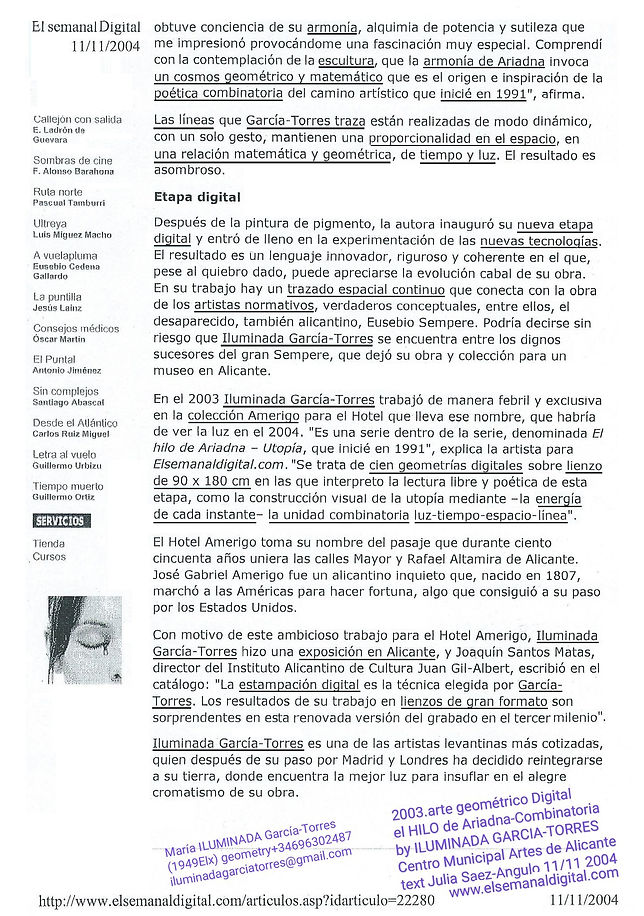

Crítica de Arte de Dámaso Santos Amestoy para el suplemento ABC Cultural:
exposición individual "EL HILO DE ARIADNA 1991-2002" de ILUMINADA GARCIA-TORRES (Elche 1949) en la Sala Municipal LA LONJA de ALICANTE, mayo 2002 y exposición colectiva "Des´de la otra riva" en Museu d´Art Contemporani d´EIVISSA, en julio y museo MACE de Elche-ELX, en septiembre, 2002.
Hace casi tres lustros que el sueño de la valiente e ingeniosa Ariadna fascinó a una pintora que devanaba el hilo de una propuesta geométrica singular. ILUMINADA GARCIA-TORRES venía practicando una pintura de virtuosa técnica realista, justo en el límite de lo que estaba a punto de convertirse en la nutrida corriente neo-metafísica, hoy vigente. Y un día descubrió en el Museo del Prado la estatua de la durmiente Ariadna de la que pintó varias versiones ensoñadas y «metafísicas». Hacía entonces unos cuadros realistas sobre motivos tan abstractos como cilindros y prismas que luego pasarían a su obra escultórica. De unas y otras cosas hay testimonio breve en esta retrospectiva. Indica —ya lo enseñaba Meyer Schapiro— la continuidad de la pintura abstracta con el arte figurativo precedente, incluido el de autoría propia.
El hilo de Ariadna que Iluminada declara en el título de esta exposición nos lleva a la pintura. Hilvana, si ya no el laberinto, un reverberante espacio imaginario. Hileras de cuadrados con líneas de trazos regulares, aunque sensibles, modulan el plano bidimensional; los bordes son indiferentes a la extensión de aquellos infinitos trazos-pincelada, al hilo de los cuales teje la pintura. Contraponen éstos la huella corporal y psicológica del ductus a la geometría del orden racional. Diálogo de la repetición y de la diferencia de la serialidad y la tonalidad, conjura la plenitud de la pintura moderna para que el cuadro, como decía Klee, no quede en «una buena alfombra» y sea capaz de convocar sin artificio ilusionista la presencia real de una tercera dimensión.
ILUMINADA GARCIA-TORRES (Elche 1949) teje el tapiz de los sueños, tapiz de los sueños de Ariadna.
Dámaso Santos Amestoy ABC Cultural Madrid, 1/6/2002 Nº 540
Art critic by Dámaso Santos Amestoy for the ABC Cultural supplement:
Solo exhibition "THE THREAD OF ARIADNE 1991-2002" by ILUMINADA GARCIA-TORRES (Elche, 1949) at the LA LONJA Municipal Gallery in ALICANTE. Colective Exhibition "Des´de la otra riva" at the Museum of Contemporary Art of EIVISSA (MACE) in July 2002 and the MACE Museum in Elche-ELX in September 2002.
Nearly fifteen years ago, the dream of the brave and ingenious Ariadne fascinated a painter who was spinning the thread of a singular geometric proposal. Iluminada García-Torres had been practicing a painting of virtuous realistic technique, right on the edge of what was about to become the prolific neo-metaphysical movement current today. One day, at the Museo del Prado, she discovered the statue of the sleeping Ariadne, of which she painted several dreamlike and "metaphysical" versions. At that time, she was creating realistic paintings based on motifs as abstract as cylinders and prisms, which would later transition into her sculptural work. This retrospective offers brief testimony to both. It indicates—as Meyer Schapiro once taught—the continuity of abstract painting with the preceding figurative art, including that of one’s own authorship.
The "Ariadne’s Thread" that ILUMINADA GARCIA-TORRES declares in the title of this exhibition leads us to painting itself. It stitches together, if no longer the labyrinth, a reverberating imaginary space. Rows of squares with regular yet sensitive lines modulate the two-dimensional plane; the edges remain indifferent to the extension of those infinite brushstroke-threads, along which the painting is woven. These contrast the corporal and psychological trace of the ductus with the geometry of rational order. Through a dialogue of repetition and difference, of seriality and tonality, she conjures the fullness of modern painting so that the work—as Klee used to say—does not remain merely "a good carpet," but is capable of summoning the real presence of a third dimension without illusionist artifice.
ILUMINADA GARCIA-TORRES (Elche, 1949) weaves the tapestry of dreams, the tapestry of Ariadne’s dreams.
Dámaso Santos Amestoy ABC Cultural Madrid, 06/01/2002 No. 540

El texto que proporcionas detalla la metodología pictórica de ILUMINADA GARCIA TORRES (Elche.1949) para su exposición "GEOMETRÍAS" de 1996 en el Instituto Alicantino de Cultura Juan Gil-Albert.
Aquí tienes los puntos clave de su técnica de "trazado espacial continuo" descrita en el documento:
1. El Sistema de Cuadrícula (Matriz Universo cada cuadrado)
-
La Base: Todo comienza con un cuadrado matriz dividido en 25 cuadrados exactos (una cuadrícula de 5x5).
-
Función: No es solo un dibujo, sino un "campo de actuación" donde cada cuadrado es un subcampo que condiciona el nacimiento de la obra.
2. La Acción Pictórica (El Trazo)
-
Pinceladas a Pulso: La artista visual ILUMINADA GARCIA TORRES realiza líneas de color a mano alzada, en proporción al tamaño de la superficie de los cuadrados.
-
Gesto Único: Cada línia es un solo trazo de pincel. La dirección, el sentido y la carga de pigmento (textura) dependen del estado físico y psicológico de la artista en ese instante.
-
Eco Emotivo: El texto define cada línea como un "eco de sí misma", donde una pincelada determina la calidad y dirección de la siguiente, creando una cadena de decisiones sucesivas.
3. Concepto de Obra Infinita
-
Bordes Provisionales: Para ella, los bordes del cuadro no son el final de la obra. Son "límites provisionales".
-
Al sistema se le pueden añadir más "cuadrados matriz" a los lados de los cuadrados, permitiendo que la obra crezca teóricamente de forma infinita y mantenga un potencial geométrico creciente.
Nota: El texto fue escrito por Segundo García, quien en ese entonces era el Director del Museo de La Asegurada (actual MACA - Museo de Arte Contemporáneo de Alicante


texto M. Carmen África Vidal Claramonte FASCINACIÓN POR EL ESPACIO. Diario INFORMACIÓN de Alicante, el 10 de junio de 1993.
Exposición COMBINABLES de ILUMINADA GARCIA TORRES
LA CAM ha ofrecido en su sala de la avenida Oscar Esplá 37, una exposición digna de ver. Se trata de la obra de ILUMINADA GARCIA TORRES (Elche 1949, Alicante), ilicitana de nacimiento y hoy afincada en Madrid. A primera vista, lo que nos ofrece es muy simple: hay cuadros de una primera época, aparentemente realista, profundamente metafísicos. Y otros de una etapa que inicia su andadura precisamente en Alicante: cuadros que son casi esculturas.
A Iluminada García le fascina el espacio, y en él juega con dos elementos básicos en su pintura, el cuadrado y el círculo, el cubo y el cilindro. En los cuadros anteriores, más realistas, se atisba, no obstante, esa obsesión por la forma geométrica y por el espacio: el inevitable atractivo de la serie de Salinas nos obliga a reflexionar sobre la soledad, sobre el silencio, sobre nuestra propia alma; y la maravillosa pintura que expone de Ariadna dormida pintada de espaldas, mira el infinito, acaso hacia adentro de nosotros mismos.
De ahí se pasa a los cuadros construidos con líneas y puntos, con rectángulos que han sido pintados de un solo trazo, y, así, ninguno es igual, todos son diferentes. Identidad, repetición y diversidad a un tiempo. A veces, deja espacio entre los rectángulos, espacios que podrá rellenar el observador con sus propias experiencias: los cuadros quedan infinitamente abiertos a interpretaciones variadas como observadores.
La única escultura que hay en la sala es una pequeñísima muestra de la labor realizada por la artista visual en ese campo. Siguiendo con los cuadrados y los cilindros, con la exactitud matemática de las medidas, pero al mismo tiempo con la tolerancia de los huecos, construye una escultura que nace de su acercamiento a objetos tan cotidianos como cajas o cubos que le sirven de referencia.
Pero además de crear pintura y escultura, Iluminada García-Torres, es capaz también de componer poemas.
Y, lo más importante, ese carácter interdisciplinar de la obra surge del mismo concepto estético.
El excelente catálogo que acompaña a la exposición muestra cómo ILUMINADA GARCIA TORRES, utiliza el lenguaje en sus cubos, componiendo así poemas de nuevo abiertos a lecturas infinitas.
Texto M. Carmen África Vidal Claramonte. Exposición COMBINABLES en Caja Ahorros del Mediterráneo, Alicante Avenida Oscar Esplá 37, del 5 de mayo al 9 de junio de 1993.
"FASCINATION WITH SPACE" is a text written by M. Carmen África Vidal Claramonte for the COMBINABLES exhibition by Iluminada García Torres, published in the INFORMACIÓN Daily Newspaper of Alicante on June 10, 1993.
The CAM has offered in its hall at Avenida Oscar Esplá 37, an exhibition worth seeing. It concerns the work of Iluminada García Torres (Elche 1949, Alicante), born in Elche and today settled in Madrid. At first glance, what she offers us is very simple: there are paintings from a first period, apparently realistic, deeply metaphysical. And others from a stage that begins its journey precisely in Alicante: paintings that are almost sculptures.
Iluminada García is fascinated by space, and in it she plays with two basic elements in her painting, the square and the circle, the cube and the cylinder. In the previous, more realistic paintings, one glimpses, nevertheless, the obsession with geometric form and with space: the inevitable attraction of the Salinas series forces us to reflect on solitude, on silence, on our own soul; and the wonderful painting she exhibits of Sleeping Ariadne painted from behind, looks at the infinite, perhaps toward the inside of ourselves.
From there, one passes to the paintings constructed with lines and points, with rectangles that have been painted with a single stroke, and, thus, none is equal, all are different. Identity, repetition, and diversity at one time. At times, she leaves space between the rectangles, spaces that the observer will be able to fill with their own experiences: the paintings remain infinitely open to varied interpretations like the observers themselves.
The only sculpture in the room is a very small sample of the work carried out by the visual artist in that field. Continuing with squares and cylinders, with the mathematical accuracy of the measurements, but at the same time with the tolerance of the gaps, she constructs a sculpture that is born from her approach to objects as everyday as boxes or cubes that serve as her reference.
But in addition to creating painting and sculpture, Iluminada García-Torres is also capable of composing poems.
And, most importantly, that interdisciplinary character of the work arises from the same aesthetic concept.
The excellent catalog that accompanies the exhibition shows how ILUMINADA GARCIA TORRES uses language in her cubes, thus composing poems again open to infinite readings.
COMBINABLES exhibition by Iluminada García Torres
The exhibition took place at the Caja de Ahorros del Mediterráneo in Alicante from May 5 to June 9, 1993.
This image documents a 1993 exhibition by the Spanish visual artist ILUMINADA GARCIA TORRES (born 1949, Elche).
Texto de Carmen Africa Vidal en el Diario INFORMACIÓN Alicante 10 junio 1993. The exhibition, titled "COMBINABLES TRAZADO ESPACIAL CONTINUO," was held at the Caja de Ahorros del Mediterráneo (CAM) in Alicante from May 20 to June 9, 1993.
Iluminada García-Torres is known for an "audacious and coherent" career that evolved from realistic figuration to geometric abstraction. Her work is characterized by:
-
Mathematical Patterns: She seeks harmony through proportional relationships between structures, often using the square as a base module.
-
Continual Spatial Tracing: Her system uses "brushstrokes of a single gesture" to create a continuous geometric flow across the canvas.
-
The "Ariadne" Influence: A significant portion of her geometric and digital work is inspired by the marble sculpture of Ariadne at the Museo del Prado, which she found fit a perfect mathematical pattern.
Key Works in the Image
The artwork shown includes both paintings and sculptures from her "Combinables" series.
-
Sculptures: The foreground features a large, interlocking geometric sculpture. A similar work titled "Combinables-Eje energético" (1999) is permanently installed in the Plaza de San Juan in Elche.
-
Paintings: The wall displays acrylic on canvas works where color and line rhythms are inscribed in mathematical relation to the space.
Her work is held in several public collections, including the Biblioteca Nacional de Madrid, the Museo de Arte Contemporáneo de Elche, and the Diputación de Alicante.
This image is a press clipping from the newspaper Diario INFORMACIÓN (Alicante), dated June 10, 1993. It reviews a solo exhibition by the Spanish visual artist Iluminada García-Torres (born 1949, Elche) titled "COMBINABLES," held at the Caja de Ahorros del Mediterráneo (CAM) in Alicante.
The exhibition marked a significant evolution in her career, transitioning from her earlier realistic and metaphysical style toward the geometric abstraction for which she is now best known

Este texto, titulado "Un Cuadrado," es una presentación escrita en 1993 por Segundo García (entonces director del Museo de la Asegurada de Alicante) para la exposición COMBINABLES de la artista visual Iluminada García-Torres (Elche.1949), en la Caja de Ahorros del Mediterráneo en ALICANTE.
Resumen de los puntos clave del análisis:
El Concepto del "Cuadrado"
El autor describe la obra de M. África Vidal Claramonte como una búsqueda de la armonía. El cuadrado no es solo una forma, sino una matriz donde se desarrolla un "cosmos de interdependencias matemáticas y geométricas".
Evolución Artística
-
Influencia Clásica: Menciona que en 1986-87 Iluminada García-Torres se enfrentó al "misterio de aquella escultura de Ariadna que pintó en dos lienzos en el Museo del Prado", una escultura clásica que le sirvió de pretexto para explorar la realidad
-
Hacia la Abstracción: El texto marca la transición desde esa etapa figurativa hacia una "etapa de equilibrios y esencialidades", donde los objetos se vuelven puramente geométricos, "ajenos a cualquier asunto que no sea su propia forma".
El Constructivismo y la Técnica
-
Rigor Geométrico: Define su trabajo como una incursión en el constructivismo, donde se concibe la "sustancia geométrica como origen y fundamento de toda realidad".
-
Presencia Humana: A pesar del rigor de las estructuras cúbicas y cilíndricas en la escultura, el autor del texto, Segundo García, destaca la sensibilidad del color y el "latido humano" en la firmeza de la pincelada única, sin retoques para realizar ILUMINADA GARCIA TORRES cada línea en su pintura.


Este texto es una introducción crítica escrita en 1993 por
José Manuel Álvarez Enjuto para el catálogo de la exposición "COMBINABLES" de la artista visual ILUMINADA GARCIA TORRES, celebrada en la Caja de Ahorros del Mediterráneo en ALICANTE,1993.
resumen de los puntos clave del análisis:
La Evolución hacia la Geometría
El autor describe una transición fundamental en la obra de Iluminada García-Torres García-Torres (Elche 1949):
-
Abandono de la arquitectura: Los elementos geométricos dejaron de ser parte de composiciones arquitectónicas para convertirse en el sujeto mismo del lienzo.
-
Hacia el volumen: El texto menciona el paso a formas cuadrangulares y cilíndricas, alcanzando una "disposición tridimensional" que roza la escultura.
-
Metamorfosis: Se detalla un proceso riguroso que va de la línea al radio, de este al diámetro, luego a la circunferencia y finalmente al cuadrado. Es una evolución "de la nada al ser".
La Filosofía de la Artista
-
Aislamiento creativo: Describe a la artista en su estudio trabajando de forma irrefrenable para resolver lo que ella consideraba el "paradigma".
-
Orden y Mística: El texto vincula la disposición numérica y geométrica con la poesía. Define conceptos clave para su obra:
-
Aritmética como orden, soledad y silencio.
-
La palabra como una extensión de las figuras geométricas.
-
Conclusión sobre su Estilo
El autor concluye que la pintura es inseparable de la propia ILUMINADA GARCIA TORRES "su alma es la pintura". Su trabajo se caracteriza por un diálogo entre:
-
Rectas divisiones y formalismos indiscutibles.
-
Exploración líneas "quintuplicadas".

_%20expo%20CajaA.jpg)
Esta imagen muestra una página interior del catálogo de la exposición "COMBINABLES - Trazado Espacial Continuo" de la artista visual ILUMINADA GARCIA TORRES, celebrada en la sala de exposiciones de la Caja de Ahorros del Mediterráneo (CAM) en Alicante, del 20 de mayo al 9 de junio de 1993.
Detalles del Catálogo y la Obra
-
Contenido: El catálogo documenta una etapa crucial en la que la artista integró la pintura, la escultura y el arte digital bajo un lenguaje de abstracción geométrica.
-
Conceptos visuales: La página de la izquierda muestra un diagrama conceptual con términos como "Trazo", "Línea", "Infinito" y "Comunicación", que forman parte de su investigación sobre la geometría generativa.
-
Escultura: La imagen de la derecha presenta una de sus piezas escultóricas características, donde utiliza cilindros y planos metálicos para explorar el espacio y el ritmo visual.
ILUMINADA GARCIA TORRES nacida en Elche en 1949, es una figura relevante del arte geométrico normativo en España. Su trabajo se caracteriza por:
-
Evolución: Transitó desde una figuración realista hacia una abstracción matemática influenciada por su paso por el Centro de Cálculo de la Universidad Complutense y la enseñanza de Eusebio Sempere.
-
Series destacadas: Además de Combinables, ha desarrollado series como Trazado Espacial Continuo y El Hilo de Ariadna, donde los conceptos de musicalidad y color son fundamentales.
-
Presencia pública: Cuenta con obras en espacios urbanos, como la escultura "Combinables-Eje" (1999) en la Plaza de San Juan en Elche.


%20.jpg)


"Between the One, the Two, and the Three"
Catalogue text by Isabel Tejeda May 2001
Exhibition "Continuous Spatial Tracing paintings",
"COMBINABLES ceramic sculptures"
by ILUMINADA GARCÍA-TORRES
exhibition Casa Cultura de El CAMPELLO (Alicante), May 12 – June 20, 2001
Years ago, ILUMINADA GARCÍA-TORRES (Elche 1949, Alicante) evolved from figurative painting to abstraction. Her earlier work drew inspiration from the silence of Morandi and the obsession with capturing essence characteristic of Antonio López. At just 16, she was López's student at the San Fernando Royal Academy of Fine Arts in Madrid, and she would paint with him again twenty years later in a workshop he led at the Círculo de Bellas Artes.
Last year, at the Institut Municipal de Cultura in Elche, ILUMINADA GARCIA-TORRES presented a magnificent exhibition curated by Isabel Chinchilla, who perfectly understood the painter's evolutionary process. Under the title "La Esencia de Ariadna" (The Essence of Ariadne), Vicente Verdú highlighted in the exhibition catalogue the profound impact that encountering the sculpture of the mythological goddess (Sleeping Ariadne) from the Prado Museum had on Iluminada’s artistic trajectory. She painted that sculpture in the mid-80s alongside impressive still lifes of geometric objects. In his text, Verdú accurately reasoned the logic and evolutionary coherence of the Elche-born painter's transition from figuration to abstraction.
I completely agree with Verdú’s assessment. The pictorial analysis of Iluminada García-Torres is built upon the classic constant of representing essences and their paradoxical application to transitory concepts such as time and light.
Light. I remember the vibrant palette used in the works from last year’s exhibition. At its core, the minimalist aspect of her series "Continuous Spatial Tracing"—which reached its climax around 1993 with impeccable geometries close to the emotional purism of Mitsuo Miura—was still lingering in that work. Some of those paintings, which were truly excellent, hid something beyond words—something not as easily defined as the formal conventions and pacts we constantly make.
In ILUMINADA GARCÍA TORRES's current exhibition, these chromatic vibrations have been eliminated. In fact, she takes a risk by stripping away much of her color palette, sticking only to a few primaries she previously used during her time in London. Now, she incorporates black. The question of light is partially diluted to focus on composition and, fundamentally, the discourse of the line. She is gradually refining her work, removing everything she already knows—to avoid creative tics—or elements she considers anecdotal.
At first glance, this painting could be linked to Minimalism or even certain aspects of Eusebio Sempere's work; however, a more detailed reading points in a different direction. It establishes a subtle formal relationship between those 1960s and 70s trends and the Abstract Expressionism of Rothko.
They are lines drawn obsessively, analyzing the rhythms that emerge from the path of their trajectory within the proportional relationships established with the space contained in the modules. Modules which, according to ILUMINADA GARCÍA-TORRES, hide the laws of harmony beneath their cloak. It could be a rational, meditated composition, and in principle, it is. However, a physical closeness to each stroke reveals that they do not follow a unifying model. On the contrary, they bring an impossibility to the fore: achieving the absolute difference of every single line from all others in the painting. From the totality of lines in the paintings that make up the series. From all the series of stripes begun in the early 90s. From all the painted lines in the world.
The hand and the moment of its production are evidenced, albeit quite subtly; a time of painting that intends to drag the time of perception along with it. At its core, it is a far from trivial matter: the transmission of emotions. And where is the emotion in Rothko? I find that, beyond the empathy the American painter creates from several meters away, it lies in what is hidden, in the vibration of the interstices, in a centimeter of cobalt blue beneath meters of oranges and yellows. In that tiny point. And everything else is placed at its service.
Within the neatly arranged modules of Iluminada García-Torres’s paintings, one glimpses varying degrees of emotion, tension, relaxation, restraint, passion, coldness, agitation, weakening, inhibition, shock, detachment, vibration, enthusiasm, tepidity, exhaustion... of the moment of painting itself. Lichtenstein already proposed this, albeit ironically, when he designed his large-format brushstroke with Ben-Day dots. And it is the praise of that brushstroke, though silent, upon which ILUMINADA GARCIA- TORRES disturbingly insists. At times grandiloquently, at others like a mantra. Timidly. With the rhetoric of repetition. Less spectacular, yet also more surprising.
In her latest work, begun less than a year ago in a ceramics workshop organized by the Fundación Capa, Iluminada García-Torres speaks in three dimensions. These are initial investigations into the experience of boundaries that she had already touched upon in sculpture. What happens at the boundaries? What happens in the shift from one form to another? From a wave to an angle, for example. These are never obvious questions; they contain the elemental, the fundamental aspects of geometric expression.
Numbers go on to infinity. However, if one wishes to glimpse anything at all, it is necessary to analyze to the point of exhaustion the infinite relationships between 1, 2, and 3.
Catalogue exhibition by ILUMINADA GARCÍA-TORRES Casa Cultura de El CAMPELLO (Alicante), May 12 – June 20, 2001
"entre el uno, el dos y el tres"
Texto catálogo de ISABEL TEJEDA mayo, 2001
Exposición "pintura Trazado Espacial Continuo",
"escultura cerámica COMBINABLES"·
by ILUMINADA GARCÍA-TORRES
exposición en Casa Cultura de El CAMPELLO (Alicante), 12 mayo-20 junio 2001
Hace años que ILUMINADA GARCIA TORRES (Elche 1949. Alicante) evolucionó de la pintura figurativa a la abstracción; una pintura aquella que tenía como grandes referentes el silencio de Morandi y la obsesión por captar las esencias de Antonio López, de quien, con tan sólo 16 años fue su alumna en la Escuela Superior de Bellas Artes de San Fernando en Madrid y con el que volvería a pintar veinte años después en el Taller que éste pintor impartió en el Círculo de Bellas Artes.
El pasado año en la Sala del Institut Municipal de Cultura de Elx, Iluminada García-Torres presentaba una magnífica exposición cuya comisaria, Isabel Chinchilla, entendió a la perfección el proceso evolutivo de esta pintora. Bajo el título "La Esencia de Ariadna", Vicente Verdú subrayaba en el catálogo de aquella muestra la trascendencia que ha significado para la trayectoria plástica de Iluminada, el encuentro con la escultura de esa diosa mitológica (Ariadna dormida) perteneciente al Museo del Prado que allí pintó a mediados de la década de los 80 junto a unas impresionantes naturalezas muertas de objetos geométricos. En aquel texto razonaba acertadamente este escritor sobre la lógica y la coherencia evolutiva que transitaba de la figuración a la abstracción en la obra de la pintora ilicitana.
Y estoy absolutamente de acuerdo con Verdú en esta apreciación concreta, ya que el análisis pictórico de Iluminada García-Torres se asienta sobre la constante clásica de la representación de las esencias y su paradójica aplicación a conceptos transitorios como son el tiempo y la luz.
Luz. Recuerdo la vibrante paleta utilizada en las obras de la muestra del pasado año. En el fondo, el aspecto minimalizador de su trabajo "Trazado Espacial Continuo" - que tuvo hacia 1993 su clímax en unas impecables geometrías. cercanas al purismo emocional de Mitsuo Miura- seguía rondando por este trabajo. Algunos de estos cuadros, realmente excelentes, escondían sin embargo algo más que se escapa a lo verbal, que no es tan sencillo de definir como las convenciones y los pactos formales que hacemos constantemente.
En la exposición actual de ILUMINADA GARCIA TORRES se eliminan estas vibraciones cromáticas. De hecho juega y arriesga al eliminar también parte de la paleta de colores para quedarse sólo con algunos, los primarios, que ya utilizó durante su estancia en Londres. Ahora incorpora el negro. Se diluye parcialmente la cuestión de la luz para centrarse en la composición y, fundamentalmente, en el discurso de la línea. Va limpiando paulatinamente su trabajo eliminando todo aquello que ya conoce -para intentar esquivar los tics- o los elementos que considera anecdóticos. En principio esta pintura, que podría relacionarse con el Minimal e incluso con algunos aspectos de la obra de Eusebio Sempere, señala en una lectura más detallada hacia otro camino. Establece una sutil relación formal entre estas tendencias de los años sesenta y setenta y el expresionismo abstracto de Rothko.
Son líneas dibujadas obsesivamente en las que se analizan los ritmos que se desprenden en la trayectoria de su trazado dentro de las relaciones de proporcionalidad establecidas con el espacio contenido de los módulos. Módulos que, según ILUMINADA GARCIA TORRES, esconden tras su manto las leyes de la armonía. Podría tratarse de una composición racional, meditada, y de hecho en principio lo es. Sin embargo un acercamiento físico a cada trazo evidencia que no responden a un modelo unificador. Bien al contrario ponen en la palestra un imposible: conseguir la diferencia absoluta de cada una de las líneas con el resto de las que se sitúan en el cuadro. Con la totalidad de las líneas de los cuadros que conforman la serie. De todas las series de rayas iniciadas a principios de los años 90. De todas las líneas pintadas del mundo.
Se evidencia, si bien de manera harto sutil, la mano y el instante de su producción; un tiempo de la pintura que pretende arrastrar con él al tiempo de la percepción. En el fondo se trata de una cuestión nada banal: la transmisión de emociones. ¿Y dónde está la emoción en Rothko? Encuentro que, amén de la empatía que el pintor americano crea a la vista de varios metros, se haya en lo oculto, en la vibración de los intersticios, en un centímetro de azul cobalto bajo metros de naranjas y amarillos. En ese pequeño punto. Y todo lo demás se pone a su servicio.
En los módulos ordenadamente dispuestos de los cuadros de Iluminada García-Torres se entreven los distintos grados de emoción, tensión, relajo, contención, pasión, frialdad, agitación, debilitamiento, freno, conmoción, alejamiento, vibración, entusiasmo, tibieza, desgaste..., del instante de la pintura. Ya lo planteó, aunque de manera irónica, Lichtenstein cuando diseñó su brochazo de gran formato con puntos bendéi. Y es el elogio de ese brochazo, aunque callado, en el que insiste perturbadoramente ILUMINADA GARCIA TORRES. A veces de forma grandilocuente, otra como en un mantra. De manera tímida. Con la retórica de la repetición. Menos espectacular pero también más sorprendente.
En su último trabajo, iniciado hace ahora algo menos de un año en un taller de cerámica organizado por la Fundación Capa, ILUMINADA GARCIA TORRES habla en tres dimensiones. Son unas primeras investigaciones sobre la experiencia de los límites que ya había tocado en la escultura. ¿Qué ocurre en los límites? ¿Qué ocurre en el cambio de una forma a otra? De una onda a un ángulo, por ejemplo. Cuestiones éstas nunca obvias que encierran lo elemental, los aspectos basales de la expresión geométrica.
Números hay hasta el infinito. Sin embargo, si se quiere vislumbrar algo es preciso analizar hasta la saciedad las relaciones infinitas entre el 1, el 2 y el 3.
Catálogo Exposición de ILUMINADA GARCÍA-TORRES en Casa Cultura de El CAMPELLO (Alicante), 12 mayo-20 junio 2001
iluminadagarciatorres.blogspot.com
diagram-musicality.blogspot.com
combinable-numerical.blogspot.com 2001


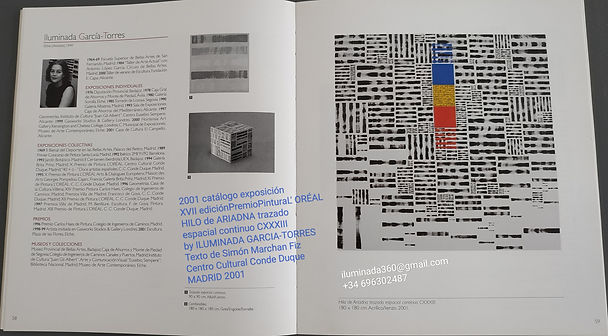

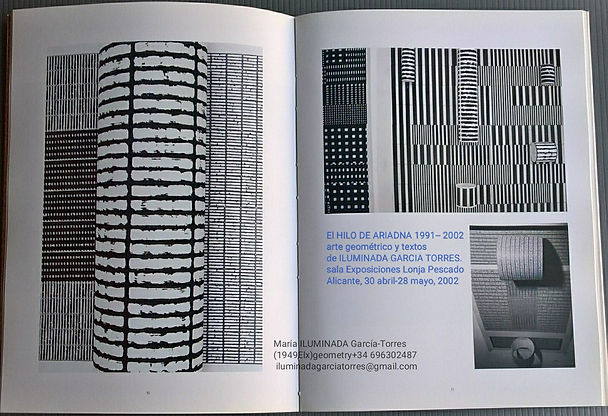
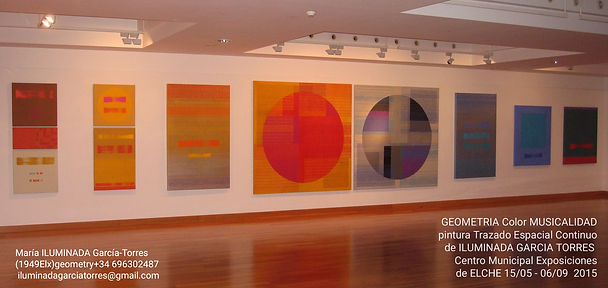
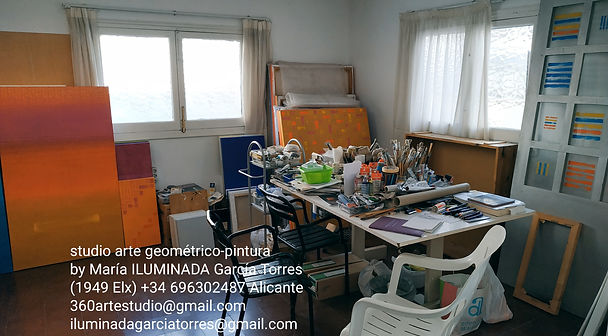

Soy un párrafo. Haz clic aquí para agregar tu propio texto y edítame. Es muy sencillo.
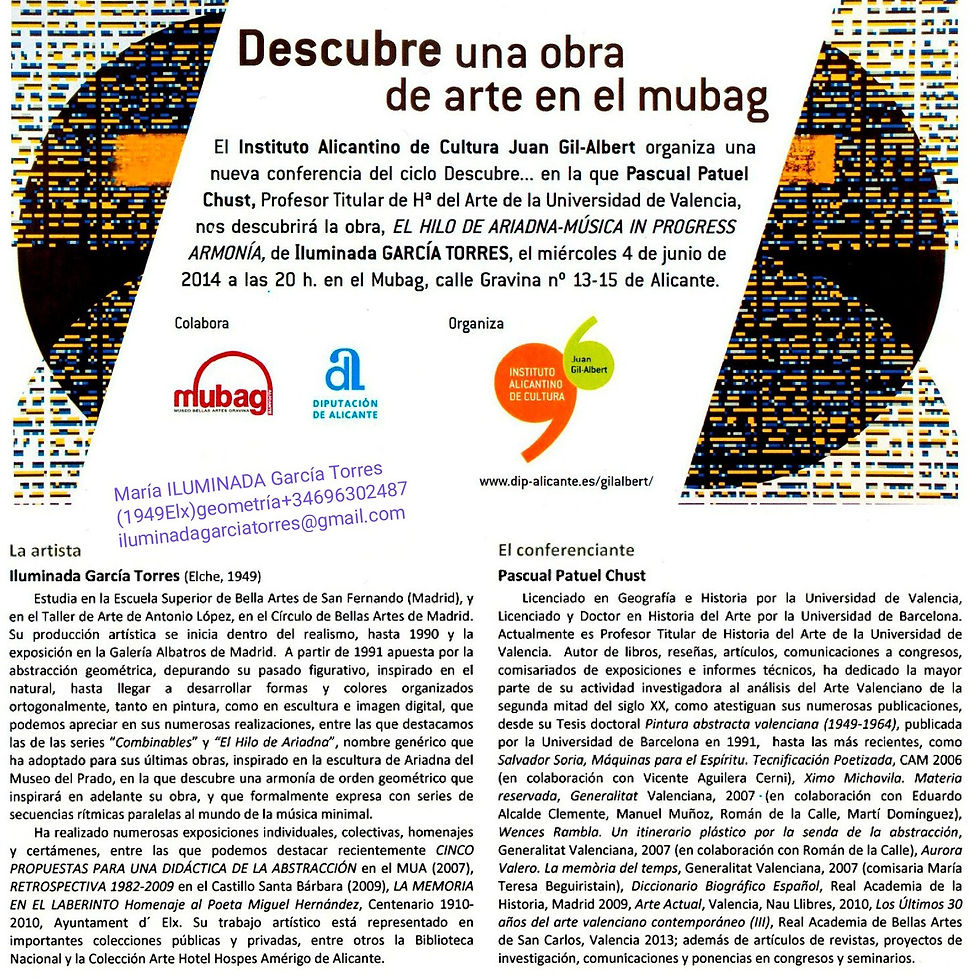
.jpg)
Mª ILUMINADA GARCIA TORRES (1949 Elche, Alicante)
(+34) 696302487 arte geométrico iluminadagarciatorres@gmail.com
www.elhilodeariadna.net
iluminadagarciatorres.blogspot.com
CATÁLOGOS
https://360artestudio/arte-geometrico/catalogs-iluminada-garciatorres
exposiciones de ARTE GEOMÉTRICO en ALICANTE de Mª ILUMINADA GARCIA TORRES (1949Elx Alicante)
Diputación Provincial Alicante Cultura T. 965 98 89 00 C/Tucumán 8, 03005 Alicante
exposición 1993, Caja Ahorros del Mediterráneo, Oscar Esplá 37 Alicante. (Fundación Mediterráneo T. 966 012 540)
Instituto Alicantino de Cultura, IAC Juan Gil-Albert T.965 12 12 14 C/San Fernando 44, 03001Alicante
exposición 1996 GEOMETRIAS
https://exposiciónGEOMETRIAS/ILUMINADA-GARCIA-TORRES/instituto-cultura-juan-gil-albert-Alicante-1996
lines-among-musicality.blogspot.com-CondeDuque
exposición 2003, Centro Municipal de las Artes de Alicante/Ayuntamiento
T. 965 14 71 60. Plaza de Quijano 2, 03002 Alicante
pixel-pixels-design.blogspot.com2003
https://el-hilo-ariadna-combinatoria-by-ILUMINADA-GARCIA-TORRES/centro-municipal-artes-Alicante-2003
1982-2009 RETROSPECTIVA de Mª ILUMINADA GARCÍA TORRES, exposición en cuatro salas del Castillo de Santa Bárbara de Alicante
https://2009-El-Salt-n17-IAC-Instituto-Alicantino-Cultura-Juan-Gil-Albert/María-ILUMINADA-Garcia-Torres-Alicante-2009/
https://ILUMINADA-GARCÍA-TORRES/retrospectiva-1982-2009/expo-castillo-santa-barbara-Alicante-2009
Iluminada-García-Torres, Exposición retrospectiva en el Castillo de Santa Bárbara-2009
exposición EL HILO DE ARIADNA 1991-2002, Lonja del Pescado de Alicante. Paseo Almirante Julio Guillén Tato s/n. 03001 Alicante
https://geometria/el-Hilo-de-Ariadna-1991-2002-by-ILUMINADA-GARCIA-TORRES-exposicion-AIicante-2002
Casa Cultura de EL CAMPELLO (Alicante) exposición arte geométrico Pintura y escultura cerámica 2001
https://360artestudio/arte-geometrico/2001-texto-de-natalia-molinos-exposicion-pintura-escultura-ceramica-by-iluminada-garciatorres
2006 arte geométrico digital by Mª ILUMINADA GARCIA-TORRES (1949ELX) exposición
Colegio Territorial Arquitectos Alicante CTAA.
https://360artestudio/pixels-lines-dots/2006-ctaa-digital-iluminada-garciatorres
/geometría-digital-iluminada-garcia-torres/
24.01- 28.02 2007 Museo Universidad Alicante MUA exposición Cinco Propuestas para una Didáctica de la Abstracción participa/ILUMINADA GARCÍA-TORRES (1949) arte geométrico DIGITAL
https://2007-Museo-Universidad-Alicante/-participa-exposicion-Iluminada-Garcia-Torres-2007/
ATENEO Científico, Literario y Artístico de ALICANTE C/Navas 32 03001Alacant T.965142405. exposición 2014
https://ariadne-thread-music-by-ILUMINADA-GARCIA-TORRES-geometry-digital/Ateneo-Alicante-2014
https://lamiradaactual.blogspot.com/2014/10/iluminada-garcia-torres-expone-su.html
thethreadofariadne-musicality.blogspot.com2014
CULTURA de ELCHE-ELX, T 966 65 82 20, Museu Art Contemporani de ELX-EIVISSA 2002, exposiciones de Arte geométrico de Mª ILUMINADA GARCIA TORRES (1949Elx Alicante)
exposiciones, 2000, 2002, 2015 en Centro Municipal Exposiciones de Elche-Elx, Plaza de San Joan
https://geometria-color-musicalidad-by-ILUMINADA-GARCIA-TORRES-exposicion-Elche-2015
http://lamiradaactual.blogspot.com.es/2015/06/iluminada-garcia-torres-geometria-color.html
https://Museu-Art-Contemporani-de-EIVISSA-y-ELCHE-ELX-exposicion-Desde-la-Altra-Riba-participa-ILUMINADA-GARCIA-TORRES-2002
spatial-layout.blogspot.com-LONDON-1998-2000
exposición, MÚSICA y ARTE II, 15 pintores valencianos del siglo XXI. catálogo 46, en el PALAU de la MÚSICA de VALENCIA. PENTAGRAMAS DIGITALES de Mª ILUMINADA GARCIA-TORRES (1949Elx Alicante)
musicalidad-numerica.blogspot.com2004
1994 CENTRO CULTURAL CONDE DUQUE MADRID
exposición, 40+ó DOCE ARTISTAS/
exposición serigrafía, 1995 Galería BRITA PRINZ
https://1995-galeria-Brita-Prinz/serigrafias-MariaILUMINADA-GarciaTorres(1949Elx)-Madrid1995
VI MUESTRA ARTE ELECTRÓNICO DE MÓSTOLES MAEM 07, MADRID (29-octubre-16-noviembre 2007)
https://geometria-digital/2007-ArteElectronicoMostoles-Madrid/iluminada-garcia-torres
http://listalab.es/blog/index.php/maem07-osmosis/maem07-artistas-participantes/iluminada-garcia-torres/
LONDON UK. Geometric Art by Mª ILUMINADA GARCIA TORRES (1949Elx Alicante)
exhibition, Kensington and Chelsea College Hortensia Gallery. 12 January 2000 LONDON
Gasworks Studios 1DEC1998 - 1 MAR1999
https://gasworks.org.uk/residencies/iluminada-garcia-torres/#.XhjFjuwO2LE.gmail
http://spatial-layout.blogspot.com/2020/12/iluminadagarciatorres.html
http://toa-musicality.blogspot.com/2020/12/iluminadagarciatorres.html
selección arte Geométrico by Mª Iluminada García-Torres en CONCURSOS Arte Contemporáneo, MADRID CENTRO CULTURAL CONDE DUQUE 1994-95-96-97. 2001-2002
https://ILUMINADA-GARCIA-TORRES-concursos-Premio-Pintura-L'OREAL-X-XI-centro-cultural-CONDE-DUQUE-MADRID-1994-1995
https://premios-Villa-de-Madrid/Pintura/by-Iluminada-Garcia-Torres(1949)-CC-CondeDuque-Madrid-1997/
selección arte Geométrico by Mª Iluminada García-Torres en CONCURSOS Arte Contemporáneo, ALICANTE
https://geometria-digital-El-Hilo-de-Ariadna-Musica-in-progress-Armonia-by-ILUMINADA-GARCIA-TORRES-convocatoria-Artes-Plasticas-2008-Diputacion-de-ALICANTE-2008
https://Geometria-Digital-75AE-by-ILUMINADA-GARCIA-TORRES-IV-certamen-UMH-IBERDROLA-2006
CATÁLOGOS exposiciones de PINTURA REALISTA de Mª ILUMINADA GARCIA TORRES (1949Elx)
https://1990-madrid-galeria-albatros-expo/pintura-de-escultura-ariadna-by-iluminada-garcia-torres/
https://1985-ILUMINADA-Garcia-Torres-(1949)/exposición-Torreón-de-Lozoya-SEGOVIA-1985/
https://pinturas-de-ILUMINADA-GARCIA-TORRES-exposición-Galeria-Sorolla-ELCHE-1979
trazadoespacialcontinuo.blogspot.com CV
https://iluminadagarciatorres/arte-geometrico
https://lamiradaactual.blogspot.com/2019/11/retrato-iluminada-garcia-torres.html
https://lamiradaactual.blogspot.com/2020/06/iluminada-garcia-torres-la-geometria-y.html
https://360artestudio/arte-geometrico/catalogs-iluminada-garciatorres
%20e.jpg)
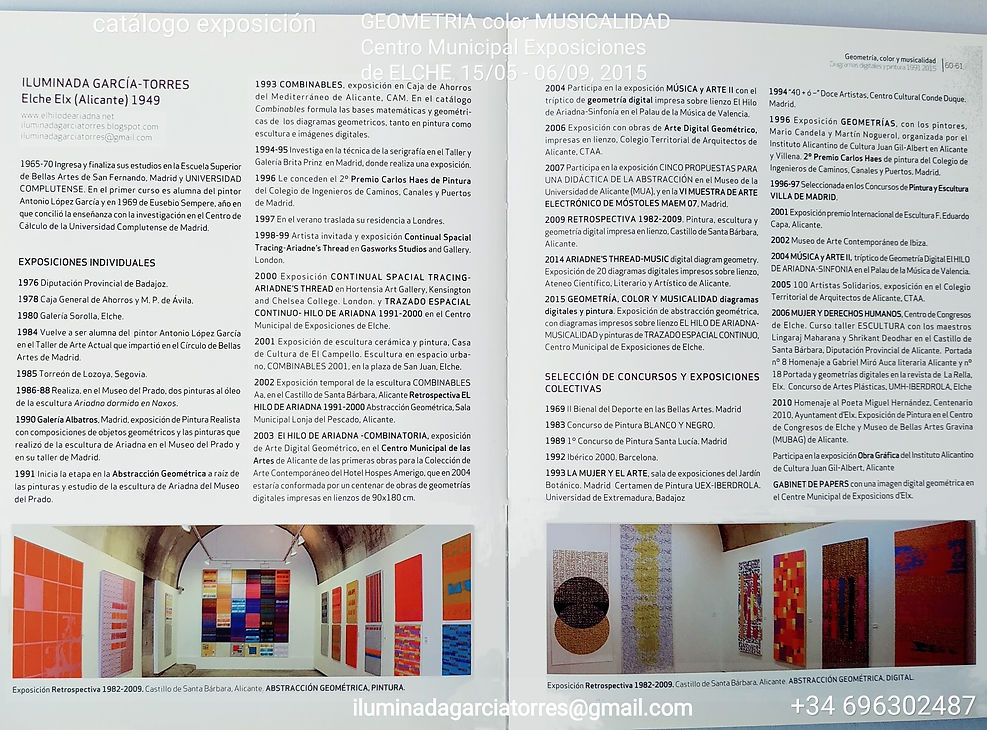%20Centro%20Municipal%20Exposicio.jpg)
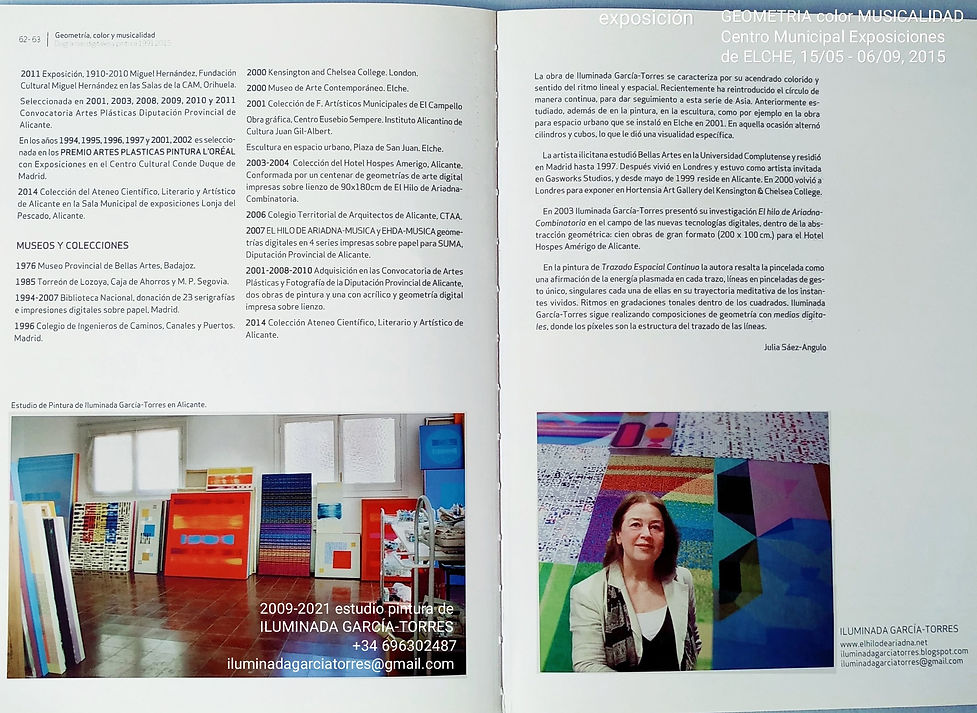%20Centro%20Municipal%20Exposicio.jpg)
+34 696302487
https://www.instagram.com/iluminadagarciatorres/
https://avam.es/artistas/iluminada-garcia-torres/
https://www.elche.me/biografia/garcia-torres-iluminada
linkedin.com/in/iluminada-garcia-torres-793189326
https://www.avvac.net/asociados/ ILUMINADA GARCÍA-TORRES
iluminadagarciatorres@gmail.com
MADRID+34 696302487 digital geometría
https://iluminadagarciatorres/arte-geometrico
https://iluminadagarciatorres/pixels-lines-dots
https://iluminadagarciatorres/lines-continuousdata
iluminadagarciatorres.blogspot.com
spatial-drawings.blogspot.com-blogs
https://by ILUMINADA GARCIA TORRES/COMBINABLES 1993
lines-among-musicality.blogspot.com CondeDuque
spatial-layout.blogspot.com LONDON-1998-2000
gravitationalwaves-music.blogspot.com
pixel-pixels-design.blogspot.com 2003
thethreadofariadne-music.blogspot.com 2014
elhilodeariadna-musicalidad.blogspot.com 2015
trazadoespacialcontinuo.blogspot.com CV
elhilodeariadna-musicalidad.blogspot.com 2015
geometria-color-musicality.blogspot.com 2015
thethreadofariadne-musicality.blogspot.com 2014
music-numerical.blogspot.com Berlin 2015
musica-numerico.blogspot.com Madrid 2015
numerical-musicality.blogspot.com Europa
musicality-numerical.blogspot.com mumbai 2015
lines-numerical.blogspot.com Sweden 2015
music-numerical-drawings.blogspot.com AFRICA
cartography-musicality.blogspot.com NY
musicality-numerical-drawings.blogspot.com tokyo
continuous-spatial-design.blogspot.com PARIS
gravitationalwaves-music.blogspot.com1990
net-drawings.blogspot.com 1976-90
https://youtu.be/8PmuVJpX0ws?si=Hlqk8hFwsZEkKQEo
drawings-line.blogspot.com 1994-7
lines-among-musicality.blogspot.com concurs
spatial-layout.blogspot.com LONDON 1997-2000
net-squares-lines.blogspot.com 2000
combinable-numerical.blogspot.com 2001
numerical-design.blogspot.com 2002
pixel-pixels-design.blogspot.com 2003
musicalidad-numerica.blogspot.com 2004
ehda-music.blogspot.com suma2007
el-hilo-digital.blogspot.com 2005-07
https://fmarch.orex.es/cgi-bin/koha/opac-detail.pl?biblionumber=188127
pixelbylight.blogspot.com mua2007
among-lines.blogspot.com 2009retrospctv
2011 exposición GABINETE DE PAPEL 2011
https://www.arteinformado.com/agenda/f/gabinete-de-papel-44910
spatial-drawings.blogspot.com bio
combinable-combinables.blogspot.com catalog
https://ILUMINADA-GARCÍA-TORRES/retrospectiva-1982-2009/expo-castillo-santa-barbara-Alicante-2009
https://ariadne-thread-music-by-ILUMINADA-GARCIA-TORRES-geometry-digital/Ateneo-Alicante-2014
https://geometria-color-musicalidad-by-ILUMINADA-GARCIA-TORRES-exposicion-Elche-2015
net-squares-lines.blogspot.com 2000
https://es.wikipedia.org/wiki/Vicente_Verdú
elhilodeariadna-combinatoria.blogspot.com 2021
https://drive.google.com/2021-catalogo/art-contemporani-de-la-generalitat-valenciana-iv-pag-246-iluminada-garcia-torres/
iluminadagarciatorres.blogspot.com
Mª Iluminada García-Torres
Paseo de Goya 21, esc D, bajo B
28932 Móstoles, Madrid
Iluminada García-Torres. studio
Avda Alcalde de Móstoles 14, 6ºC
28933 Móstoles, Madrid
iluminadagarciatorres@gmail.com
MADRID+34 696302487 digital geometría
musicality-numerical-drawings.blogspot.com
continuous-spatial-design.blogspot.com
geometry-color-musicality.blogspot.com
numerical-drawings.blogspot.com
numerical-combinable.blogspot.com 1993
gravitationalwaves-sound.blogspot.com
pixels-drawing.blogspot.com-2003
presentcontinuous-music.blogspot.com
toa-musicality.blogspot.com
waves-waves-waves.blogspot.com
waves-waves-waves-waves-waves-waves.blogspot.com
pixelbylight.blogspot.com
light-pixels.blogspot.com
pixel-de-luz.blogspot.com
MARIA ILUMINADA GARCIA TORRES
Alicante. España, SPAIN
(+34) 696302487 geometric art
iluminadagarciatorres@gmail.com
iluminada360@gmail.com
360artestudio@gmail.com
iluminadagarciatorres.blogspot.com
spatial-drawings.blogspot.com-blogs
https://360artestudio/arte-geometrico/catalogs-iluminada-garciatorres
Curriculum Vitae-artes visuales desde 1965
de MARIA ILUMINADA GARCIA-TORRES (22/enero/1949 ELCHE, Alicante España).
Comienzo los estudios de Profesora de Dibujo en 1965, en la Escuela Superior de Bellas Artes de San Fernando de MADRID, cuando aprobé el examen de INGRESO, que consistía en hacer un dibujo al carboncillo de una estatua clásica de grandes dimensiones. Finalizo los cinco cursos de la carrera en 1970 en la Universidad Complutense, Facultad de Bellas Artes (1965-1970).
trazadoespacialcontinuo.blogspot.com CV
Destacar la influencia de la obra pictórica y enseñanza del pintor realista Antonio López García del que fui alumna en el primer curso Preparatorio (1965-66) en la Escuela Superior de Bellas Artes de San Fernando, Madrid y en el Taller de Arte Actual (1984) que impartió en el Círculo de Bellas Artes de Madrid. Influencia que se reflejaría cuando años después inicié mi etapa de Arte Geométrico (1991), en la acción pictórica, la medida y el gesto directo.
net-art-drawings.blogspot.com
combinables.blogspot.com-1993
https://iluminadagarciatorres/arte-geometrico
Un hecho significativo en mi proceso creativo en las artes visuales fue pintar al óleo dos lienzos (121x114cm y 130x146cm) desde 1986 a 1988, en el MUSEO NACIONAL del PRADO, Madrid, de la escultura clásica de mármol, ARIADNA dormida en Naxos. El pintor Antonio López García, Premio Príncipe de Asturias de las Artes (1985) avaló con su firma la solicitud para que me concedieran el carnet de copista del Museo, necesario para poder pintar esa estatua clásica, situada en la Rotonda de cristales, sala de las Musas del Museo del Prado, de la que supe, mientras pintaba, que el pintor VELÁZQUEZ (1599-1660) la trajo de Roma para el rey Felipe IV, y en un viaje a Roma (1650) la pintó en el lienzo (44x38cm), Vista del jardín de la Villa Medicis-El mediodía, que se exhibe en el Museo del Prado. (Mitología griega- el Hilo de Ariadna). La primera pintura de la estatua (1987) se mostró en la exposición, LA MITOLOGÍA CLÁSICA en la Pintura y Escultura Actuales, en el Centro Cultural Galileo (1995) y la segunda pintura de la escultura (1988) la mostré junto a composiciones pictóricas de objetos geométricos de influencia metafísica y arquitectónica en la Galería Albatros de MADRID (1990), que resultó ser la última exposición de mi época de pintura realista (1965-1990), que sin ser consciente de lo que sucedería después, le anticipé, a Miguel Fernández-Cid en la entrevista que me hizo y que publicó en DIARIO 16 (5-diciembre 1990), que me motivó tanto pintar los dos lienzos de la estatua clásica ARIADNA dormida en Naxos en el Museo del Prado que, << sé que volveré a partir de esta Ariadne, porque me resulta imposible olvidar su perfección, su armonía, su control matemático>>. Cuando se clausuró esta exposición dediqué el tiempo en hacer una revisión y dejar mi futuro abierto y preguntarme si lograría encontrar una nueva manera expresiva fui adentrándome en el Arte Geométrico y entonces volví a la escultura clásica de mármol, pero expresándola en la poética de mi obra de arte geométrico, El Hilo de Ariadna-Trazado Espacial Continuo, a partir del texto que escribí y se publicó (1995) en el catálogo del Premio de Pintura L'ORÉAL Arte Contemporáneo con exposición en Centro Cultural Conde Duque de Madrid.
Desde que fui alumna del pintor cinético, Eusebio Sempere (1923-1985), durante los meses que este fue profesor en la Facultad de Bellas Artes de la Universidad Complutense (1969) al tiempo que investigaba en el Seminario de Generación Automática de Formas Plásticas en el Centro de Cálculo de la Universidad Complutense y nos animaba a los que éramos sus alumnos para que asistiéramos a dicho Seminario, explicándonos la investigación que hacían los pintores participantes apoyados por informáticos del Centro de Cálculo e ingenieros de IBM, me dio a conocer las posibilidades de la Informática en el arte, que nunca olvidé, y que fue decisivo para fundamentar mi investigación desde el comienzo (1991) en términos matemáticos y geométricos.
Mi Propuesta en ARTE GEOMÉTRICO, Sistemático, Constructivo y Generativo la escribí y publiqué en el catálogo de la exposición COMBINABLES, TRAZADO ESPACIAL CONTINUO (1993) en la Caja de Ahorros del Mediterráneo CAM, de Avenida Oscar Esplá 37, en ALICANTE (1993).
El resultado de la investigación origen de mi propuesta consistió en la formulación de relaciones de proporcionalidad matemática y geométrica de las líneas inscritas en el espacio del sistema Continuo de cuadrados, con la misma base conceptual interdisciplinar de las obras Pictórica, Poética, Escultórica y Digital con programas de diseño con los nuevos avances tecnológicos para aplicar en el proceso creativo a mis obras en, COMBINABLES, TRAZADO ESPACIAL CONTINUO (1991) Hilo de Ariadna, plasmando en la acción pictórica de las LÍNEAS, -la medida y el gesto directo-, único de la pincelada para expresar la singularidad de cada línea y en el espacio exacto de cada CUADRADO en la composición, de la misma manera que en las obras de geometría generadas mediante computación, y, el PUNTO, circunferencias y círculos en composiciones libres.
En sentido Poético PALABRAS GEOMÉTRICAS y en escultura, el CUBO y el CILINDRO y la diversidad de sus segmentos integrados en el sistema modular de formas planas y curvas y con la LUZ ya sea estática o en movimiento, que proyecta nuevos rítmos geométricos al incidir en los elementos.
https://iluminadagarciatorres/pixels-lines-dots
Vivía y tenía el estudio en Madrid donde pensaba exponer, pero, en un viaje a Alicante conoció mi propuesta en Arte Geométrico el Catedrático de Dibujo y Director del Museo de la Asegurada Colección Eusebio Sempere (MACA Museo de Arte Contemporáneo de Alicante), Segundo García Manzanet (1930-2014) que quiso organizar mi exposición, COMBINABLES en la Caja de Ahorros del Mediterráneo CAM, de Avenida Oscar Esplá 37, en ALICANTE (1993). Escribió el texto, UN CUADRADO, en el catálogo, y otro texto, también excelente, para la exposición GEOMETRÍAS (1996) en la que participé en Alicante y Villena (1996-97).
En el Catálogo COMBINABLES Alicante (1993) también escriben Elena Albajar el texto con mi nombre, ILUMINADA GARCIA TORRES, y José Manuel Álvarez Enjuto el texto EL ARTE COMO RAZÓN DE SER que volverá a escribir otros dos textos en 1994 comisariando la exposición, 40 +, en el Centro Cultural Conde Duque de Madrid, en la que yo participé, y en 2002 el texto, POESÍA GEOMÉTRICA Y CÁLCULO EMOCIONAL, en el catálogo de mi exposición individual, EL HILO de ARIADNA 1991-2002, en la Lonja del Pescado de Alicante.
Durante mi exposición, COMBINABLES (1993), Carmen África Vidal y Pirula Arderius escribieron en Diario INFORMACIÓN de Alicante, José Antonio Lisbona escribió el texto titulado, COMBINABLES, en Espiral de las Artes num 5-6 en 1993, Madrid.
La periodista y escritora Julia Sáez-Angulo escribió en revistas de arte y cultura, Antiquaria, Artes Hoy, Euromundo. En LA MIRADA ACTUAL, algunos textos sobre las exposiciones que realizaba de mi proceso creativo en arte geométrico.
Se han publicado textos de críticos de arte en los catálogos, revistas de Cultura, Diarios, etc. Entre otros, un texto de Rosa Martínez de la Hidalga presentando mi obra en el catálogo de la exposición en Galería Albatros Madrid 1990, una entrevista de Miguel Fernández-Cid en Diario 16 Madrid 1990. Para mis obras de arte geométrico Trazado Espacial Continuo, seleccionadas en los Premio de Pintura L'ORÉAL Arte Contemporáneo con exposición en Centro Cultural Conde Duque Madrid en los años 1994, 1995, 1996, 1997 y 2001, 2002), escribieron Simón Marchán-Fiz y Miguel Fernández Cid.
1999 entrevista con Alessio Antoniolli presentando Open Sudios con las obras de arte geométrico que realicé, 1Diciembre1998 -1Marzo1999, en GASWORKS Studios LONDON.
musicalidad-numerica.blogspot.com-2004
En el siglo XXI, texto de Guillem Ramos-Poquí en la exposición en Hortensia Art Gallery, KENSINGTON and CHELSEA COLLEGE LONDON enero de 2000. Textos de Vicente Verdú e Isabel Chinchilla Mata en el catálogo de la exposición en el Centro Municipal de Exposiciones de ELCHE-ELX 2000, Martín Sanz en 2001 y 2002 en el DIARIO el MUNDO, Isabel Tejeda en 2001 texto del catálogo de la exposición en Casa Cultura de El Campello (Alicante), José Luis Ferris 2001 en el Diario EL PAÍS C. Valenciana y en el catálogo presentando mi exposición, RETROSPECTIVA 1982-2009 de ILUMINADA GARCIA-TORRES, en el Castillo de Santa Bárbara y en el Diario INFORMACIÓN Alicante en 2009, Tomás Martinez Blasco 2002 en el Diario INFORMACIÓN, Dámaso Santos Amestoy en ABC Cultural 2002,Sergio Balseyro textos en 1996, 2000, 2003 y 2009 en Diario LA VERDAD, Mario Gimenez Migallón en 2002 y mención de Cristina Martínez en 2003 en el Diario INFORMACIÓN Alicante, Joaquín Santo Matas en 2003 catálogo de la exposición de arte geométrico digital El Hilo de Ariadna- Combinatoria geometría digital, Santiago Córcoles en 2003, Juan Angel Blasco Carrascosa texto en 2003 en la Enciclopedia Valenciana de Escultura del siglo XX, Hector Fernández en 2004 LAS PROVINCIAS Alicante, Pascual Patuel y Laura Sanz texto en 2004 catálogo nº46 de la exposición en la que participé con un Tríptico de PENTAGRAMAS de geometría digital en el PALAU de la MÚSICA de VALENCIA, Lino Cabezas Gelabert revista LA RELLA 2005 ELX, texto de Manuel Parra Pozuelo en Diario INFORMACIÓN Alicante con motivo de mi exposición de arte geométrico Digital en 2006 en el Colegio Territorial de Arquitectos de Alicante CTAA, en 2007 texto de Juan Antonio LLeó en el catálogo de la exposición de la VI Muestra de Arte Electrónico de Móstoles Madrid en la que participé con dos Geometrías digitales. Joaquín Santo Matas en 2009 escribió en el Diario LA VERDAD con motivo de mi RETROSPECTIVA 1982-2009, en el Castillo de Santa Bárbara, M Dolores Gallardo López en 2013 una conferencia en un Congreso en el Museo Reina Sofía de Madrid.
https://2007-Museo-Universidad-Alicante/-participa-exposicion-Iluminada-Garcia-Torres-2007/
among-lines.blogspot.com 2009
Yo, MARÍA ILUMINADA GARCÍA TORRES (22 de enero de 1949 Elche-Elx), escribí en algunos CATÁLOGOS de mis exposiciones, 1976 Casa de Cultura de Badajoz. 1993 arte geométrico COMBINABLES, Caja Ahorros del Mediterráneo CAM Alicante. 1995 Premio de Pintura L'ORÉAL Arte Contemporáneo Centro Cultural Conde Duque Madrid. 1996 Geometrías, IAC Instituto Alicantino de Cultura Juan Gil-Albert Alicante. 1999 Open Sudios en GASWORKS Studios LONDON. 2000 “Trazado Espacial Continuo Hilo de Ariadna”, Centro Municipal de Exposiciones de ELCHE-ELX. 2001 Casa Cultura de El Campello (Alicante). 2002 “El Hilo de Ariadna 1991-2002” Lonja del Pescado de Alicante. 2003 El Hilo de Ariadna-Combinatoria, Centro Municipal de las Artes de Alicante y en 2007 Cinco propuestas para una didáctica de la abstracción, MUA Museo Universidad de Alicante.
pixel-pixels-design.blogspot.com 2003
Pasados 5 años desde 2009, logré volver a realizar una exposición, (aunque sin lograr que compraran alguna de las obras que exponía) en 2014 de arte geométrico digital, del 7 al 30 de Octubre, en el Ateneo Científico, Literario y Artístico de Alicante. La Presidenta de la Diputación de Alicante y la Presidenta del Ateneo Maribel Berná Box, presentaron con un texto en el catálogo la exposición que se tituló, ARIADNE´S THREAD-MUSIC Europa-París-Beijing-Africa-NewYork-Nepal-Universe-Greece-Japan, 20 diagramas digitales impresión /canvas. Doné una copia de la geometría digital Ariadne´s Thread-Music XXX de 90x90cm, a la colección de arte del PATRIMONIO del ATENEO y formó parte de la exposición que del PATRIMONIO se celebró en la Lonja del Pescado de Alicante en Noviembre de 2014.
https://ariadne-thread-music-by-ILUMINADA-GARCIA-TORRES-geometry-digital/Ateneo-Alicante-2014
http://lamiradaactual.blogspot.com.es/2015/06/iluminada-garcia-torres-geometria-color.html
Exposición, GEOMETRÍA, COLOR Y MUSICALIDAD en el Centro Municipal de Exposiciones de ELCHE del 15 de Mayo al 6 de Septiembre de 2015, (prorrogada hasta el 11 de Octubre), donde en tres salas de amplios espacios expuse 100 obras de arte geométrico, Trazado Espacial Continuo y arte geométrico Digital, El Hilo de Ariadna-Musicality Madrid- Berlín- MumbaiBombay- Sweden- Nepal- Brooklyn- Paris- Tokyo- Latinoamérica- Europa- Beijing- Africa- NewYork- Grecia- Universe. la escritora y crítica de arte Julia Sáez Angulo varios textos, algunos de 2013-14 que se publicaron en el excelente catálogo de esta exposición, como también la estudiante de periodismo Viviana Rodríguez Gimeno y otros textos de críticos de arte publicados en anteriores exposiciones.
https://lamiradaactual.blogspot.com/2019/11/retrato-iluminada-garcia-torres.html
musica-numerico.blogspot.com-Madrid
Inicié mi obra de ARTE GEOMÉTRICO hace 30 años en 1991 (siglo XX) y sigo encontrando motivación para continuar y emprender nuevos proyectos con los nuevos avances tecnológicos que la Ciencia proporciona al Arte.
5 febrero 2021 en Alicante by MARIA ILUMINADA GARCIA-TORRES (22/enero/1949 Elche-Elx, Alicante España).
(+34) 696302487 arte geométrico
iluminadagarciatorres@gmail.com
net-art-drawings.blogspot.com
iluminadagarciatorres.blogspot.com
Arte Chino, Conferencia de Julia Sáez-Angulo en la Facultad de Bellas Artes de Madrid
blogspot.com.es/2013/09/mujer-actual-e-iconografia-clasica.html
http://lamiradaactual.blogspot.com.es/2013/01/iluminadagarcia-torres-entre-dos-series.html
http://lamiradaactual.blogspot.com.es/2013/07/iluminada-garcia-torres-geometria.html
http://lamiradaactual.blogspot.com.es/2014/01/iluminada-garcia-torres-investiga-geometria-su.html
http://lamiradaactual.blogspot.com.es/2014/10/iluminada-garcia-torres-expone.html
http://lamiradaactual.blogspot.com.es/2015/06/iluminada-garcia-torres-geometria-color.html
http://lamiradaactual.blogspot.mx/2015/02/iluminada-garcia-torres-geometria-color.html
http://lamiradaactual.blogspot.com.es/search?q=Iluminada
trazadoespacialcontinuo.blogspot.com CV
https://texto-by-MariaIluminada-GarciaTorres-(1949ELCHE-Alicante-Spain)-21-diciembre-2019
https://lamiradaactual.blogspot.com/2019/11/retrato-iluminada-garcia-torres.html

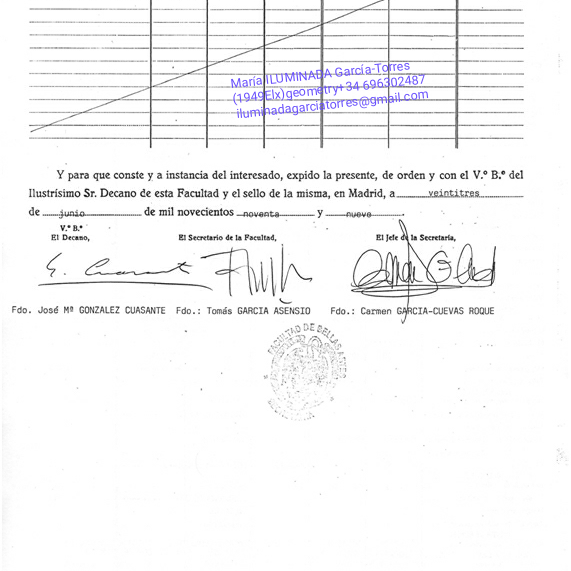
MARIA ILUMINADA GARCIA TORRES
1949 Elche Elx (Alicante) España,SPAIN
1965-1970 Enter and Studies Professor Drawing at the Superior Academy of Fine Arts of San Fernando, Madrid and Faculty of Fine Arts COMPLUTENSE UNIVERSITY, MADRID. In the first course 1965-66, is the painter Antonio López García the teacher of ILUMINADA GARCIA TORRES and in 1969 Eusebio Sempere, year that reconciled the teaching with the research at the Computing Center of the Complutense University of Madrid.
Texts of exhibitions made by ILUMINADA GARCIA TORRES (ELX 1949) of Geometric Art: Pictorial, Sculpture and DIGITAL that she started in 1991 with Geometry: COMBINABLES, TRAZADO ESPACIAL CONTINUO and THE THREAD OF ARIADNE-MUSIC, formulating continuous mathematics and geometry for her work. Previously, she worked 25 years (1965-1990) in landscape painting, design of architectural compositions of geometry and in the two paintings oil/canvas (1986-88) that ILUMINADA GARCIA TORRES made in the MUSEUM NACIONAL del PRADO (Madrid) of ARIADNE DORMIDA en NAXOS marble sculpture. (exhibition paintings at the Galería Albatros, Madrid 1990).
https://Retrospectiva/by-IluminadaGarciaTorres2009
http://lamiradaactual.blogspot.mx/2015/02/iluminada-garcia-torres-geometria-color.html
https://GeometryDigital/IluminadaGarciaTorres2015
spatial-drawings.blogspot.com-blogs-texts
catalogos-textos-art-rawings.blogspot.com
LA MIRADA ACTUAL
Tuesday, June 2, 2015
02/06/15.- ILUMINADA GARCIA TORRES (Elche 1949) she has made a Retrospective Exhibition with the title of Geometry, Color and Musicality, digital diagrams and painting 1991-2015, in the Municipal Exhibition Center of the city, Elche-Elx.
Julia Sáez-Angulo, vicepresident of the Madrid Association of Art Critics, AMCA, and member of the AECA / Spain International, writes in the catalog:
Geometry, Color and Musicality are three concepts of the eurythmy that emerges from the artistic work of ILUMINADA GARCIA-TORRES.
Geometry in which the rhythm of a musicality visible to the eyes is appreciated, inaudible, only in appearance.
She draws the dancing rhythm of a musicality that manifests herself in the wise administration of color on the support of paper, canvas ... geometry that dances; a musicality that is expressed in colors. Kandinsky already talked about it when he attributed musical notes to colors. Look at the sounds, hear the color.
Since the 90s she, ILUMINADA GARCIA-TORRES has a coherent research trajectory in Geometric Art, painting, sculpture and digital diagrams, from her work of Continuous Spatial Tracing,
Combinables to El Hilo de Ariadne. Geometry, color, rhythm and musicality are present in a creative world of lines, circles, squares, pixels ... designed by her artistic mind. Without leaving the painting, she uses the new technological means, which are fundamental in the generation of her innovative geometric artworks.
Geometry, Color and Musicality, is the conceptual key that describes the digital and pictorial geometrical work of ILUMINADA GARCIA-TORRES.
The lines drawn in the space reticular square, horizons that expand in cartographies of the musicality, express in the digital geometries of ILUMINADA GARCIA-TORRES a perception of she at different countries, continents or cities: MUSICALITY-Sweden-Madrid-South America-Berlin -NewYork-MumbaiBombay-Beiying-Europe-GreeceGrecia-Tokyo-Paris-Nepal-Brooklyn-Africa-Universe.
ILUMINADA GARCIA TORRES, in 1965 she ingress and studied Professor of Drawing at the Superior Academy of Fine Arts of San Fernando, Madrid and Complutense University of Madrid. She lived in Madrid until 1997 and later in London, where she was a guest artist at Gasworks Studios of London, and since mid-1999 she resides in Alicante. In 2000 she returned to London to make an exhibition at Hortensia Gallery, Kensington and Chelsea College in London.
In 2003 ILUMINADA GARCIA-TORRES presented her geometry research, El hilo de Ariadna-Combinatoria, with the new technological media. Geometric art: one hundred works (200x100 cm.each) for the Art Collection of Hotel H. Amerigo, Alicante.
In her Continuous Spatial Drawings, she, the painter ILUMINADA GARCIA-TORRES highlights each brushstroke in an affirmation of the energy, lines in brushstrokes of unique gesture, singular each of the lines in the meditative trajectory of rhythms in color gradations in the squares of her works in Geometric Art, and in the geometry compositions of she, with the new digital media, the PIXELS constitute the structure of the lines.
Texto catalog de Julia Sáez-Angulo exposición GEOMETRIA, COLOR y MUSICALIDAD diagramas digitales y pintura de ILUMINADA GARCIA TORRES, en el Centro Municipal de exposiciones de ELCHE, 15mayo- 6septiembre 2015
https://GeometryDigital/IluminadaGarciaTorres2015
http://lamiradaactual.blogspot.com.es/2015/06/iluminada-garcia-torres-geometria-color.html
lines-among-musicality.blogspot.com-L´oreal-CC-Conde-Duque-1994
spatial-layout.blogspot.com-LONDON-1998-2000
pixels-drawing.blogspot.com-2003
musicalidad-numerica.blogspot.com-2004
cartography-musicality.blogspot.com-NY
music-numerical.blogspot.com-Berlin
lines-numerical.blogspot.com-Sweden
musica-numerico.blogspot.com-Madrid
numerical-musicality.blogspot.com Europa
https://-convocatoria-Artes-plasticas-fotografia-11-DIP-Alicante/-Trazado-Espacial-Continuo-30AL=110-11by-Iluminada-Garcia-Torres-2011
50 YEARS OF TRAJECTORY PICTORIAL AND DIGITAL GEOMETRY
Text catalog by Viviana Rodríguez Gimeno (2015)
ILUMINADA GARCIA TORRES (1949 Elche) celebrates 50 years of her Pictorial work and Digital Geometric Art.
It is in 1986, when the appointments, she paints the marble sculpture of Ariadna in the Prado Museum and finds a new pictorial concept in her work. If the teachers of quantum physics, theory of everything, make hypotheses of the universe. The painter ILUMINADA GARCIA-TORRES discovered in the mythology of the Thread of Ariadna the point to develop in the Geometric Art and to find a full significance to her work.
The concepts that give name to the exhibition Geometry, Color and Musicality by ILUMINADA GARCIA-TORRES encompass the extensive work, the intense dedication and the innovative research and reflection of she in geometric art.
Each brushstroke of her has its mathematical reason and makes each line unique, of harmony in a lucid composition and combinatorial of color in turn incalculable, and Musicality, perhaps for the spectators of her geometry work, is creativethat feeling of musicality. A rhythm of vitality, eurythmy of shapes and color, which makes it possible to glimpse the whole geometric universe in equilibrium created by ILUMINADA GARCIA-TORRES in her painting of Continuous Space Path and digital diagrams printed on canvas Ariadne's thread -Musicality in which she shows her perception of different cities, continents, countries ... - Sweden-Beijing-Africa- Madrid-Greece-New York -Mumbai Bombay-Europe-Tokyo- Paris-Brooklyn-Nepal-Berlin-Latin America-Universe- ... GEOMETRY, COLOR and MUSICALITY of renewal in Geometric Art.
50 AÑOS DE TRAYECTORIA PICTORICA Y DIGITAL GEOMETRIA
Text catalog by Viviana Rodríguez Gimeno 2015
exhibition GEOMETRIA, COLOR y MUSICALIDAD diagramas digitales y pintura de ILUMINADA GARCIA TORRES
Centro Municipal de exposiciones de ELCHE, 15may-06september 2015
https://lamiradaactual.blogspot.com.es/2018/03/iluminada-garcia-torres-50.html
https://GeometryDigital/IluminadaGarciaTorres2015
LA MIRADA ACTUAL enero 4, 2014
Iluminada García Torres investigates in her Digital Geometry, Mumbai Bombay.
text by Julia Sáez-Angulo
ILUMINADA GARCIA TORRES (ELCHE 1949) investigates in her Digital Geometry artworks that she denominate Mumbai Bombay, in wide view and reflection on Asia.
In fact all her work in geometric abstraction begins with the proposal that she formulated in the catalog of her exhibition Combinables in 1993, where is the origin and the mathematical reason that ILUMINADA GARCIA-TORRES has developed in the geometry digital works, Tokyo, Beijing and now Mumbai Bombay, in hers Asian contemplation. She declares that after the New York digital geometries, she became interested in Asia in concepts of musicality, color and though.
text by Julia Sáez-Angulo
International Association of Art Critics, AICA
musicality-numerical-drawings.blogspot.com
musicality-numerical.blogspot.com
thethreadofariadne-musicality.blogspot.com 2014
https://music-geometryDigital/iluminada-garcia-torres2014
https://-convocatoria-Artes-plasticas-fotografia-11-DIP-Alicante/-Trazado-Espacial-Continuo-30AL=110-11by-Iluminada-Garcia-Torres-2011
Las huellas de Ariadna
texto catalog José luis Ferris (2009)
En el Castillo alicantino de Santa Bárbara, en cuatro salas, desde el 6 de octubre y hasta el 29 de noviembre, custodian un hallazgo más que recomendable: la exposición que con el título de «Retrospectiva 1982-2009» recoge casi tres décadas de la producción artística de Iluminada García Torres. Discípula destacada de Antonio López García en la Escuela Superior de BBAA de San Fernando, en Madrid, alberga una formación pictórica que pronto se traduce en una obra figurativa de luz y pincelada precisa.
La fascinación llegó después, al pintar en el Museo del Prado la escultura de Ariadna. El encuentro hizo que Iluminada se enfrentara al misterio de la estatua y más allá del mármol o su estructura, hallara en ella su música secreta. El arte fue desde entonces la puerta misma de la vida, el vano que conduce al espacio callado, al territorio del silencio.
Después el hilo de aquella Ariadna comenzó a deslizarse por la abstracción de sus geometrías «Combinables» y su «Trazado espacial continuo» que es sustancia geométrica, orden matemático, pero también latido humano, trazo único y razón poética. De aquí surgió asimismo la escultura, la integración de formas planas y curvas, la alianza de cubos y cilindros como soporte del vacío, de la ausencia, de la nada quizás. Y más allá, probablemente al otro lado ya del laberinto, los últimos años han dado lugar una nueva serie («El hilo de Ariadna / música») de armonía y audacia en arte digital, secuencia medida, ritmos, gestos, huellas de una naturaleza matemática, emocional, que se sirve del lenguaje tecnológico para propagar sus latidos.
Ahora, 27 años después, la artista nos presenta la insólita retrospectiva de una obra coherente hasta el asombro o hasta el misterio. Hemos tenido que seguir el HILO revelador, el mismo que enseñara a Teseo la salida del LABERINTO para llegar hasta aquí, ver y creer. Con una antológica de esta naturaleza, con una muestra tan sólida, tan sugerente y cabal, no creo que nadie dude de un hecho definitivamente irrebatible: que Iluminada García Torres es una de las artistas más significativas de nuestro tiempo, una creadora del arte contemporáneo.
Las huellas de Ariadna
texto catalog José luis Ferris (2009)
Exposición "RETROSPECTIVA 1982-2009 Iluminada García-Torres"
Castillo de Santa Bárbara. Alicante 2009
https://Retrospectiva/by-IluminadaGarciaTorres2009
Iluminada-García-Torres, Exposición retrospectiva en el Castillo de Santa Bárbara-2009
ILUMINADA POR EL ARTE
texto de Joaquín Santo Matas
ILUMINADA GARCIA TORRES (ELCHE 1949), En 1967, Madrid, es alumna del profesor de Dibujo Cristóbal Toral, siendo también discípula, en dos etapas, 1965 y 1984, del pintor hiperrealista Antonio López García. Y aunque supiera asimilar la docencia de sus maestros, ha marcado un estilo perfectamente definido con unas etapas evolutivas que pudieran parecer drásticas pero están plenas de una coherencia absoluta.
Residente desde tiempo en Alicante, podemos contemplar ahora en el Castillo de Santa Bárbara, la excelente exposición retrospectiva de ILUMINADA GARCIA-TORRES, desde 1982 hasta 2009, y que permiten asimilar la madura fortaleza expresiva que emana de su obra. Los paisajes urbanos y la fruta del membrillo nos muestran sus comienzos como pintora realista. En 1984, descubrir en el Museo del Prado la escultura de mármol de Ariadna dormida en Naxos que plasmará al óleo (1986-88) desde distintas perspectivas, y cuya armonía, según sus palabras, “ codifica un cosmos, geométrico y matemático ”.
La gran aportación innovadora de ILUMINADA GARCIA-TORRES arribará en 1991. La abstracción geométrica había tenido su maestro en Eusebio Sempere, pero ella, en el terreno del arte analítico y su nexo con el gesto, enlaza la geometría y la medida con el impacto directo de la pincelada, -afirmación de la energía en cada trazo- que rompe con la línea estricta y precisa.
Y comienza a trabajar en serigrafía, poseyendo dieciocho de las suyas, realizadas en 1996, la Biblioteca Nacional. Será esta técnica, tan utilizada en el pop-art y por los cinéticos, el primer paso de su interés por el arte digital. Tiene muy claro ILUMINADA GARCIA TORRES que la investigación de las formas geométricas y del color, con las aplicaciones informáticas, no disminuye la capacidad creadora sino que aporta nuevas posibilidades y también lo que ella denomina -la democratización del arte- el acceso de las mayorías a una obra, con la copia por el autor mediante los nuevos medios tecnológicos, sin perder un ápice de calidad ni los colores originales. Aunque este concepto pudiera llamar a la controversia, ILUMINADA GARCIA-TORRES piensa que es necesario un cambio de mentalidad, una nueva mirada al Arte Electrónico actual, pensar que los avances técnicos que permitieron reproducir una pieza musical en un disco o un texto literario en un libro, no infravalora la calidad de los autores sino que han hecho posible, sin acudir a un concierto ni leer un manuscrito, que se conozca o adquiera.
El Hotel H. Amérigo de Alicante posee una colección cercana al centenar de obras de Arte Geométrico Digital realizadas por ILUMINADA GARCIA-TORRES, una posibilidad de contemplar sugerentes geometrías impresas en lienzo, con innovadoras combinatorias. En 2003 tuve el inmenso honor de escribir con el título Píxeles la huella del trazo en el catálogo de la exposición que sobre esta colección se hizo y ahora me ratifico en los conceptos de admiración de “aquellas impresiones visuales que nos adentrarán en un mundo de armonías fusionadas con la luz mediterránea ”.
texto de Joaquín Santo Matas
Diario La Verdad Alicante 18-10-09
ILUMINADA GARCIA TORRES Retrospectiva 1982- 2009
exposición en el Castillo de Santa Bárbara Alicante
https://Retrospectiva-de-ILUMINADA-GARCIA-TORRES/prospecto-exposicion-Castillo-Santa-Barbara-Alicante-2009
https://Retrospectiva/by-IluminadaGarciaTorres2009
Iluminada-García-Torres, Exposición retrospectiva en el Castillo de Santa Bárbara-2009
https://n17-El Salt-IAC-Juan-Gil-Albert-january 2009/iluminada -garcia-torres
https://EL-HILO-de-ARIADNA-ARMONIA-by-ILUMINADA-GARCIA-TORRES-geometriaDigital/exposicion-Alicante-2008
https://geometria-digital/2007-ArteElectronicoMostoles-Madrid/iluminada-garcia-torres
https://-IV-certamen-UMH-IBERDROLA-2006-geometria-digital-75AE-by-Iluminada-Garcia-Torres-2006
STRUCTURES OF HARMONY
text Lino Cabezas Gelabert (2005)
ILUMINADA GARCIA-TORRES (Elche, Alicante, 1949) she in her recent work exhibit a long trajectory of Geometric Art with, The thread of Ariadna-combinatorial, where the results derived from one of the most important issues in history are reached of art: the search for a basic harmony and order that beats in human nature. Establishing order and proportion in art means giving an intellectual and conscious direction to a subconscious impulse.
Modern psychology defends the hypothesis that the search for order on which beauty is based is something inherent to our identity as rational beings, and in that situation our interpretation of nature is predominantly mathematical. In these circumstances, the new technologies are used by ILUMINADA GARCIA TORRES to make use of their lines and brushstrokes as the basic material of her artworks and as a point of reflection of it, using as a matter of creation the formal elements and conceptuals.
Einstein affirmed that there is no logical way to discover the elementary laws; according to him there is only the path of intuition. The perception of the order behind appearances, its musicality, is something that is intuited by the artist ILUMINADA GARCIA-TORRES. Consequently, her works could be conceived as structures of the harmony in mathematical lines. The paintings and digital geometry of the work of Iluminada García-Torres is founded on an irrefutable truth of numbers and proportions that seem to reveal in some way the pre-established harmony.
text Lino Cabezas Gelabert (2005) Professor at the University of Barcelona.
La Rella Magazine Nº 18.
Anuari de l'Institut d'Estudis Comarcals del Baix Vinalopó 2005 Elx. Elche
pixel-pixels-design.blogspot.com-2003
https://Trazado-Espacial-ContinuoHilo-de-Ariadna-by-ILUMINADA-GARCIA-TORRES-2000
SOUNDS OF PAINTING Música y Arte II
Text catalog by Laura Sanz García (2004)
Pascual Patuel Chust (2004)
ILUMINADA GARCIA TORRES, (Elche, Alicante, 1949) she has made a decided commitment to Geometric Art, developing orthogonally organized shapes and colors. Following paths opened by the geometric Kandinsky of the German Bauhaus, author of POINT AND LINE ON THE PLANO, and Dutch Neoplasticism, ILUMINADA GARCIA TORRES
understands her painting and her sculpture as a mathematical system of proportions and geometric shapes.
ILUMINADA GARCIA TORRES achieves to formulate, in 1991, a basic module of squares, where she drew the points and lines. This module will be the beginning of future experimentation in Geometric Art.
A geometric and mathematical cosmos, that ILUMINADA GARCIA TORRES considers independent worlds, but participants of the totality, calculated according to systems of proportion in their measurements. The relation between full space and empty spaces is dynamic, because it generates multiple variations, determined by the color, shape, number, and direction of the lines, an interactive space that generates an integrating harmony of all the geometric elements in the composition.
The thread of Ariadna, is the generic name that has adopted to denominate to her work ILUMINADA GARCIA TORRES, as a consequence painting (1986-88) the marble sculpture of Ariadna of the Museum of the Prado, in which she discovered a harmony of geometric y order mathematician that was to preside over her future work. The space research has been formally complicating his proposals with a multiplication of rhythmic sequences, parallel to the world of music, pictorial geometries that she calls Continuous Spatial Drawings. From this proposal her work is incorporated into the new technologies applicable to the art of painting.
The recent works of ILUMINADA GARCIA-TORRES, geometries of infinite development of the combinatorial of color and the process of the image generated by computer where the brushstroke is now structured by the pixel (picture element), dot in a rectilinear grid of points to form a geometric digital image.
With this digital process of the image, she has made the geometries of the present exhibition Música y Arte II. They constitute the beginning of a new series whose dot of expansion is musicality.
ILUMINADA GARCIA-TORRES has been able to see and work on the aesthetic aspects offered by the graphics of the musical notation. The pentagram or tetragram constitute the linear structure where the musical "signs" are deposited, she attempt to evoke the true graphia, which allows it to develop formal investigations related to Optical art and suggest virtual movements.
Text catalog by Laura Sanz García (2004) Carlos III University of Madrid
Pascual Patuel Chust University of Valencia
Triptych Digital, El Hilo de Ariadna-utopia: sinfonía, sonata y penta by Iluminada Garcia-Torres (imagendigital/ canvas 285x200cm). Exhibition Música y Arte II, catalog nº 46, Palau Música of VALENCIA 2004
http://lamiradaactual.blogspot.com.es/2016/02/Iluminada-Garcia-Torres-sonidos-digital-geometry.html
https://Musica-Arte-II.catalogo46-triptico-digital-285x200cm-by-ILUMINADA-GARCIA-TORRES.Palau-Musica-de-VALENCIA-2004
musicalidad-numerica.blogspot.com-2004
PIXELS (2003)
Text catalog by Joaquín Santo Matas (2003)
Director of Alicante Institute of Culture Juan Gil-Albert
ILUMINADA GARCIA TORRES (ELCHE 1949), she in this exhibition presents her work of Digital Geometric Art, El Hilo de Ariadna - Combinatoria, a research with new technological media. The result is innovative, rigorous and coherent that we can observe in the evolution of her work, whose genesis is in the pictorial work of teacher Antonio López García and from which her assimilated the measure and direct-gesture.
In the observation when painting the sublime marble sculpture of Ariadna in the Prado Museum, which she would see in 1984, ILUMINADA GARCIA TORRES attempt her creative Thread to armonize the labyrinth of her artistic capacity.
Geometry in the plane and in the space that in something would assimilate of the teachings that she received from the also Alicante artist, Eusebio Sempere.
The lines drawn, made in a dynamic way, of a single gesture, in relation of proportionality with space reticular, mathematics and geometry, time and light. And the origin of Trazado Espacial Continuo Continuous Spatial Drawings has been for more than a decade in the geometry of her work Combinables.
That is why in the artworks of ILUMINADA GARCIA-TORRES we contemplate geometries that can be multiplied infinitely thanks to the combinatorial of color and digital processes, which are possible by linking their Geometry research with the new technological advances of science computer.
She draws, from the point, original singular gestural lines in the space, in rhythmic sequences, that in this work of Digital Geometric Art, the pixels constituting of the new structure of the line.
This exhibition, belonging to the hundred works of geometry (digital printing on canvas 90x180cm each) which constitute the Amerigo Collection, can be seen in Alicante at the Hotel of the same name, where the geometries designed by ILUMINADA GARCIA TORRES will show us a world of harmonies fused with the Mediterranean light, where the azure and marine blue, the earth and solar ocher, and the violet tones of an alborear of the horizon prevail, which is the line from which all forms emerge.
PÍXELES, La Huella del Trazo
Text catalog by Joaquín Santo Matas-Director of Alicante Institute of Culture Juan Gil-Albert. Exhibition El Hilo de Ariadna-Combinatoria by ILUMINADA GARCIA-TORRES. Centro Municipal de las Artes. Alicante 2003
el-Hilo-de-Ariadne-combinatoria-by-Iluminada-Garcia-Torres-geometrydigital-2003
pixel-pixels-design.blogspot.com-2003
GEOMETRIC POETRY AND EMOTIONAL ARITHMETICS
text catalog by José Manuel Alvarez Enjuto,2002
It is not easy to respond to the arithmetic and orthogonal processes, of the poetry and sensitivity in the compositional contents in the work of ILUMINADA GARCIA-TORRES (ELCHE1949). She makes in Geometric Art an expressive formulation centered almost specifically on the research of spatial ordering through the serial multiplication of the line in progression. In the relation and the consecutive evolution with the only trace of a mediatic line in the space, or what is the same, through the drawing of a line, she manages to reach the metaphysical purpose of the creative eagerness.
The arithmetic and emotional poetry in the work of ILUMINADA GARCIA-TORRES has that consubstantial truth that responds to a pristine and essential fact endowed with a metaphysical transcendence capable of altering any philosophical conjecture. Art transcending through arithmetic formulas and rhythmic spatial sequences that she describes.
Iconography where the continuous module, the coherent mathematical variation dominates the visuality, demands, at least, a reflection on the mathematical painting and the balanced spatial orders. And this inevitably leads us to the stream of Stilj, Mondrian, Rietveld authors who understood that in geometry and spatial arrangement by means of balanced flat chromatic or compositional icons, rational orders could be established in the argumentation of their proposals.
Processes in the elaboration of those gestural lines support of the works. A fact of transcendence if we understand the Geometric Art of ILUMINADA GARCIA-TORRES from her creativity, with the congregation of all these expressive singularities that she has in geometric poetry.
Certainly the iconography transcribed in the paintings of the artist ILUMINADA GARCIA-TORRES may correspond to the genuine calligraphic material of the geometric repertoire of the square reticular and the music of arithmetic in their interactions.
Composition based on the repetitive modular beauty of the line and the quadrangular geometric grid, capable of claiming expansion, limitlessness and affirmation once the gestures drawn from the mathematical variable are the agents of the resulting harmonies, We have understand a very special expressiveness in the works of ILUMINADA GARCIA-TORRES that she gives in the accuracy of the brushstroke in the discursive process of a meditative calligraphic order.
A pristine pictorial expression, based on the measure, the gesture the compositional rhythms, the formal transition, the chromatic vibration, the metaphysical transcendence. The geometry and arithmetic as a determining reason.
POESIA GEOMÉTRICA Y ARITMETICA EMOCIONAL
text catalog by José Manuel Alvarez Enjuto,2002
Exhibition catalog of ILUMINADA GARCIA-TORRES.
EL HILO DE ARIADNA 1991-2002
30/04 - 28/05, 2002, Municipal Exhibition Lonja del Pescado. Alicante
https://El-HILO-de-ARIADNA-1991-2002 by ILUMINADA-GARCIA-TORRES/exposicion-Alicante 2002
https://by-ILUMINADA-GARCIA-TORRES/-COMBINABLES-1993
The expansion of painting in the cold auras
text catalog Simón Marchán Fiz
ILUMINADA GARCIA TORRES (EICHE 1949), she unravels Ariadne's Thread through an optical combinatorial impregnated by cybernetic randomness, a code expressed in lines that contrast with the unchanging presence of squares as zero grade and reference to the essentials, a great lyricism, color vibrations and harmony of balance complement each other.
text Simón Marchán Fiz(2001), Professor of Aesthetics and Theory of Art, Faculty of Philosophy UNED Madrid.
La expansión de la pintura en las auras frias text Catalog Exhibition XVII Edition Painting Prize L'OREAL. Conde Duque Cultural Center. Madrid 2001
https://ILUMINADA-GARCIA-TORRES/-Premio-Pintura-L´OREAL-CentroCultural-CONDE-DUQUE-MADRID-2001-2002
lines-among-musicality.blogspot.com-Iluminada-Garcia-Torres-1994
between 1, 2 and 3
text catalog Isabel Tejeda Martín 2001
... are her drawn lines in which ILUMINADA GARCIA TORRES (ELCHE 1949) meditates the rhythms that emerge in the trajectory of its layout in relation of proportionality with the space of the square modules in hers works of Geometric Art. Modules that according to her, contain laws of harmony. It could be a rational, thoughtful composition, and in fact it is in principle. But observing each line it is evident that they do not respond to a unifying system. On the contrary, they confirm: the absolute difference of each one of the lines with the rest of those that are placed in the picture. With all the lines of the paintings that make up the series. Of all the series of lines started at the beginning of the 90s. Of all the painted lines of the world.
It is evident, albeit in a subtle way, the instant of its production; a time of the painting that purport to drag with him the time of perception. The transmission of emotions.
In the lines of the modules arranged tidily in the paintings made by ILUMINADA GARCIA-TORRES, the different degrees of emotion, tension, tranquility, enthusiasm, distancing... from the moment of painting are glimpsed. Already raised it, albeit in an ironic way, Lichtenstein when he designed his large-format brushstroke with bendéi points. And it is the praise of that brushstroke, in which with hers lines insists ILUMINADA GARCIA-TORRES. Sometimes at great brushstrokes, anothers as in a mantra. In numerous and small lines. With the rhetoric of repetition. But also more surprising.
A year ago in a ceramic workshop organized by the CAPA Foundation(2000), ILUMINADA GARCIA-TORRES, experiments in the three dimensions, she presented some first investigations of the limits, which she had already done in sculpture. What happens in the limits? From a wave to an angle, for example. Fundamental considerations in Geometric Art.Numbers are there to infinity. But, if you want to understand it, you need to analyze the infinite relation between 1, 2 and 3.
Entre el uno, el dos y el tres
text catalog Isabel Tejeda Martín 2001
Exhibition, trazado espacial continuo-hilo de ariadna, pintura 2001
combinables-palabras geométricas, cerámica 2001 by ILUMINADA GARCIA-TORRES
12may-20june 2001, Casa de Cultura El Campello (Alicante)
https://Casa-Cultura-de-El-Campello-Alicante/Geometria-de-ILUMINADA-GARCIA-TORRES-2001
https://Trazado-Espacial-ContinuoHilo-de-Ariadna-by-ILUMINADA-GARCIA-TORRES-2000
https://Museu-Art-Contemporani-de-EIVISSA--ELX/ILUMINADA-GARCIA-TORRES-2000
GASWORKS STUDIOS, LONDON
ILUMINADA GARCIA TORRES (Spain)
1 December 1998 - 1 March 1999
This is the first time you will see the work of the visual artist ILUMINADA GARCIA-TORRES in the United Kingdom. During her residency at Gasworks, she has produced new works with the referent of the marble sculpture Ariadne at the Museo del Prado, in Madrid, I discovered that the harmony she evoked was fitted perfectly a geometric and mathematical pattern.
ILUMINADA GARCIA-TORRES seeks to achieve harmony through the expression of the moment, constituted by line-space-time within proportional relation with the square reticle structures. The singularity of each line is a step towards Light.
published by Alessio Antoniolli 1999 GASWORKS STUDIOS, LONDON
2015.Text in catalog, exhibition GEOMETRIA, COLOR y MUSICALIDAD geometría digital de ILUMINADA GARCIA-TORRES, in Centro Municipal de exposiciones de ELCHE-ELX, 15may- 6september 2015
spatial-layout.blogspot.com-Iluminada-Garcia-Torres-LONDON-1998-2000
GEOMETRIAS (1996)
Text catalog by Segundo García Manzanet (1996)
Director Museum Asegurada, MACA
ILUMINADA GARCIA TORRES (1949 Elche, Alicante), she is, painter. And of -her work we could say that it is a rationalization, sensitivity and expression in the Geometric Art. To realized her work ILUMINADA GARCIATORRES establishes a previous Geometric order, very concrete and precise, -square matrix-, divided into other twenty-five exact and equal, as a grid, defined by lines or points; which in turn can be subdivided.
Mathematical disposition that will direct the initiation and realization of her work. The beginning of the –pictorial action- becomes an event, an extraordinary and unique fact that modifies the established and conditions the development of the work of ILUMINADA GARCIA-TORRES. And the painting is full of infinite possibilities - lines expressed with the law of verticality and horizontality and in proportionality with the dimensions of the squares. For example, the painting can only be the structure, as a regularized surface; or be arranged in sections; or -the square matrix- contain squares of different dimensions, color, location and texture; or that on a color with different gradations juxtapose other forms of color and establish new interactions, etc.
Hers brushstrokes, of the painter ILUMINADA GARCIA TORRES, are lines of color with dimensions in proportion to the surfaces of the squares, in a single gesture -meditated- each one of the brush strokes made, an echo of herself with its emotional poetic . And also an event, which determines the quality of the successive brushstroke.
ILUMINADA GARCIA-TORRES necessarily draws from the sensitivity, which requires a preparation, tense attitude and meditative attention in the realization of the linear brushstrokes. The picture as she is painting it changes, and she, the painter, is there to decide the next action pictorial.
ILUMINADA GARCIA-TORRES, does not consider the edges as the end of the work, allowing it to continue. Fortunately, she conceives each painting as a possible part of a more complex whole; and in consequence, the linear edge is a provisional limit. Because the basic structure is, the square, studied in the spatial modulation that is produced in its subdivision or the sum of geometric squares -as she formulates it in her theoretical reflections (1991)-, and to constitute a theoretically infinite work. That requires the systematic application of the concept so that each work of Geometric Art maintains its potential development. An undoubted risk, although full of interest, that would give the work of ILUMINADA GARCIA-TORRES an innovative dimension.
Text catalog by Segundo García Manzanet (1996), Director Museum Asegurada, MACA.
Exhibition GEOMETRIAS / ILUMINADA GARCIA-TORRES. Institute of Culture Juan Gil-Albert, University of Alicante 1996, MUA. Exhibition Alicante, November 6-26, 1996 • Casa de Cultura de Villena, January 24-February 16, 1997.
https://GEOMETRIAS-IAC-Juan-Gil-Albert-UA/ILUMINADA-GARCIA-TORRES-1996
COMBINABLES
text by J. Antonio Lisbona (1993)
ILUMINADA GARCIA TORRES (ELCHE 1949). She remained pensive observing when painting the power and subtlety of a sculpture that is in the Rotunda of the Hall of the Muses of the Prado Museum. It was the marble sculpture of Ariadna, the sculpture that the painter Diego Velázquez (1599-1660) brought from Rome to King Felipe IV and that Velázquez himself would paint it in Rome in the canvas of 44x38 cm, View of the garden of the Villa Medicis-Noon.
ILUMINADA GARCIA-TORRES, at the Museo del Prado interpreted this marble sculpture of Ariadna in two paintings from 1986-88, what is really important is that this marble sculpture would give reasons to ILUMINADA GARCIA-TORRES for his future work geometric.
Now he presents her recent work of Geometric Art in the Exhibition Hall CAM of Alicante, which has taken the scoop of her proposal, with the title of COMBINABLES, Continuous Space Path, works that ILUMINADA GARCIA-TORRES, has also been grouped in three research notebooks, laborious, concrete, mathematical and geometric arrangement, the point, the lines, the square, color ... The process surprised the author and impelled her as in a story by Jorge Luis Borges, in the boundless infinity of geometry and color.
She painted labyrinths of cubic and cylindrical forms on the surface of some tables, compositions of an approach to the work of Morandi, which later she would represent with architectural influence in large-format paintings. This theme preludes the geometry that would intensively come later in the artistic creativity of ILUMINADA GARCIA-TORRES. In the sculpture COMBINABLES mixes cubes and cylinders of steel in balanced composition. Space, point, lines, numbers, structures, brushstrokes, variants, layout, trajectory, technology, painting ..., all are words and concepts that the artist ILUMINADA GARCIA-TORRES has written in the notebooks and on the canvas poetic brushstrokes. Art and theoretical formulation made at the same time.
COMBINABLES text by J. Antonio Lisbona (1993)
Espiral de las Artes num.5-6 September / October 1993
https://1993/Espiral-Artes-texto-Jose-Antonio-Lisbona-COMBINABLES-1993
https://-convocatoria-Artes-plasticas-fotografia-10-DIP-Alicante/-Trazado-Espacial-Continuo-al25-by-Iluminada-Garcia-Torres-2010
FASCINATION FOR SPACE
text by Carmen Vidal Claramonte (1993)
The CAM of Alicante has offered in its exhibition hall on Oscar Esplá Avenue 37, an exhibition of GEOMETRIC ART by ILUMINADA GARCIA TORRES (ELCHE 1949) which since the mid 60s has studied and lives in Madrid.
She offers us paintings from her first realistic period of metaphysical influence. And paintings and a sculpture of her new stage of geometric art that presents precisely in Alicante.
ILUMINADA GARCIA-TORRES is fascinated by space, and she hypothesizes with two basic elements in her work, the square and the circle, the cube and the cylinder. In the previous, realistic paintings, we notice, however, certain evolution towards the geometric shape and the space that makes us to reflect on solitude, on silence, on our own soul: and the wonderful painting that she made (1987) of the marble sculpture of Ariadne, looking towards the infinite.
From this sculpture ILUMINADA GARCIA-TORRES, realized her new works in geometric art, to paintings constructed with lines and dots, with rectangles that have been painted in a single stroke, and, thus, none is the same, they are all different. Identity, repetition and diversity at the same time. Continuing with the squares, the cubic and cylindrical structure, with the mathematical accuracy of the measurements, ILUMINADA GARCIA-TORRES, realizes the projects for her sculptural work. But in addition to creating painting and sculpture, she composes with the words.
And, most importantly, the integral proposal in the Geometric Art by ILUMINADA GARCIA-TORRES for the realization of her work, emerges from the same mathematical concept that she has transcribed in the excellent catalog of the exhibition.
FASCINACION POR EL ESPACIO
text by María Carmen Africa Vidal Claramonte (1993)
Diario Información. Alicante 10-june-1993
https://by-ILUMINADA-GARCIA-TORRES/-COMBINABLES-1993
The individual Painting of Iluminada García-Torres
Text by Miguel Fernández-Cid
ILUMINADA GARCIA TORRES (Elche 1949), she makes an exhibition at the Galería Albatros in Madrid. Some of her work have as motif the marble sculpture of Ariadne (intangible Thread). "I went to the Prado Museum thinking about an image that motivates my mind and I found this sculpture. There I painted the sculpture in a canvas facing it and then en another canvas as if the sculpture were looking at infinity... and I know I will return to interpret this Ariadne again, because I find it impossible to forget her perfection, her harmony, her mathematical control".
The paintings of the sculpture of Ariadne she made from an interpretation, with the sea and a diluted landscape. "I was born near the sea and, although at the age of sixteen, I came to Madrid to study Fine Arts, I always have his presence close by, I know it because of the need to include a horizon line, a reference to space in each painting".
The style of her painting is more evident in the works in which she, ILUMINADA GARCIA-TORRES with the idea and the minimum elements of a composition, it drifts towards architectural formulas. Morandi, the metaphysical painting of Giorgio de Chirico and quattrocentistas are not far from her painting. With a few cylindrical bars and a box on a table she paints geometries sharp, spatiality paintings. Seen from another perspective, the same elements resemble a labyrinth, with a geometrical idea that constantly evokes her painting, "an object is different according to how we see it, the proximity of another object modifies it in our perception". How not to understand that the painting of ILUMINADA GARCIA-TORRES is individual?.
Text by Miguel Fernández-Cid
Diario 16. Madrid 5- december-1990
https://ILUMINADA-GARCIA-TORRES/Premio-Pintura-LOREAL-Centro-Cultural-CONDE-DUQUE-MADRID-1994-1995
lines-among-musicality.blogspot.com-Iluminada-Garcia-Torres-1994
The immense risk of setting out across the waves
Text catalog Rosa Martínez de Lahidalga (1990)
... It is the Ariadne sculpture of the Museo del Prado, the marble sculpture that Velázquez brought from Rome and that he painted in his magnificent paintings of "Villa Médicis", the one that has inspired to ILUMINADA GARCIA TORRES (Elche1949) to draw Labyrinths in the Geometric Art.
She recovers in her paintings a metaphysics of space and form; of the transit with light and thought.
It can be done to transcend the simplest image if the brushstroke and the mind are able to raise it to the category level.
This is what happens with her pictorial compositions of cylindrical and cubic forms of reflecting light. They silence or reveal codes.
El inmenso riesgo de partir sobre las ondas
Text catalog Rosa Martínez de Lahidalga (1990)
Exhibition paintings by ILUMINADA GARCIA-TORRES
Galería Albatros. Madrid 1990
https://Pinturas-Geometrias-et-escultura-marmol-ARIADNE-MUSEO-del-PRADO/by-ILUMINADA-GARCIA-TORRES-exposicion-GaleriaAlbatros-Madrid 1990
gravitationalwaves-music.blogspot.com
iluminadagarciatorres.blogspot.com
waves-waves-waves-waves-waves.blogspot.com
spatial-drawing.blogspot.com
spatial-lines.blogspot.com
waves-musicality.blogspot.com
waves-music-waves.blogspot.com

.jpg)

%20en%20la%20Escuela%20Superior%20de%20Bellas%20Artes%20San%20Fernando.jpg)
Mª ILUMINADA GARCIA TORRES
Elche-Elx, Alicante, España SPAIN
+34 696302487 arte geométrico
https://iluminadagarciatorres/lines-continuousdata
iluminadagarciatorres.blogspot.com
https://www.instagram.com/iluminadagarciatorres/
https://avam.es/artistas/iluminada-garcia-torres/